

Latest [Dec 11, 2021] Real Microsoft AZ-204 Exam Dumps Questions
AZ-204 Dumps To Pass Microsoft Azure Exam in One Day (Updated 265 Questions)
Microsoft AZ-204 and Key Details
Microsoft AZ-204 is a 120-minutes test covering a wide range of topics and subtopics. Microsoft does not usually reveal the details of its exams but it is known from the experience of the previous test takers that this one is made up of 40-60 questions. Their formats that you can expect in your delivery of the exam include case studies, drag and drop, multiple choice, scenario-based, active screen, build list, short answer, and best answer. The fee for taking this certification test is $165. To register for the exam, you need to sign up with Pearson VUE, the Microsoft testing partner. Depending on your language preference, the AZ-204 exam can be taken in English, Simplified Chinese, Japanese or Korean.
NEW QUESTION 136
You develop a web application.
You need to register the application with an active Azure Active Directory (Azure AD) tenant.
Which three actions should you perform in sequence? To answer, move all actions from the list of actions to the answer area and arrange them in the correct order.
Answer:
Explanation:
Explanation
Register a new application using the Azure portal
* Sign in to the Azure portal using either a work or school account or a personal Microsoft account.
* If your account gives you access to more than one tenant, select your account in the upper right corner.
Set your portal session to the Azure AD tenant that you want.
* Search for and select Azure Active Directory. Under Manage, select App registrations.
* Select New registration. (Step 1)
* In Register an application, enter a meaningful application name to display to users.
* Specify who can use the application. Select the Azure AD instance. (Step 2)
* Under Redirect URI (optional), select the type of app you're building: Web or Public client (mobile & desktop). Then enter the redirect URI, or reply URL, for your application. (Step 3)
* When finished, select Register.
NEW QUESTION 137
You need to configure Azure Service Bus to Event Grid integration.
Which Azure Service Bus settings should you use? To answer, select the appropriate options in the answer area.
NOTE: Each correct selection is worth one point.
Answer:
Explanation:
Explanation
Box 1: Premium
Service Bus can now emit events to Event Grid when there are messages in a queue or a subscription when no receivers are present. You can create Event Grid subscriptions to your Service Bus namespaces, listen to these events, and then react to the events by starting a receiver. With this feature, you can use Service Bus in reactive programming models.
To enable the feature, you need the following items:
A Service Bus Premium namespace with at least one Service Bus queue or a Service Bus topic with at least one subscription.
Contributor access to the Service Bus namespace.
Box 2: Contributor
Reference:
https://docs.microsoft.com/en-us/azure/service-bus-messaging/service-bus-to-event-grid-integration-concept
NEW QUESTION 138
You are building a traffic monitoring system that monitors traffic along six highways. The system produces time series analysis-based reports for each highway. Data from traffic sensors are stored in Azure Event Hub.
Traffic data is consumed by four departments. Each department has an Azure Web App that displays the time-series-based reports and contains a WebJob that processes the incoming data from Event Hub. All Web Apps run on App Service Plans with three instances.
Data throughout must be maximized. Latency must be minimized.
You need to implement the Azure Event Hub.
Which settings should you use? To answer, select the appropriate options in the answer area.
NOTE: Each correct selection is worth one point.
Answer:
Explanation:
Explanation
Box 1: 6
The number of partitions is specified at creation and must be between 2 and 32.
There are 6 highways.
Box 2: Highway
References:
https://docs.microsoft.com/en-us/azure/event-hubs/event-hubs-features
NEW QUESTION 139
You develop and deploy a Java RESTful API to Azure App Service.
You open a browser and navigate to the URL for the API. You receive the following error message:
You need to resolve the error.
What should you do?
- A. Bind an SSL certificate
- B. Map a custom domain
- C. Enable authentication
- D. Enable CORS
- E. Add a CDN
Answer: D
Explanation:
Explanation
We need to enable Cross-Origin Resource Sharing (CORS).
References:
https://medium.com/@xinganwang/a-practical-guide-to-cors-51e8fd329a1f
NEW QUESTION 140
You need to support the message processing for the ocean transport workflow.
Which four actions should you perform in sequence? To answer, move the appropriate actions from the list of actions to the answer area and arrange them in the correct order.
Answer:
Explanation:
Explanation:
Step 1: Create an integration account in the Azure portal
You can define custom metadata for artifacts in integration accounts and get that metadata during runtime for your logic app to use. For example, you can provide metadata for artifacts, such as partners, agreements, schemas, and maps - all store metadata using key-value pairs.
Step 2: Link the Logic App to the integration account
A logic app that's linked to the integration account and artifact metadata you want to use.
Step 3: Add partners, schemas, certificates, maps, and agreements
Step 4: Create a custom connector for the Logic App.
References:
https://docs.microsoft.com/bs-latn-ba/azure/logic-apps/logic-apps-enterprise-integration-metadata
NEW QUESTION 141
You are building a traffic monitoring system that monitors traffic along six highways. The system produces time series analysis-based reports for each highway. Data from traffic sensors are stored in Azure Event Hub.
Traffic data is consumed by four departments. Each department has an Azure Web App that displays the time-series-based reports and contains a WebJob that processes the incoming data from Event Hub. All Web Apps run on App Service Plans with three instances.
Data throughout must be maximized. Latency must be minimized.
You need to implement the Azure Event Hub.
Which settings should you use? To answer, select the appropriate options in the answer area.
NOTE: Each correct selection is worth one point.
Answer:
Explanation:
References:
https://docs.microsoft.com/en-us/azure/event-hubs/event-hubs-features
NEW QUESTION 142
You are deploying an Azure Kubernetes Services (AKS) cluster that will use multiple containers.
You need to create the cluster and verify that the services for the containers are configured correctly and available.
Which four commands should you use to develop the solution? To answer, move the appropriate command segments from the list of command segments to the answer area and arrange them in the correct order.
Answer:
Explanation:
1 - az group create
2 - az aks create
3 - kubectl apply
4 - az aks get-credentials
References:
https://docs.bitnami.com/azure/get-started-aks/
NEW QUESTION 143
Note: This question is part of a series of questions that present the same scenario. Each question in the series contains a unique solution that might meet the stated goals. Some question sets might have more than one correct solution, while others might not have a correct solution.
After you answer a question in this question, you will NOT be able to return to it. As a result, these questions will not appear in the review screen.
You are developing a solution that will be deployed to an Azure Kubernetes Service (AKS) cluster. The solution will include a custom VNet, Azure Container Registry images, and an Azure Storage account.
The solution must allow dynamic creation and management of all Azure resources within the AKS cluster.
You need to configure an AKS cluster for use with the Azure APIs.
Solution: Enable the Azure Policy Add-on for Kubernetes to connect the Azure Policy service to the GateKeeper admission controller for the AKS cluster. Apply a built-in policy to the cluster.
Does the solution meet the goal?
- A. No
- B. Yes
Answer: A
Explanation:
Explanation
Instead create an AKS cluster that supports network policy. Create and apply a network to allow traffic only from within a defined namespace References:
https://docs.microsoft.com/en-us/azure/aks/use-network-policies
NEW QUESTION 144
Your company has several websites that use a company logo image. You use Azure Content Delivery Network (CDN) to store the static image.
You need to determine the correct process of how the CDN and the Point of Presence (POP) server will distribute the image and list the items in the correct order.
In which order do the actions occur? To answer, move all actions from the list of actions to the answer area and arrange them in the correct order.
Answer:
Explanation:
1 - A user requests the image..
2 - If no edge servers in the POP have the..
3 - The origin server returns the..
4 - Subsequent requests for..
References:
https://docs.microsoft.com/en-us/azure/cdn/cdn-overview
NEW QUESTION 145
You need to implement the Log policy.
How should you complete the EnsureLogging method in EventGridController.cs? To answer, select the appropriate options in the answer area.
NOTE: Each correct selection is worth one point.
Answer:
Explanation:
Reference:
https://blog.hompus.nl/2017/05/29/adding-application-logging-blob-to-a-azure-web-app-service-using-powershell/ This is a case study. Case studies are not timed separately. You can use as much exam time as you would like to complete each case. However, there may be additional case studies and sections on this exam. You must manage your time to ensure that you are able to complete all questions included on this exam in the time provided.
To answer the questions included in a case study, you will need to reference information that is provided in the case study. Case studies might contain exhibits and other resources that provide more information about the scenario that is described in the case study. Each question is independent of the other questions in this case study.
At the end of this case study, a review screen will appear. This screen allows you to review your answers and to make changes before you move to the next section of the exam. After you begin a new section, you cannot return to this section.
NEW QUESTION 146
You are implementing a software as a service (SaaS) ASP.NET Core web service that will run as an Azure Web App. The web service will use an on-premises SQL Server database for storage. The web service also includes a WebJob that processes data updates. Four customers will use the web service.
Each instance of the WebJob processes data for a single customer and must run as a singleton instance.
Each deployment must be tested by using deployment slots prior to serving production data.
Azure costs must be minimized.
Azure resources must be located in an isolated network.
You need to configure the App Service plan for the Web App.
How should you configure the App Service plan? To answer, select the appropriate settings in the answer area.
NOTE: Each correct selection is worth one point.
Answer:
Explanation:
References:
https://azure.microsoft.com/sv-se/blog/announcing-app-service-isolated-more-power-scale-and-ease-of-use/
NEW QUESTION 147
You are using Azure Front Door Service.
You are expecting inbound files to be compressed by using Brotli compression. You discover that inbound XML files are not compressed. The files are 9 megabytes (MB) in size.
You need to determine the root cause for the issue.
To answer, select the appropriate options in the answer area.
NOTE: Each correct selection is worth one point.
Answer:
Explanation:
Reference:
https://docs.microsoft.com/en-us/azure/frontdoor/front-door-caching
NEW QUESTION 148
Note: This question is part of a series of questions that present the same scenario. Each question in the series contains a unique solution that might meet the stated goals. Some question sets might have more than one correct solution, while others might not have a correct solution.
After you answer a question in this question, you will NOT be able to return to it. As a result, these questions will not appear in the review screen.
You are developing a website that will run as an Azure Web App. Users will authenticate by using their Azure Active Directory (Azure AD) credentials.
You plan to assign users one of the following permission levels for the website: admin, normal, and reader. A user's Azure AD group membership must be used to determine the permission level. You need to configure authorization.
Solution:
* Create a new Azure AD application's manifest, set value of the groupMembershipClaims option to All.
* In the website, use the value of the groups claim from the JWI for the user to determine permissions.
Does the solution meet the goal?
- A. No
- B. Yes
Answer: B
Explanation:
To configure Manifest to include Group Claims in Auth Token
1. Go to Azure Active Directory to configure the Manifest. Click on Azure Active Directory, and go to App registrations to find your application:
2. Click on your application (or search for it if you have a lot of apps) and edit the Manifest by clicking on it.
3. Locate the "groupMembershipClaims" setting. Set its value to either "SecurityGroup" or "All". To help you decide which:
"SecurityGroup" - groups claim will contain the identifiers of all security groups of which the user is a member.
"All" - groups claim will contain the identifiers of all security groups and all distribution lists of which the user is a member Now your application will include group claims in your manifest and you can use this fact in your code.
References:
https://blogs.msdn.microsoft.com/waws/2017/03/13/azure-app-service-authentication-aad-groups/
NEW QUESTION 149
You need to ensure that the solution can meet the scaling requirements for Policy Service.
Which Azure Application Insights data model should you use?
- A. an Application Insights event
- B. an Application Insights metric
- C. an Application Insights dependency
- D. an Application Insights trace
Answer: B
Explanation:
Application Insights provides three additional data types for custom telemetry:
Trace - used either directly, or through an adapter to implement diagnostics logging using an instrumentation framework that is familiar to you, such as Log4Net or System.Diagnostics.
Event - typically used to capture user interaction with your service, to analyze usage patterns.
Metric - used to report periodic scalar measurements.
Scenario:
Policy service must use Application Insights to automatically scale with the number of policy actions that it is performing.
References:
https://docs.microsoft.com/en-us/azure/azure-monitor/app/data-model
NEW QUESTION 150
You need to add code at line AM09 to ensure that users can review content using ContentAnalysisService.
How should you complete the code? To answer, select the appropriate options in the answer area.
NOTE: Each correct selection is worth one point.
Answer:
Explanation:
Reference:
https://docs.microsoft.com/en-us/azure/active-directory/develop/reference-app-manifest
Topic 2, Windows Server 2016 virtual machine
Current environment
Windows Server 2016 virtual machine
The virtual machine (VM) runs BizTalk Server 2016. The VM runs the following workflows:
Ocean Transport - This workflow gathers and validates container information including container contents and arrival notices at various shipping ports.
Inland Transport - This workflow gathers and validates trucking information including fuel usage, number of stops, and routes.
The VM supports the following REST API calls:
Container API - This API provides container information including weight, contents, and other attributes.
Location API - This API provides location information regarding shipping ports of call and tracking stops.
Shipping REST API - This API provides shipping information for use and display on the shipping website.
Shipping Data
The application uses MongoDB JSON document storage database for all container and transport information.
Shipping Web Site
The site displays shipping container tracking information and container contents. The site is located at http://shipping.wideworldimporters.com/ Proposed solution The on-premises shipping application must be moved to Azure. The VM has been migrated to a new Standard_D16s_v3 Azure VM by using Azure Site Recovery and must remain running in Azure to complete the BizTalk component migrations. You create a Standard_D16s_v3 Azure VM to host BizTalk Server. The Azure architecture diagram for the proposed solution is shown below:
Requirements
Shipping Logic app
The Shipping Logic app must meet the following requirements:
Support the ocean transport and inland transport workflows by using a Logic App.
Support industry-standard protocol X12 message format for various messages including vessel content details and arrival notices.
Secure resources to the corporate VNet and use dedicated storage resources with a fixed costing model.
Maintain on-premises connectivity to support legacy applications and final BizTalk migrations.
Shipping Function app
Implement secure function endpoints by using app-level security and include Azure Active Directory (Azure AD).
REST APIs
The REST API's that support the solution must meet the following requirements:
Secure resources to the corporate VNet.
Allow deployment to a testing location within Azure while not incurring additional costs.
Automatically scale to double capacity during peak shipping times while not causing application downtime.
Minimize costs when selecting an Azure payment model.
Shipping data
Data migration from on-premises to Azure must minimize costs and downtime.
Shipping website
Use Azure Content Delivery Network (CDN) and ensure maximum performance for dynamic content while minimizing latency and costs.
Issues
Windows Server 2016 VM
The VM shows high network latency, jitter, and high CPU utilization. The VM is critical and has not been backed up in the past. The VM must enable a quick restore from a 7-day snapshot to include in-place restore of disks in case of failure.
Shipping website and REST APIs
The following error message displays while you are testing the website:
Failed to load http://test-shippingapi.wideworldimporters.com/: No 'Access-Control-Allow-Origin' header is present on the requested resource. Origin 'http://test.wideworldimporters.com/' is therefore not allowed access.
NEW QUESTION 151
You are debugging an application that is running on Azure Kubernetes cluster named cluster1. The cluster uses Azure Monitor for containers to monitor the cluster.
The application has sticky sessions enabled on the ingress controller.
Some customers report a large number of errors in the application over the last 24 hours.
You need to determine on which virtual machines (VMs) the errors are occurring.
How should you complete the Azure Monitor query? To answer, select the appropriate options in the answer area.
NOTE: Each correct selection is worth one point.
Answer:
Explanation:
Explanation
Box 1: ago(1d)
Box 2: distinct containerID
Box 3: where ContainerID in (ContainerIDs)
Box 4: summarize Count by Computer
Summarize: aggregate groups of rows
Use summarize to identify groups of records, according to one or more columns, and apply aggregations to them. The most common use of summarize is count, which returns the number of results in each group.
Reference:
https://docs.microsoft.com/en-us/azure/azure-monitor/log-query/get-started-queries
https://docs.microsoft.com/en-us/azure/azure-monitor/log-query/query-optimization
NEW QUESTION 152
You need to update the APIs to resolve the testing error.
How should you complete the Azure CLI command? To answer, select the appropriate options in the answer area.
NOTE: Each correct selection is worth one point.
Answer:
Explanation:
References:
http://donovanbrown.com/post/How-to-clear-No-Access-Control-Allow-Origin-header-error-with-Azure-App-Service
NEW QUESTION 153
You plan to create a Docker image that runs an ASP.NET Core application named ContosoApp. You have a setup script named setupScript.ps1 and a series of application files including ContosoApp.dll.
You need to create a Dockerfile document that meets the following requirements:
Call setupScripts.ps1 when the container is built.
Run ContosoApp.dll when the container starts.
The Dockerfile document must be created in the same folder where ContosoApp.dll and setupScript.ps1 are stored.
Which five commands should you use to develop the solution? To answer, move the appropriate commands from the list of commands to the answer area and arrange them in the correct order.
Answer:
Explanation:
NEW QUESTION 154
You are developing an Azure Web App. You configure TLS mutual authentication for the web app.
You need to validate the client certificate in the web app. To answer, select the appropriate options in the answer area.
NOTE: Each correct selection is worth one point.
Answer:
Explanation:
Explanation
Accessing the client certificate from App Service.
If you are using ASP.NET and configure your app to use client certificate authentication, the certificate will be available through the HttpRequest.ClientCertificate property. For other application stacks, the client cert will be available in your app through a base64 encoded value in the "X-ARR-ClientCert" request header. Your application can create a certificate from this value and then use it for authentication and authorization purposes in your application.
References:
https://docs.microsoft.com/en-us/azure/app-service/app-service-web-configure-tls-mutual-auth
NEW QUESTION 155
You need to correct the VM issues.
Which tools should you use? To answer, select the appropriate options in the answer area.
NOTE: Each correct selection is worth one point.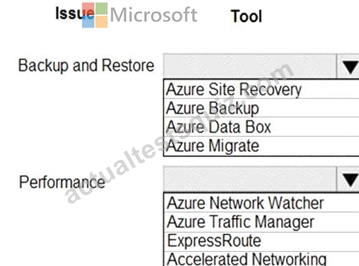
Answer:
Explanation:
Explanation
Backup and Restore: Azure Backup
Scenario: The VM is critical and has not been backed up in the past. The VM must enable a quick restore from a 7-day snapshot to include in-place restore of disks in case of failure.
In-Place restore of disks in IaaS VMs is a feature of Azure Backup.
Performance: Accelerated Networking
Scenario: The VM shows high network latency, jitter, and high CPU utilization.
Accelerated networking enables single root I/O virtualization (SR-IOV) to a VM, greatly improving its networking performance. This high-performance path bypasses the host from the datapath, reducing latency, jitter, and CPU utilization, for use with the most demanding network workloads on supported VM types.
References:
https://azure.microsoft.com/en-us/blog/an-easy-way-to-bring-back-your-azure-vm-with-in-place-restore/
NEW QUESTION 156
Hotspot Question
You are configuring a development environment for your team. You deploy the latest Visual Studio image from the Azure Marketplace to your Azure subscription.
The development environment requires several software development kits (SDKs) and third-party components to support application development across the organization. You install and customize the deployed virtual machine (VM) for your development team. The customized VM must be saved to allow provisioning of a new team member development environment.
You need to save the customized VM for future provisioning. Which tools or services should you use? To answer, select the appropriate options in the answer area.
NOTE: Each correct selection is worth one point.
Answer:
Explanation:
Explanation:
Box 1: Azure Powershell
Creating an image directly from the VM ensures that the image includes all of the disks associated with the VM, including the OS disk and any data disks.
Before you begin, make sure that you have the latest version of the Azure PowerShell module.
You use Sysprep to generalize the virtual machine, then use Azure PowerShell to create the image.
Box 2: Azure Blob Storage
References:
https://docs.microsoft.com/en-us/azure/virtual-machines/windows/capture-image- resource#create-animage-of-a-vm-using-powershell
NEW QUESTION 157
You are configuring a development environment for your team. You deploy the latest Visual Studio image from the Azure Marketplace to your Azure subscription.
The development environment requires several software development kits (SDKs) and third-party components to support application development across the organization. You install and customize the deployed virtual machine (VM) for your development team. The customized VM must be saved to allow provisioning of a new team member development environment.
You need to save the customized VM for future provisioning.
Which tools or services should you use? To answer, select the appropriate options in the answer area.
NOTE: Each correct selection is worth one point.
Answer:
Explanation:
Explanation:
Box 1: Azure Powershell
Creating an image directly from the VM ensures that the image includes all of the disks associated with the VM, including the OS disk and any data disks.
Before you begin, make sure that you have the latest version of the Azure PowerShell module.
You use Sysprep to generalize the virtual machine, then use Azure PowerShell to create the image.
Box 2: Azure Blob Storage
References:
https://docs.microsoft.com/en-us/azure/virtual-machines/windows/capture-image-resource#create-an-image-of-a-vm-using-powershell
NEW QUESTION 158
You need to resolve a notification latency issue.
Which two actions should you perform? Each correct answer presents part of the solution.
NOTE: Each correct selection is worth one point.
- A. Ensure that the Azure Function is set to use a consumption plan.
- B. Set Always On to false.
- C. Ensure that the Azure Function is using an App Service plan.
- D. Set Always On to true.
Answer: C,D
Explanation:
Azure Functions can run on either a Consumption Plan or a dedicated App Service Plan. If you run in a dedicated mode, you need to turn on the Always On setting for your Function App to run properly. The Function runtime will go idle after a few minutes of inactivity, so only HTTP triggers will actually "wake up" your functions. This is similar to how WebJobs must have Always On enabled.
Scenario: Notification latency: Users report that anomaly detection emails can sometimes arrive several minutes after an anomaly is detected.
Anomaly detection service: You have an anomaly detection service that analyzes log information for anomalies. It is implemented as an Azure Machine Learning model. The model is deployed as a web service. If an anomaly is detected, an Azure Function that emails administrators is called by using an HTTP WebHook.
Reference:
https://github.com/Azure/Azure-Functions/wiki/Enable-Always-On-when-running-on-dedicated-App-Service-Plan
NEW QUESTION 159
You are creating a script that will run a large workload on an Azure Batch pool. Resources will be reused and do not need to be cleaned up after use.
You have the following parameters:
You need to write an Azure CLI script that will create the jobs, tasks, and the pool.
In which order should you arrange the commands to develop the solution? To answer, move the appropriate commands from the list of command segments to the answer area and arrange them in the correct order.
Answer:
Explanation:
Explanation
Step 1: az batch pool create
# Create a new Linux pool with a virtual machine configuration.
az batch pool create \
--id mypool \
--vm-size Standard_A1 \
--target-dedicated 2 \
--image canonical:ubuntuserver:16.04-LTS \
--node-agent-sku-id "batch.node.ubuntu 16.04"
Step 2: az batch job create
# Create a new job to encapsulate the tasks that are added.
az batch job create \
--id myjob \
--pool-id mypool
Step 3: az batch task create
# Add tasks to the job. Here the task is a basic shell command.
az batch task create \
--job-id myjob \
--task-id task1 \
--command-line "/bin/bash -c 'printenv AZ_BATCH_TASK_WORKING_DIR'"
Step 4: for i in {1..$numberOfJobs} do
References:
https://docs.microsoft.com/bs-latn-ba/azure/batch/scripts/batch-cli-sample-run-job
NEW QUESTION 160
You have an application that provides weather forecasting data to external partners. You use Azure API Management to publish APIs.
You must change the behavior of the API to meet the following requirements:
* Support alternative input parameters.
* Remove formatting text from responses.
* Provide additional context to back-end services.
Which types of policies should you implement? To answer, drag the policy types to the correct scenarios. Each policy type may be used once, more than once, or not at all. You may need to drag the split bar between panes or scroll to view content NOTE: Each correct selection is worth one point.
Answer:
Explanation:
NEW QUESTION 161
......
AZ-204 Exam Brain Dumps - Study Notes and Theory: https://www.actualtestsquiz.com/AZ-204-test-torrent.html
100% Guaranteed Results AZ-204 Unlimited 265 Questions: https://drive.google.com/open?id=1NY57dnlAWkHVtkMtJAEKViBqg_gvd4C1
