

[Jan 07, 2022] HPE6-A70 PDF Dumps is essential on your HPE6-A70 Exam Questions Certain Success!
HPE6-A70 PDF Questions - Perfect Prospect To Go With HPE6-A70 Practice Exam
The benefit in Obtaining the Aruba Certified Mobility Associate (HP HPE6-A70) Professional Exam
This certification is an industry-recognized credential from Aruba Networks that assesses the applicant’s understanding of fundamental concepts and skills on Terraform OSS and the characteristics that exist on Terraform Cloud & Terraform Enterprise packages. When it comes to employment, this certification is a career game-changer that will advance you closer to achieving your dream profession.
Some more benefits are:
- Achieve recognition for your hard work
- Better avenues for improving professional expertise
- Planning for a better future
- Opportunities to grow your professional network.
- Generate new leads and gain new projects
- Demonstrate your involvement levels
- Better Salary
How to schedule Aruba Certified Mobility Associate (HP HPE6-A70) Professional Exam
To apply for the Aruba Certified Mobility Associate (HP HPE6-A70) Professional Exam, You have to follow these steps:
- Step 1: Go to the Aruba Certified Mobility Associate (HP HPE6-A70) Professional Official Site. You must first create an account, use your email address to register. You must purchase your training through your local distributor. If you are a partner, you must first create an account on the Partner Portal. You must use your company email address to register.
- Step 2: Read the instruction Carefully
- Step 3: Follow the given steps
- Step 4: Apply for the Aruba Certified Mobility Associate (HP HPE6-A70)-Professional Exam
For queries, contact your regional training team:
NEW QUESTION 56
Refer to the exhibit.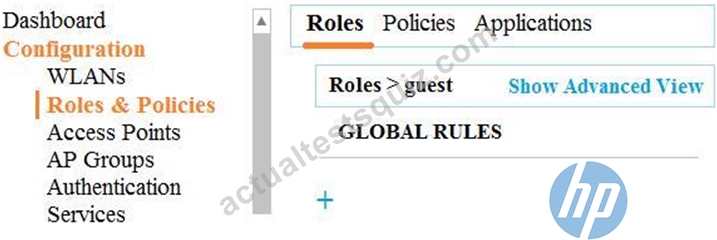
A network administrator adds a global rule in the area shown in the exhibit. Where does the global rule take effect?
- A. It immediately applies to the guest role and other roles, as part of the first policy applied to the role.
- B. It immediately applies only to the guest role and other roles, as part of the first policy applied to the role.
Administrators can choose to apply the rule to other roles. - C. It immediately applies to the guest role and other roles, as part of the final policy applied to the role.
- D. It immediately applies only to the guest role, as part of the final policy applied to the role.
Administrators cannot apply the rule to other roles.
Answer: B
NEW QUESTION 57
A network administrator examines a list of 2.4GHz clients with low performance in the Mobility Master (MM) dashboard. Which property should pose a concern as a potential performance issue?
- A. Usage of 10 MB
- B. Goodput data rate of 12Mbps
- C. Radio PHY of HT 20MHz
- D. Max speed of 72Mbps
Answer: A
NEW QUESTION 58
Refer to the exhibit.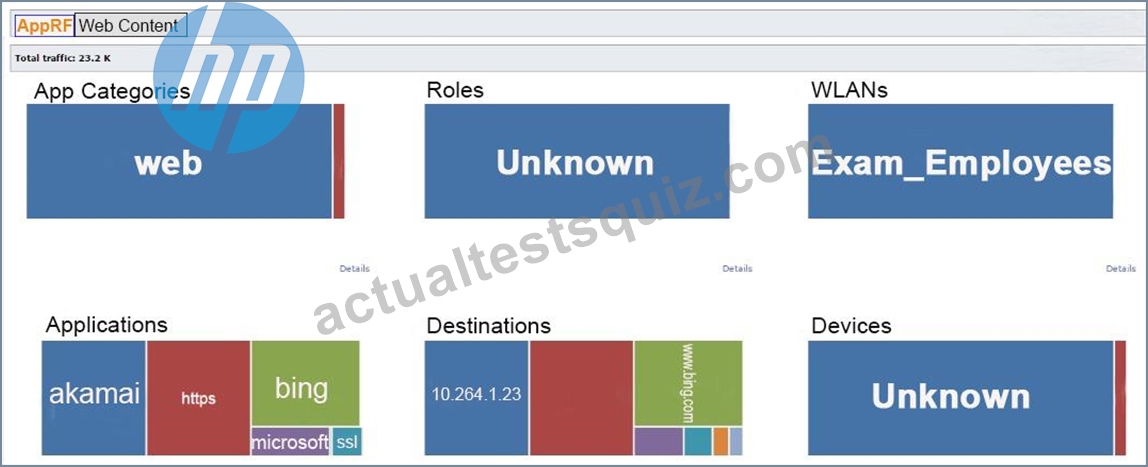
The exhibit shows output from a Mobility Master (MM) dashboard. What is a valid reason for the administrator to click the akamai square under applications?
- A. to download a report about the usage of this application over time
- B. to see the break down for only roles, destinations, WLANs and devices that use this application
- C. to create filter rules in order to control wireless user access to this application
- D. to see more details about this application, such as a list of aggregated sessions
Answer: D
NEW QUESTION 59
Refer to the exhibits.
Exhibit 1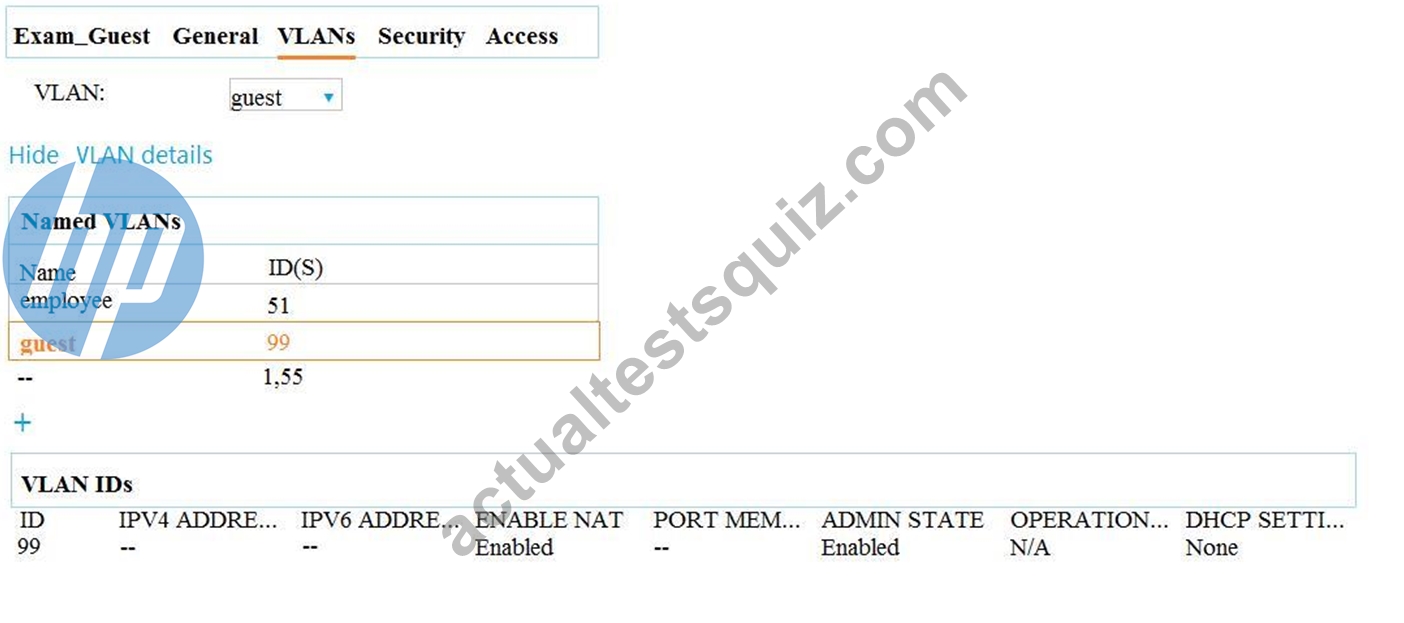
Exhibit 2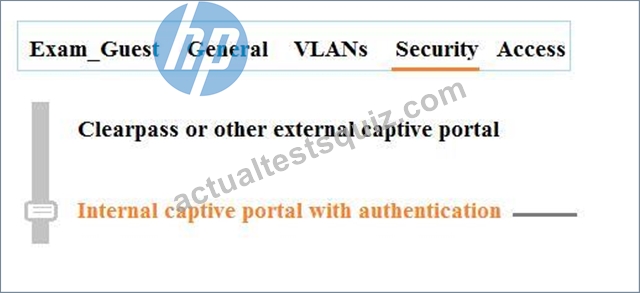
Exhibit 3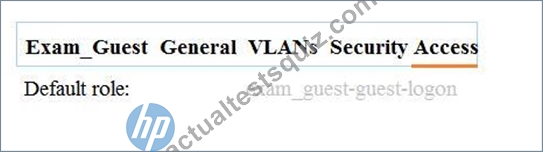
A network administrator creates a guest WLAN on an Aruba Mobility Manager (MM). The exhibits show some of the settings for the WLAN. The administrator does not change the policies for those roles.
How does the firewall control guest clients when they first connect to the WLAN?
- A. It permits them to send any DHCP traffic and DNS and web traffic to the Internet. It redirects web traffic destined to the private network to a login portal.
- B. It permits them to send any DHCP and DNS and it redirects all web traffic to a login portal.
- C. It does not permit them to send any traffic until they are authenticated.
- D. It permits them to send any DHCP and RADIUS traffic. It redirects all web traffic destined to the Internet to a login portal and drops web traffic destined to the private network.
Answer: C
NEW QUESTION 60
A network administrator uses a wireless intrusion detection system (WIDS) to detect 802.11 association floods. At which layer do these attacks occur?
- A. Layer 1
- B. Layer 7
- C. Layer 3
- D. Layer 2
Answer: D
Explanation:
Explanation
https://www.cnrood.com/en/media/solutions/Wi-Fi_Overview_of_the_802.11_Physical_Layer.pdf
NEW QUESTION 61
A network administrator uses a wireless intrusion detection system (WIDS) to detect 802.11 association floods. At which layer do these attacks occur?
- A. Layer 1
- B. Layer 7
- C. Layer 3
- D. Layer 2
Answer: D
NEW QUESTION 62
Refer to the exhibits.
Exhibit 1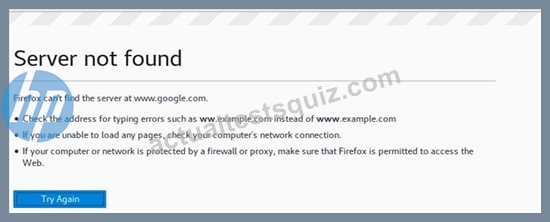
Exhibit 2
A company has a Mobility Master (MM)-based solution with a guest WLAN. Users can connect to the WLAN, but they receive the error shown browser rather than see login page. Exhibit 2 shows the status for one of the guest clients.
What is one issue that could cause the errors described?
- A. The Captive Portal is not enabled for the role to which these clients are assigned.
- B. The MM and Mobility Controllers (MCs) have invalid certificates.
- C. The DHCP pool for guests does not assign users a DNS server address.
- D. The firewall blocks DHCP traffic between the guest clients and the DHCP server.
Answer: C
NEW QUESTION 63
A company currently uses 802.11ac Wave 1 as a wireless solution. They want to upgrade to 802.11ac Wave2.
Which new feature will now be available with this upgrade?
- A. multi-user MIMO (MU-MIMO)
- B. multiple spatial streams
- C. band steering
- D. 40MHz channel bonding
Answer: A
NEW QUESTION 64
A network administrator needs to create an Aruba firewall rule that permits wireless users to receive DHCP settings when they first connect to the Aruba solution. What are the correct source and destination aliases for the rule?
- A. source = any and destination = any
- B. source = user and destination = any
- C. source = user and destination = user
- D. source = any and destination = user
Answer: D
NEW QUESTION 65
A company wants to provide wireless access for visitors with their Aruba solution. Which configuration feature enables the guest to access the wireless network without authentication?
- A. use of internal captive portal with email registration
- B. use of internal captive portal with authentication
- C. addition of custom rules to control access for unauthenticated guests
- D. redirection of guests to an external captive portal that provides encryption services
Answer: C
NEW QUESTION 66
How can network administrators upgrade AirMatch on an Aruba Mobility Master (MM)?
- A. Upgrade AirMatch as part of a global software upgrade, and upgrade Client Match separately as a loadable service module (LSM).
- B. Upgrade AirMatch and Client Match through a global software upgrade.
- C. Upgrade Client Match as part of a global software upgrade, and upgrade AirMatch separately as a loadable service module (LSM).
- D. Upgrade Client Match and AirMatch separately as loadable service modules (LSMs).
Answer: D
NEW QUESTION 67
A network administrator monitors an Aruba Mobility Controller with Aruba AirWave and sees the configuration status is Error. What should the administrator conclude?
- A. AirWave checks the controller configuration and detects a syntax error.
- B. AirWave has a communication issue with the controller and cannot check the configuration.
- C. AirWave detects a mismatch with the controller configuration and software version.
- D. AirWave determines that the controller configuration does not match the template for its group.
Answer: B
NEW QUESTION 68
Assume that administrators accept the default forwarding mode for WLANs. How does wireless user traffic flow in a master-local architecture, and how does it flow in a Mobility Master (MM) architecture?
- A. In both architectures, APs forward corporate user traffic locally and tunnel guest user traffic to a Mobility Controller (MC) to handle.
- B. In both architectures, traffic is tunneled to a Mobility Controller (MC) to handle.
- C. In the master-local architecture, traffic is tunneled to a local Mobility Controller (MC) to handle. In a MM architecture, all traffic is tunneled to the MM to handle.
- D. In the master-local architecture, all traffic is tunneled to the master controller to handle. In a MM architecture, all traffic is tunneled to the MM to handle.
Answer: B
NEW QUESTION 69
A company has an Aruba Mobility Master (MM)-based solution. Under which circumstance will an AP radio change channel without the use of the Mobility Master (MM)?
- A. when the Client Match rules indicate that nearby clients do not support the current channel
- B. when the Mobility Controller (MC) detects a rogue AP on the channel
- C. when the AP detects a large amount of interference on its channel
- D. when the MM detects that a different channel has significantly better quality
Answer: C
NEW QUESTION 70
A company plans to deploy a Mobility Master (MM) solution with two MM nodes. The MM solution will manage 10 Mobility Controller (MC) appliances that will control a total of 400 APs.
How should the network administrator install the AP licenses?
- A. 40 AP licenses on the MM and no licenses on the MC
- B. 800 AP licenses on each MC and no licenses on the MC
- C. 400 AP licenses on the MM and no licenses on the MC
- D. 800 AP licenses on the MM and 40 AP licenses on each MC
Answer: C
NEW QUESTION 71
Exhibit 1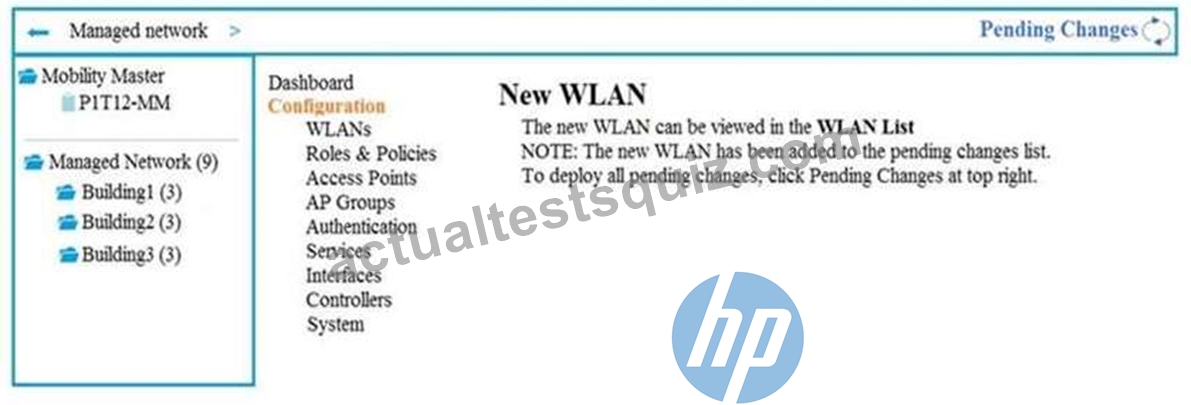
Exhibit 2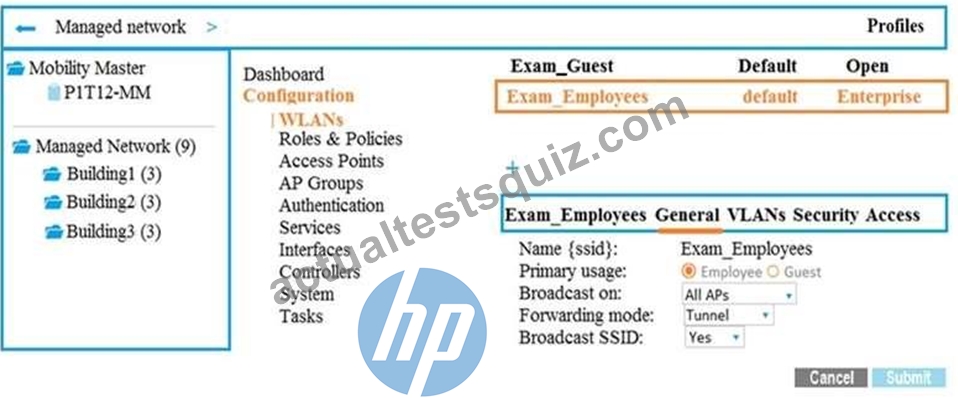
A company has an Aruba Mobility Master (MM)-based solution and needs a new WLAN for the corporate campus. A network administrator completes the creation of this WLAN, as shown in Exhibit 1. When administrators try to test a connection to the WLAN, the WLAN does not show up in the list of WLANs on the client. The administrator can see the WLAN in the list, as shown in Exhibit 2.
What is the error?
- A. The WLAN is configured at a lower level in the Managed Network hierarchy.
- B. The configuration is not deployed.
- C. The WLAN is configured as a hidden SSID.
- D. The Mobility Master (MM) does not have an active PEFNG license.
Answer: A
NEW QUESTION 72
A company has an Aruba solution and wants to provide guests with wireless access. The company wants to assign guests IP addresses in subnets that exist only within the Aruba solution.
Which feature should network administrators set up so guests can send traffic on the Internet without changes to the company routing solution?
- A. Set up a dynamic default gateway on the Mobility Controllers (MCs).
- B. Enable NAT on the VLAN assigned to the guest WLAN.
- C. Enable policy-based routing for the guest traffic.
- D. Create destination NAT rules for the guest role.
Answer: B
NEW QUESTION 73
An Aruba solution has a WLAN that uses WPA2-Enterprise security. How are encryption keys dynamically managed for the wireless users?
- A. The MM generates and distributes keys to clients and access points (APs).
- B. Keys are generated and distributed securely during each wireless user authentication process.
- C. Administrators configure identical key strings on the Mobility Controllers (MCs) and wireless client
802.1X settings. - D. Keys are derived from the preshared key configured on the WLAN and on each wireless client.
Answer: B
NEW QUESTION 74
......
Understanding functional and technical aspects of Aruba Certified Mobility Associate (HP HPE6-A70) Professional Exam Object Management
The following will be discussed in HP HPE6-A70 dumps:
- Document customer intent and solution design
- Identify key customer business, technical and system requirements and outcomes
- Recognize and distinguish the fundamental firewall policies and roles, and compare the roles to the policies and how they are applied in the hierarchy
- Distinguish the scalability limits in the Aruba controller models, and given a scenario with customer specifications decide which model is most suitable
- Identify and position HPE solutions and workload offerings with the alliance partner ecosystem components to the appropriate customer use case
- Configure a guest WLAN & validate the configuration
- Update a proposed solution based on availability, supply constraints, additional or updated requirements, and/or cost
- Describe elements, define the functionality, and distinguish between the 802.11 standards and amendments, RF bands, channels, and regulatory domains
- Given a customer use case, differentiate and position HPE products for the following elements of the solution compute storage networking hyperconverged software defined and cloud services
- Classify licenses that are used for various features, define licensing pools, and differentiate among boxed-based, controller-based, and centralized licensing
- Troubleshoot an employee & a guest WLAN
- Given a set of customer requirements, design and architect a solution based on the customer requirements
- Given a set of customer requirements, select the appropriate HPE and 3rd party products and services for the solution
- Recognize and distinguish wireless security authentication types, server types, and encryption types
- Identify and collect key metrics for infrastructure and application performance
- Identify and use the appropriate tools to architect and configure the solution
- Describe, contrast and differentiate compute, storage and network architectures and how to select and optimize for specific customer workloads
- Interpret a set of customer requirements and validate that a final solution design meets those requirements
- Understand business continuity including environmental factors
- Understand complex workloads and their characteristics/differentiators as they relate to optimizing for performance and availability
- Define and distinguish between AP Modes (CAP, SA, AM, mesh point, mesh portal, IAP, RAP)
- Demonstrate, deploy, and manage an HPE Proof of Concept (PoC)
- Recognize and distinguish automatic RF management capabilities and characteristics
- Choose the relevant elements to configure a guest WLAN and validate the configuration
HPE6-A70 Exam with Accurate Aruba Certified Mobility Associate Exam PDF Questions: https://www.actualtestsquiz.com/HPE6-A70-test-torrent.html
True HP Exam Extraordinary Practice For the HPE6-A70 Exam: https://drive.google.com/open?id=1ZzQUmAppH58qeH0jbeBVwhj-eLOtDfy1
