

Exam Dumps Professional-Machine-Learning-Engineer Practice Free Latest Google Practice Tests
Professional-Machine-Learning-Engineer Exam Questions | Real Professional-Machine-Learning-Engineer Practice Dumps
NEW QUESTION # 28
You are building an ML model to predict trends in the stock market based on a wide range of factors. While exploring the data, you notice that some features have a large range. You want to ensure that the features with the largest magnitude don't overfit the model. What should you do?
- A. Use a binning strategy to replace the magnitude of each feature with the appropriate bin number.
- B. Normalize the data by scaling it to have values between 0 and 1.
- C. Standardize the data by transforming it with a logarithmic function.
- D. Apply a principal component analysis (PCA) to minimize the effect of any particular feature.
Answer: B
Explanation:
The best option to ensure that the features with the largest magnitude don't overfit the model is to normalize the data by scaling it to have values between 0 and 1. This is also known as min-max scaling or feature scaling, and it can reduce the variance and skewness of the data, as well as improve the numerical stability and convergence of the model. Normalizing the data can also make the model less sensitive to the scale of the features, and more focused on the relative importance of each feature. Normalizing the data can be done using various methods, such as dividing each value by the maximum value, subtracting the minimum value and dividing by the range, or using the sklearn.preprocessing.MinMaxScaler function in Python.
The other options are not optimal for the following reasons:
* A. Standardizing the data by transforming it with a logarithmic function is not a good option, as it can distort the distribution and relationship of the data, and introduce bias and errors. Moreover, the logarithmic function is not defined for negative or zero values, which can limit its applicability and cause problems for the model.
* B. Applying a principal component analysis (PCA) to minimize the effect of any particular feature is not a good option, as it can reduce the interpretability and explainability of the data and the model. PCA is a dimensionality reduction technique that transforms the data into a new set of orthogonal features that capture the most variance in the data. However, these new features are not directly related to the original features, and can lose some information and meaning in the process. Moreover, PCA can be computationally expensive and complex, and may not be necessary for the problem at hand.
* C. Using a binning strategy to replace the magnitude of each feature with the appropriate bin number is not a good option, as it can lose the granularity and precision of the data, and introduce noise and outliers. Binning is a discretization technique that groups the continuous values of a feature into a finite number of bins or categories. However, this can reduce the variability and diversity of the data, and create artificial boundaries and gaps that may not reflect the true nature of the data. Moreover, binning can be arbitrary and subjective, and depend on the choice of the bin size and number.
References:
* Professional ML Engineer Exam Guide
* Preparing for Google Cloud Certification: Machine Learning Engineer Professional Certificate
* Google Cloud launches machine learning engineer certification
* Feature Scaling for Machine Learning: Understanding the Difference Between Normalization vs.
Standardization
* sklearn.preprocessing.MinMaxScaler documentation
* Principal Component Analysis Explained Visually
* Binning Data in Python
NEW QUESTION # 29
You are developing an ML model to predict house prices. While preparing the data, you discover that an important predictor variable, distance from the closest school, is often missing and does not have high variance. Every instance (row) in your data is important. How should you handle the missing data?
- A. Delete the rows that have missing values.
- B. Apply feature crossing with another column that does not have missing values.
- C. Replace the missing values with zeros.
- D. Predict the missing values using linear regression.
Answer: D
NEW QUESTION # 30
You are working on a system log anomaly detection model for a cybersecurity organization. You have developed the model using TensorFlow, and you plan to use it for real-time prediction. You need to create a Dataflow pipeline to ingest data via Pub/Sub and write the results to BigQuery. You want to minimize the serving latency as much as possible. What should you do?
- A. Deploy the model to a Vertex AI endpoint, and invoke this endpoint in the Dataflow job.
- B. Containerize the model prediction logic in Cloud Run, which is invoked by Dataflow.
- C. Deploy the model in a TFServing container on Google Kubernetes Engine, and invoke it in the Dataflow job.
- D. Load the model directly into the Dataflow job as a dependency, and use it for prediction.
Answer: B
Explanation:
Containerizing the model prediction logic in Cloud Run allows for easy and efficient deployment of the model, and allows it to be invoked by Dataflow. Cloud Run is a fully managed service that allows you to run stateless containers in a serverless environment. It automatically scales instances up and down based on the traffic, which can minimize the serving latency.
Additionally, Dataflow can easily invoke Cloud Run services via HTTP requests, making it simple to integrate into your pipeline. This allows the Dataflow pipeline to focus on data ingestion and processing, while the Cloud Run service handles the real-time predictions.
While it is possible to load the model directly into the Dataflow job as a dependency, this approach can increase the complexity of the pipeline and could lead to increased latency. Other options, such as deploying the model to a Vertex AI endpoint or a TFServing container on GKE, would also work but this option is the most optimal for minimizing the serving latency.
NEW QUESTION # 31
You need to build classification workflows over several structured datasets currently stored in BigQuery. Because you will be performing the classification several times, you want to complete the following steps without writing code: exploratory data analysis, feature selection, model building, training, and hyperparameter tuning and serving. What should you do?
- A. Use Al Platform to run the classification model job configured for hyperparameter tuning
- B. Use Al Platform Notebooks to run the classification model with pandas library
- C. Configure AutoML Tables to perform the classification task
- D. Run a BigQuery ML task to perform logistic regression for the classification
Answer: C
Explanation:
https://cloud.google.com/automl-tables/docs/beginners-guide
NEW QUESTION # 32
You are building an ML model to detect anomalies in real-time sensor dat a. You will use Pub/Sub to handle incoming requests. You want to store the results for analytics and visualization. How should you configure the pipeline?
- A. 1 = BigQuery, 2 = Al Platform, 3 = Cloud Storage
- B. 1 = Dataflow, 2 - Al Platform, 3 = BigQuery
- C. 1 = BigQuery, 2 = AutoML, 3 = Cloud Functions
- D. 1 = DataProc, 2 = AutoML, 3 = Cloud Bigtable
Answer: C
NEW QUESTION # 33
You developed a custom model by using Vertex Al to forecast the sales of your company s products based on historical transactional data You anticipate changes in the feature distributions and the correlations between the features in the near future You also expect to receive a large volume of prediction requests You plan to use Vertex Al Model Monitoring for drift detection and you want to minimize the cost. What should you do?
- A. Use the features and the feature attributions for monitoring. Set a monitoring-frequency value that is lower than the default.
- B. Use the features for monitoring Set a prediction-sampling-rare value that is closer to 1 than 0.
- C. Use the features and the feature attributions for monitoring Set a prediction-sampling-rate value that is closer to 0 than 1.
- D. Use the features for monitoring Set a monitoring- frequency value that is higher than the default.
Answer: C
Explanation:
The best option for using Vertex AI Model Monitoring for drift detection and minimizing the cost is to use the features and the feature attributions for monitoring, and set a prediction-sampling-rate value that is closer to 0 than 1. This option allows you to leverage the power and flexibility of Google Cloud to detect feature drift in the input predict requests for custom models, and reduce the storage and computation costs of the model monitoring job. Vertex AI Model Monitoring is a service that can track and compare the results of multiple machine learning runs. Vertex AI Model Monitoring can monitor the model's prediction input data for feature skew and drift. Feature drift occurs when the feature data distribution in production changes over time. If the original training data is not available, you can enable drift detection to monitor your models for feature drift.
Vertex AI Model Monitoring uses TensorFlow Data Validation (TFDV) to calculate the distributions and distance scores for each feature, and compares them with a baseline distribution. The baseline distribution is the statistical distribution of the feature's values in the training data. If the training data is not available, the baseline distribution is calculated from the first 1000 prediction requests that the model receives. If the distance score for a feature exceeds an alerting threshold that you set, Vertex AI Model Monitoring sends you an email alert. However, if you use a custom model, you can also enable feature attribution monitoring, which can provide more insights into the feature drift. Feature attribution monitoring analyzes the feature attributions, which are the contributions of each feature to the prediction output. Feature attribution monitoring can help you identify the features that have the most impact on the model performance, and the features that have the most significant drift over time. Feature attribution monitoring can also help you understand the relationship between the features and the prediction output, and the correlation between the features1. The prediction-sampling-rate is a parameter that determines the percentage of prediction requests that are logged and analyzed by the model monitoring job. Using a lower prediction-sampling-rate can reduce the storage and computation costs of the model monitoring job, but also the quality and validity of the data. Using a lower prediction-sampling-rate can introduce sampling bias and noise into the data, and make the model monitoring job miss some important features or patterns of the data. However, using a higher prediction-sampling-rate can increase the storage and computation costs of the model monitoring job, and also the amount of data that needs to be processed and analyzed. Therefore, there is a trade-off between the prediction-sampling-rate and the cost and accuracy of the model monitoring job, and the optimal prediction-sampling-rate depends on the business objective and the data characteristics2. By using the features and the feature attributions for monitoring, and setting a prediction-sampling-rate value that is closer to 0 than 1, you can use Vertex AI Model Monitoring for drift detection and minimize the cost.
The other options are not as good as option D, for the following reasons:
* Option A: Using the features for monitoring and setting a monitoring-frequency value that is higher than the default would not enable feature attribution monitoring, and could increase the cost of the model monitoring job. The monitoring-frequency is a parameter that determines how often the model monitoring job analyzes the logged prediction requests and calculates the distributions and distance scores for each feature. Using a higher monitoring-frequency can increase the frequency and timeliness of the model monitoring job, but also the computation costs of the model monitoring job. Moreover, using the features for monitoring would not enable feature attribution monitoring, which can provide more insights into the feature drift and the model performance1.
* Option B: Using the features for monitoring and setting a prediction-sampling-rate value that is closer to
1 than 0 would not enable feature attribution monitoring, and could increase the cost of the model monitoring job. The prediction-sampling-rate is a parameter that determines the percentage of prediction requests that are logged and analyzed by the model monitoring job. Using a higher prediction-sampling-rate can increase the quality and validity of the data, but also the storage and computation costs of the model monitoring job. Moreover, using the features for monitoring would not enable feature attribution monitoring, which can provide more insights into the feature drift and the model performance12.
* Option C: Using the features and the feature attributions for monitoring and setting a monitoring-frequency value that is lower than the default would enable feature attribution monitoring, but could reduce the frequency and timeliness of the model monitoring job. The monitoring-frequency is a parameter that determines how often the model monitoring job analyzes the logged prediction requests and calculates the distributions and distance scores for each feature. Using a lower monitoring-frequency can reduce the computation costs of the model monitoring job, but also the frequency and timeliness of the model monitoring job. This can make the model monitoring job less responsive and effective in detecting and alerting the feature drift1.
References:
* Preparing for Google Cloud Certification: Machine Learning Engineer, Course 3: Production ML Systems, Week 4: Evaluation
* Google Cloud Professional Machine Learning Engineer Exam Guide, Section 3: Scaling ML models in production, 3.3 Monitoring ML models in production
* Official Google Cloud Certified Professional Machine Learning Engineer Study Guide, Chapter 6:
Production ML Systems, Section 6.3: Monitoring ML Models
* Using Model Monitoring
* Understanding the score threshold slider
NEW QUESTION # 34
You have been given a dataset with sales predictions based on your company's marketing activities. The data is structured and stored in BigQuery, and has been carefully managed by a team of data analysts. You need to prepare a report providing insights into the predictive capabilities of the data. You were asked to run several ML models with different levels of sophistication, including simple models and multilayered neural networks.
You only have a few hours to gather the results of your experiments. Which Google Cloud tools should you use to complete this task in the most efficient and self-serviced way?
- A. Train a custom TensorFlow model with Vertex AI, reading the data from BigQuery featuring a variety of ML algorithms.
- B. Use Vertex AI Workbench user-managed notebooks with scikit-learn code for a variety of ML algorithms and performance metrics.
- C. Read the data from BigQuery using Dataproc, and run several models using SparkML.
- D. Use BigQuery ML to run several regression models, and analyze their performance.
Answer: D
Explanation:
* Option A is correct because using BigQuery ML to run several regression models, and analyze their performance is the most efficient and self-serviced way to complete the task. BigQuery ML is a service that allows you to create and use ML models within BigQuery using SQL queries1. You can use BigQuery ML to run different types of regression models, such as linear regression, logistic regression, or DNN regression2. You can also use BigQuery ML to analyzethe performance of your models, such as the mean squared error, the accuracy, or the ROC curve3. BigQuery ML is fast, scalable, and easy to use, as it does not require any data movement, coding, or additional tools4.
* Option B is incorrect because reading the data from BigQuery using Dataproc, and running several models using SparkML is not the most efficient and self-serviced way to complete the task. Dataproc is a service that allows you to create and manage clusters of virtual machinesthat run Apache Spark and other open-source tools5. SparkML is a library that provides ML algorithms and utilities for Spark.
However, this option requires more effort and resources than option A, as it involves moving the data from BigQuery to Dataproc, creating and configuring the clusters, writing and running the SparkML code, and analyzing the results.
* Option C is incorrect because using Vertex AI Workbench user-managed notebooks with scikit-learn code for a variety of ML algorithms and performance metrics is not the most efficient and self-serviced way to complete the task. Vertex AI Workbench is a service that allows you to create and use notebooks for ML development and experimentation. Scikit-learn is a library that provides ML algorithms and utilities for Python. However, this option also requires more effort and resources than option A, as it involves creating and managing the notebooks, writing and running the scikit-learn code, and analyzing the results.
* Option D is incorrect because training a custom TensorFlow model with Vertex AI, reading the data from BigQuery featuring a variety of ML algorithms is not the most efficient and self-serviced way to complete the task. TensorFlow is a framework that allows you to create and train ML models using Python or other languages. Vertex AI is a service that allows you to train and deploy ML models using built-in algorithms or custom containers. However, this option also requires more effort and resources than option A, as it involves writing and running the TensorFlow code, creating and managing the training jobs, and analyzing the results.
References:
* BigQuery ML overview
* Creating a model in BigQuery ML
* Evaluating a model in BigQuery ML
* BigQuery ML benefits
* Dataproc overview
* [SparkML overview]
* [Vertex AI Workbench overview]
* [Scikit-learn overview]
* [TensorFlow overview]
* [Vertex AI overview]
NEW QUESTION # 35
You work on a data science team at a bank and are creating an ML model to predict loan default risk. You have collected and cleaned hundreds of millions of records worth of training data in a BigQuery table, and you now want to develop and compare multiple models on this data using TensorFlow and Vertex AI. You want to minimize any bottlenecks during the data ingestion state while considering scalability. What should you do?
- A. Use TensorFlow I/O's BigQuery Reader to directly read the data.
- B. Use the BigQuery client library to load data into a dataframe, and use tf.data.Dataset.from_tensor_slices() to read it.
- C. Export data to CSV files in Cloud Storage, and use tf.data.TextLineDataset() to read them.
- D. Convert the data into TFRecords, and use tf.data.TFRecordDataset() to read them.
Answer: A
Explanation:
The best option for developing and comparing multiple models on a large-scale BigQuery table using TensorFlow and Vertex AI is to use TensorFlow I/O's BigQuery Reader to directly read the data. This option has the following advantages:
* It minimizes any bottlenecks during the data ingestion stage, as the BigQuery Reader can stream data from BigQuery to TensorFlow in parallel and in batches, without loading the entire table into memory or disk. The BigQuery Reader can also perform data transformations and filtering using SQL queries, reducing the need for additional preprocessing steps in TensorFlow.
* It leverages the scalability and performance of BigQuery, as the BigQuery Reader can handle hundreds of millions of records worth of training data efficiently and reliably. BigQuery is a serverless, fully managed, and highly scalable data warehouse that can run complex queries over petabytes of data in seconds.
* It simplifies the integration with Vertex AI, as the BigQuery Reader can be used with both custom and pre-built TensorFlow models on Vertex AI. Vertex AI is a unified platform for machine learning that provides various tools and features for data ingestion, data labeling, data preprocessing, model training, model tuning, model deployment, model monitoring, and model explainability.
The other options are less optimal for the following reasons:
* Option A: Using the BigQuery client library to load data into a dataframe, and using tf.data.Dataset.from_tensor_slices() to read it, introduces memory and performance issues. This option requires loading the entire BigQuery table into a Pandas dataframe, which can consume a lot of memory and cause out-of-memory errors. Moreover, using tf.data.Dataset.from_tensor_slices() to read the dataframe can be slow and inefficient, as it creates one slice per row of the dataframe, resulting in a large number of small tensors.
* Option B: Exporting data to CSV files in Cloud Storage, and using tf.data.TextLineDataset() to read them, introduces additional steps and complexity. This option requires exporting the BigQuery table to one or more CSV files in Cloud Storage, which can take a long time and consume a lot of storage space.
Moreover, using tf.data.TextLineDataset() to read the CSV files can be slow and error-prone, as it requires parsing and decoding each line of text, handling missing values and invalid data, and applying data transformations and validations.
* Option C: Converting the data into TFRecords, and using tf.data.TFRecordDataset() to read them, introduces additional steps and complexity. This option requires converting the BigQuery table into one or more TFRecord files, which are binary files that store serialized TensorFlow examples. This can take a long time and consume a lot of storage space. Moreover, using tf.data.TFRecordDataset() to read the TFRecord files requires defining and parsing the schema of the TensorFlow examples, which can be tedious and error-prone.
References:
* [TensorFlow I/O documentation]
* [BigQuery documentation]
* [Vertex AI documentation]
NEW QUESTION # 36
You work at a leading healthcare firm developing state-of-the-art algorithms for various use cases You have unstructured textual data with custom labels You need to extract and classify various medical phrases with these labels What should you do?
- A. Use AutoML Entity Extraction to train a medical entity extraction model.
- B. Use TensorFlow to build a custom medical entity extraction model.
- C. Use the Healthcare Natural Language API to extract medical entities.
- D. Use a BERT-based model to fine-tune a medical entity extraction model.
Answer: D
NEW QUESTION # 37
You work on a data science team at a bank and are creating an ML model to predict loan default risk. You have collected and cleaned hundreds of millions of records worth of training data in a BigQuery table, and you now want to develop and compare multiple models on this data using TensorFlow and Vertex AI. You want to minimize any bottlenecks during the data ingestion state while considering scalability. What should you do?
- A. Use TensorFlow I/O's BigQuery Reader to directly read the data.
- B. Use the BigQuery client library to load data into a dataframe, and use tf.data.Dataset.from_tensor_slices() to read it.
- C. Export data to CSV files in Cloud Storage, and use tf.data.TextLineDataset() to read them.
- D. Convert the data into TFRecords, and use tf.data.TFRecordDataset() to read them.
Answer: A
Explanation:
TensorFlow I/O's BigQuery Reader allows you to directly read data from BigQuery tables into your TensorFlow model without the need to export the data to a separate file format. This can minimize any bottlenecks during the data ingestion stage and also it can increase the scalability. By using BigQuery Reader, you can easily read large amounts of data from BigQuery and use it to train your model without having to worry about the performance impact of reading from a dataframe or CSV file.
You can use the tfio.BigQueryRecordDataset which will return a dataset of dictionaries, and where each key corresponds to a table column and each value corresponds to the value in that column.
NEW QUESTION # 38
You are an ML engineer at a manufacturing company You are creating a classification model for a predictive maintenance use case You need to predict whether a crucial machine will fail in the next three days so that the repair crew has enough time to fix the machine before it breaks. Regular maintenance of the machine is relatively inexpensive, but a failure would be very costly You have trained several binary classifiers to predict whether the machine will fail. where a prediction of 1 means that the ML model predicts a failure.
You are now evaluating each model on an evaluation dataset. You want to choose a model that prioritizes detection while ensuring that more than 50% of the maintenance jobs triggered by your model address an imminent machine failure. Which model should you choose?
- A. The model with the highest area under the receiver operating characteristic curve (AUC ROC) and precision greater than 0 5
- B. The model with the lowest root mean squared error (RMSE) and recall greater than 0.5.
- C. The model with the highest precision where recall is greater than 0.5.
- D. The model with the highest recall where precision is greater than 0.5.
Answer: D
Explanation:
In predictive maintenance, the goal is to identify which machines are likely to fail soon, so that the repair crew can fix them before they break. In this context, it is important to prioritize detection, while also ensuring that more than 50% of the maintenance jobs triggered by your model address an imminent machine failure.
Recall is a metric that measures the proportion of actual positive observations that are correctly predicted as such by the model. In this case, recall is a good metric to use because it measures how well the model is able to identify the machines that are likely to fail soon.
Precision is a metric that measures the proportion of positive predictions that are actually true. In this case, precision is also important because it measures how many of the machines that the model predicts will fail soon, actually do fail soon.
By combining these two metrics, you can ensure that your model is able to identify the machines that are likely to fail soon with a high degree of accuracy. In this case, the model with the highest recall where precision is greater than 0.5 will be the best model, as it will have a high ability to identify the machines that are likely to fail soon and also it will have a high degree of accuracy.
Reference:
Recall and Precision
Predictive Maintenance
Metrics for classification
NEW QUESTION # 39
You are an ML engineer in the contact center of a large enterprise. You need to build a sentiment analysis tool that predicts customer sentiment from recorded phone conversations. You need to identify the best approach to building a model while ensuring that the gender, age, and cultural differences of the customers who called the contact center do not impact any stage of the model development pipeline and results. What should you do?
- A. Convert the speech to text and extract sentiments based on the sentences
- B. Convert the speech to text and extract sentiment using syntactical analysis
- C. Convert the speech to text and build a model based on the words
- D. Extract sentiment directly from the voice recordings
Answer: A
NEW QUESTION # 40
You are building a linear regression model on BigQuery ML to predict a customer's likelihood of purchasing your company's products. Your model uses a city name variable as a key predictive component. In order to train and serve the model, your data must be organized in columns. You want to prepare your data using the least amount of coding while maintaining the predictable variables. What should you do?
- A. Use Dataprep to transform the state column using a one-hot encoding method, and make each city a column with binary values.
- B. Create a new view with BigQuery that does not include a column with city information
- C. Use TensorFlow to create a categorical variable with a vocabulary list Create the vocabulary file, and upload it as part of your model to BigQuery ML.
- D. Use Cloud Data Fusion to assign each city to a region labeled as 1, 2, 3, 4, or 5r and then use that number to represent the city in the model.
Answer: D
NEW QUESTION # 41
You work on a data science team at a bank and are creating an ML model to predict loan default risk. You have collected and cleaned hundreds of millions of records worth of training data in a BigQuery table, and you now want to develop and compare multiple models on this data using TensorFlow and Vertex AI. You want to minimize any bottlenecks during the data ingestion state while considering scalability. What should you do?
- A. Use the BigQuery client library to load data into a dataframe, and use tf.data.Dataset.from_tensor_slices() to read it.
- B. Export data to CSV files in Cloud Storage, and use tf.data.TextLineDataset() to read them.
- C. Use TensorFlow I/O's BigQuery Reader to directly read the data.
- D. Convert the data into TFRecords, and use tf.data.TFRecordDataset() to read them.
Answer: B
NEW QUESTION # 42
You need to design an architecture that serves asynchronous predictions to determine whether a particular mission-critical machine part will fail. Your system collects data from multiple sensors from the machine. You want to build a model that will predict a failure in the next N minutes, given the average of each sensor's data from the past 12 hours. How should you design the architecture?
- A. 1. Events are sent by the sensors to Pub/Sub, consumed in real time, and processed by a Dataflow stream processing pipeline.
2. The pipeline invokes the model for prediction and sends the predictions to another Pub/Sub topic.
3. Pub/Sub messages containing predictions are then consumed by a downstream system for monitoring. - B. 1. HTTP requests are sent by the sensors to your ML model, which is deployed as a microservice and exposes a REST API for prediction
2. Your application queries a Vertex AI endpoint where you deployed your model.
3. Responses are received by the caller application as soon as the model produces the prediction. - C. 1. Export the data to Cloud Storage using the BigQuery command-line tool
2. Submit a Vertex AI batch prediction job that uses your trained model in Cloud Storage to perform scoring on the preprocessed data.
3. Export the batch prediction job outputs from Cloud Storage and import them into BigQuery. - D. 1. Export your data to Cloud Storage using Dataflow.
2. Submit a Vertex AI batch prediction job that uses your trained model in Cloud Storage to perform scoring on the preprocessed data.
3. Export the batch prediction job outputs from Cloud Storage and import them into Cloud SQL.
Answer: D
NEW QUESTION # 43
You work for a magazine publisher and have been tasked with predicting whether customers will cancel their annual subscription. In your exploratory data analysis, you find that 90% of individuals renew their subscription every year, and only 10% of individuals cancel their subscription. After training a NN Classifier, your model predicts those who cancel their subscription with 99% accuracy and predicts those who renew their subscription with 82% accuracy. How should you interpret these results?
- A. This is a good result because predicting those who cancel their subscription is more difficult, since there is less data for this group.
- B. This is a good result because the accuracy across both groups is greater than 80%.
- C. This is not a good result because the model is performing worse than predicting that people will always renew their subscription.
- D. This is not a good result because the model should have a higher accuracy for those who renew their subscription than for those who cancel their subscription.
Answer: C
Explanation:
In this case, the model has a high accuracy of 99% for identifying customers who cancel their subscriptions, but a lower accuracy of 82% for identifying customers who renew their subscriptions. However, this does not necessarily mean that the model is performing well, because 90% of the customers renew their subscription, so if the model always predicts that customers will renew, it will be correct 90% of the time. Therefore, the model's performance is worse than the baseline of always predicting that customers will renew their subscription.
https://en.wikipedia.org/wiki/Imbalanced_data
https://machinelearningmastery.com/baseline-performance-machine-learning-algorithms/
NEW QUESTION # 44
You have a functioning end-to-end ML pipeline that involves tuning the hyperparameters of your ML model using Al Platform, and then using the best-tuned parameters for training. Hypertuning is taking longer than expected and is delaying the downstream processes. You want to speed up the tuning job without significantly compromising its effectiveness. Which actions should you take?
Choose 2 answers
- A. Decrease the range of floating-point values
- B. Decrease the maximum number of trials during subsequent training phases.
- C. Set the early stopping parameter to TRUE
- D. Decrease the number of parallel trials
- E. Change the search algorithm from Bayesian search to random search.
Answer: B,C
Explanation:
Reference:
https://cloud.google.com/ai-platform/training/docs/using-hyperparameter-tuning#early-stopping
NEW QUESTION # 45
You are an ML engineer at a manufacturing company. You need to build a model that identifies defects in products based on images of the product taken at the end of the assembly line. You want your model to preprocess the images with lower computation to quickly extract features of defects in products. Which approach should you use to build the model?
- A. Reinforcement learning
- B. Recommender system
- C. Convolutional Neural Networks (CNN)
- D. Recurrent Neural Networks (RNN)
Answer: C
NEW QUESTION # 46
You are training an LSTM-based model on Al Platform to summarize text using the following job submission script: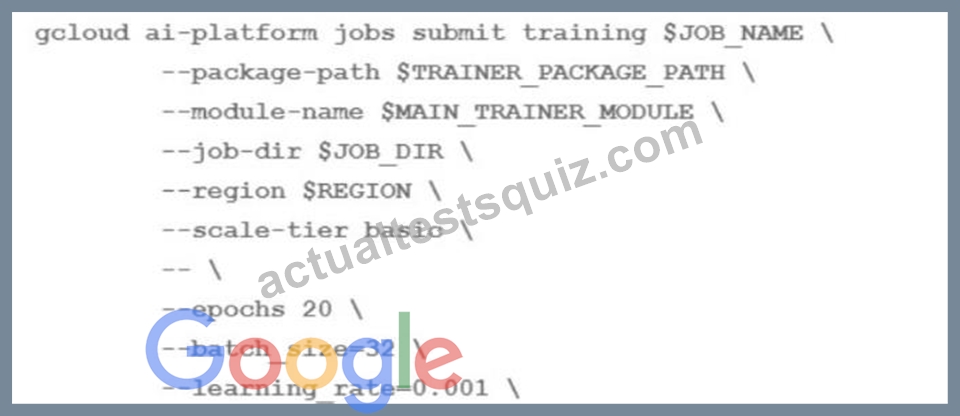
You want to ensure that training time is minimized without significantly compromising the accuracy of your model. What should you do?
- A. Modify the 'scale-tier' parameter
- B. Modify the 'epochs' parameter
- C. Modify the 'learning rate' parameter
- D. Modify the batch size' parameter
Answer: D
NEW QUESTION # 47
A Machine Learning Specialist works for a credit card processing company and needs to predict which transactions may be fraudulent in near-real time. Specifically, the Specialist must train a model that returns the probability that a given transaction may fraudulent.
How should the Specialist frame this business problem?
- A. Multi-category classification
- B. Regression classification
- C. Streaming classification
- D. Binary classification
Answer: A
NEW QUESTION # 48
......
Google Professional-Machine-Learning-Engineer Certification Exam is a professional-level certification exam that tests your proficiency in building and deploying machine learning models on Google Cloud Platform. It is designed for individuals with a solid understanding of machine learning concepts and experience in developing and deploying machine learning models on Google Cloud Platform. If you are a machine learning engineer, data scientist, or software developer looking to demonstrate your expertise in machine learning, this certification exam is an excellent way to showcase your skills and knowledge.
Verified Professional-Machine-Learning-Engineer Exam Dumps Q&As - Provide Professional-Machine-Learning-Engineer with Correct Answers: https://www.actualtestsquiz.com/Professional-Machine-Learning-Engineer-test-torrent.html
Pass Your Professional-Machine-Learning-Engineer Dumps Free Latest Google Practice Tests: https://drive.google.com/open?id=1EaybLMKGkC_sEuei88FbQFbQrwaDYpyU
