

2021 Realistic ActualTestsQuiz 5V0-21.20 Dumps PDF - 100% Passing Guarantee
Free VMware 5V0-21.20 Exam Questions & Answer
How to study the 5V0-21.20: VMware HCI Master Specialist Exam
Preparation of certification exams could be covered with two resource types. The first one is the study guides, reference books, and study forums that are elaborated and appropriate for building information from the ground up. Apart from the video tutorials and lectures are a good option to ease the pain of through study and are relatively make the study process more interesting nonetheless these demand time and concentration from the learner. Smart candidates who wish to create a solid foundation altogether examination topics and connected technologies typically mix video lectures with study guides to reap the advantages of each, but practice exams or practice exam engines is one important study tool that goes typically unnoted by most candidates. 5V0-21.20 practice exams are designed with our experts to make exam prospects test their knowledge on skills attained in the course, as well as prospects become comfortable and familiar with the real exam environment. Statistics have indicated exam anxiety plays a much bigger role in a student’s failure in the exam than the fear of the unknown. ActualTestsQuiz expert team recommends preparing some notes on these topics along with it do not forget to practice VMware 5V0-21.20 exam dumps which had been written by our expert team, each of these can assist you loads to clear this exam with excellent marks.
NEW QUESTION 29
Which two statements are true about enabling deduplication and compression on an All-Flash vSAN cluster with data? (Choose two.)
- A. Move one host at a time to maintenance mode and enable deduplication and compression.
- B. On-disk format version 3.0 or later is required to support deduplication and compression.
- C. This can be enabled through storage policies and does not require any data migration.
- D. This requires data evacuation and disk format upgrade of all the disk groups.
- E. Deduplication and Compression cannot be enabled on an existing vSAN datastore with data.
Answer: B,D
NEW QUESTION 30
A vSAN administrator is changing the number of stripes in the vSAN policy from 1 to 2 on a 3-node vSAN Cluster. What is a possible impact of this policy change?
- A. Stripes will be placed on separate media, but does not guarantee separate hosts or disk groups.
- B. The amount of raw capacity required to comply with this policy will decrease by half.
- C. The amount of raw capacity required to comply with this policy will double.
- D. Policy cannot be applied as the cluster does not meet the minimum number of fault domains.
Answer: B
NEW QUESTION 31
An administrator has been tasked with the shutdown process of one of the nodes in a 4-node vSAN Cluster, in order to replace a motherboard. The administrator must select the correct maintenance mode option to ensure all objects remain compliant with the vSAN Default Storage Policy. No changes have been made to this policy.
Which maintenance mode option should the administrator select?
- A. Full Data Migration
- B. Ensure Accessibility
- C. Allow Reduced Redundancy
- D. No Data Migration
Answer: D
NEW QUESTION 32
During planned maintenance of a four-node vSAN cluster, an outsourced IT contractor accidentally removed a
2.5" SSD cache disk from one of the vSAN nodes. The storage policy has been configured with FTT=1 RAID
1, and the disk management UI marked the disk group as
Which remediation steps should the administrator select to ensure VMs become compliant with the storage policy as soon as possible?
- A. enter host in maintenance > remove from disk group > shutdown host > replace disk > power on host
- B. replace the SSD cache disk > rescan > add disk back in disk group
- C. remove disk group > enter host in maintenance > fully evacuate all data > exit maintenance
- D. vSAN Health Check > retest > object health > repair objects immediately
Answer: B
NEW QUESTION 33
A failed storage controller has two vSAN disk groups attached. The components contained on the dnves in those disk groups are marked Degraded. vSAN reports that some objects do not comply with their assigned storage policy.
How is the compliance issue resolved?
- A. Rebuilding of the degraded components starts immediately.
- B. Storage policies must be reapplied to all affected objects.
- C. Initiate a proactive rebalance to force component repairs.
- D. Degraded components are repaired after CLOM Repair Delay Timer expires.
Answer: A
NEW QUESTION 34
An administrator is designing a network for a vSAN cluster.
What is the recommendation for the cluster's network configuration?
- A. Set shares within Network I/O Control (NIOC) to prefer vMotion traffic over vSAN traffic.
- B. Set the Multicast filtering mode in the virtual distributed switch to IGMP/MLD snooping.
- C. Create separate VMkernel ports for Management, vSAN, and vMotion.
- D. Create separate distributed switches for Management, vSAN, and vMotion.
Answer: C
NEW QUESTION 35
A vSAN disk group contains one cache drive and four capacity drives. A drive that belongs to this disk group has failed. The entire disk group containing the failed drive Is offline.
What are two possible reasons the entire disk group Is offline? (Choose two.)
- A. Two capacity dnves in the disk group are offline.
- B. Deduplication and compression is enabled on the cluster.
- C. Data-at-rest encryption is enabled for the disk group.
- D. RAID-5/6 (Erase Coding) is one of the failure tolerance methods in use.
- E. The failed drive is configured as a cache drive for the disk group.
Answer: A,D
NEW QUESTION 36
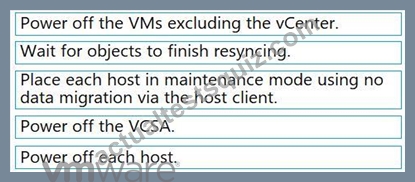
What is the correct power down sequence for shutting down all nodes in a vSAN cluster with vCenter on the vSAN datastore?
(Place the first selection in the sequence at the top of the list, followed by the second, and so on until the last selection is at the bottom of the list.)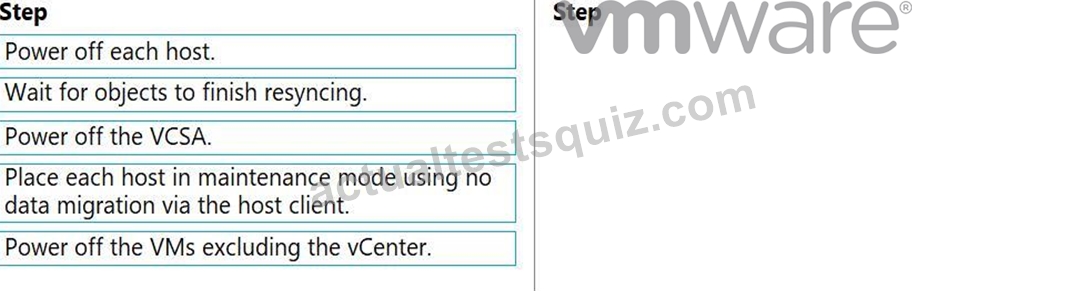
Answer:
Explanation: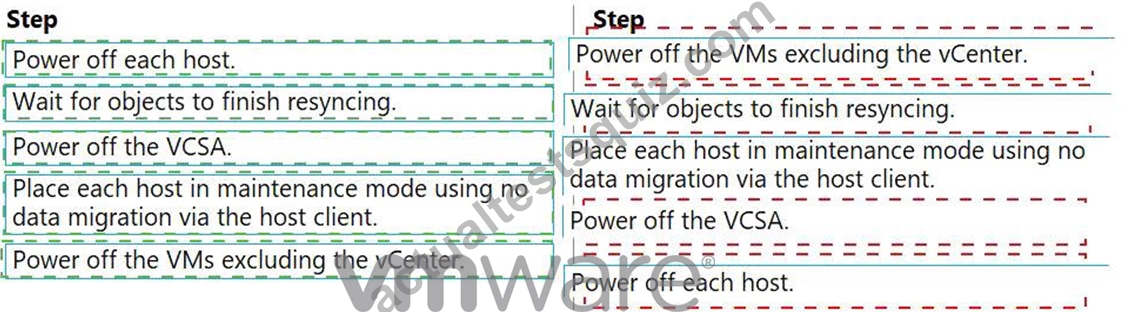
NEW QUESTION 37
The vSAN Health Check 'Hosts disconnected from vCenter Server' is reporting an error state for one host in the vSAN Cluster. All other health checks in the Network category are in a green state.
Which VMware recommended remediation task should be taken by the administrator?
- A. Configure a vSAN-enabled VMkernel port on the affected host.
- B. Right-click the affected host and click Connection > Connect.
- C. Restart the vSAN Management Daemon.
- D. Right-click the affected host and click Remove from Inventory.
Answer: C
NEW QUESTION 38
An architect is designing network high availability for a new vSAN Cluster.
Which is a supported configuration for this design?
D18912E1457D5D1DDCBD40AB3BF70D5D
- A. Configure multicast to use two separate network interfaces for vSAN traffic.
- B. Create an additional TCP/IP stack within the cluster and specify vSAN type.
- C. Use LACP on the distributed switch with a route based on IP hash algorithm.
- D. Create multiple VMkernel adapters on the same subnet for vSAN.
Answer: A
NEW QUESTION 39
A 4-node vSAN cluster has a single disk group per host. An administrator wants to increase the capacity of the vSAN datastore by adding a second disk group to each host in the cluster. The newer drives intended for the second disk group are certified and in compliance with VMware Compatibility Guide (VCG). However, the newer devices procured are of a different make and model than the existing disk group composition.
Considering the scenario, which statement is true?
- A. This configuration is supported, however a separate controller is mandatory for each disk vendor.
D18912E1457D5D1DDCBD40AB3BF70D5D - B. The Capacity Tier devices need to be the same make and model as other disk groups.
- C. This configuration is supported, however performance may vary across disk groups.
- D. The Cache Tier devices need to be the same make and model as other disk groups.
Answer: B
NEW QUESTION 40
Which Kubernetes component must be configured to allow for dynamic provisioning of container volumes on vSAN?
- A. vSphere Cloud Storage Plugin
- B. Cinder
- C. vSphere Container Storage Interface driver
- D. glusterfs
Answer: B
NEW QUESTION 41
The clomd service has stopped on 1 host in a 3-node vSAN cluster. All other services on the host, as well as the other 2, are healthy. Additionally, the unmodified vSAN Default Storage Policy is in use.
Which would be an expected outcome for a new VM deployed into the vSAN cluster?
- A. VM deployment will complete but performance will be degraded.
- B. VM deployment will be deferred by vCenter.
- C. VM deployment will fail.
- D. VM deployment will complete but VM IO will fail.
Answer: A
NEW QUESTION 42
During planned maintenance of a four-node vSAN cluster, an outsourced IT contractor accidentally removed a
2.5" SSD cache disk from one of the vSAN nodes. The storage policy has been configured with FTT=1 RAID 1, and the disk management UI marked the disk group as absent.
Which remediation steps should the administrator select to ensure VMs become compliant with the storage policy as soon as possible?
- A. enter host in maintenance > remove from disk group > shutdown host > replace disk > power on host
- B. replace the SSD cache disk > rescan > add disk back in disk group
- C. remove disk group > enter host in maintenance > fully evacuate all data > exit maintenance
- D. vSAN Health Check > retest > object health > repair objects immediately
Answer: B
Explanation:
Explanation/Reference:
NEW QUESTION 43
Which two must be considered when creating a vSAN solution that will utilize VMware vSphere Replication?
(Choose two.)
- A. Deduplication and compression must be disabled for PIT snapshots,
- B. AES-NI must be enabled prior to using snapshots for replication,
- C. vSAN Encryption cannot be used with vSphere Replication.
- D. Additional read I/O will be generated by vSphere Replication.
- E. Point-in-time snapshots count towards component limit.
Answer: C,D
NEW QUESTION 44
Refer to the exhibit: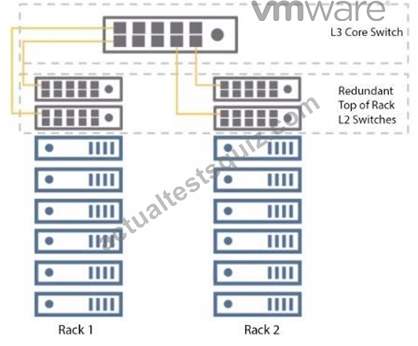
The vSAN Health service is reporting VSAN Cluster Partition' warning. The partition list shows all hosts from rack 1 in a single partition and all hosts from rack 2 in another partition.
Which hardware component requires investigation to resolve the cluster partition?
- A. core switch
- B. ToR switches
- C. vSAN Master node
- D. NICs on each host in Rack 2
Answer: B
NEW QUESTION 45
Which storage policy can be assigned to virtual machines In a 5-node, all flash vSAN cluster, to provide the highest level of redundancy?
- A. 2 failures - RAID-6 (Erasure Coding)
- B. 3 failures - RAID-1 (Mirroring)
- C. 1 failure - RAID-5 (Erasure Coding)
- D. 2 failures - RAID-1 (Mirroring)
Answer: C
NEW QUESTION 46
A hardware 10 controller manufacturer has released a new version of firmware which brings performance improvements to the controller that the vSAN disk group is currently using. The administrator would like to upgrade to the new firmware version.
Which action should the administrator perform?
- A. Check against the vSAN Compatibility Guide that this new firmware version Is certified and Install it with any certified driver.
- B. Install the latest version of vSphere before upgrading to the newest version of firmware.
- C. Install the new firmware as soon as possible after testing in his/her lab to take advantage of the performance improvements.
- D. Check against the vSAN Compatibility Guide for the correct certified firmware and driver combination and upgrade both firmware and driver.
Answer: C
NEW QUESTION 47
A vSAN administrator is working on a 4 host homogenous vSAN Cluster that has 2 disk groups per host. One of the hosts needs to be permanently removed and repurposed for some other use.
These are the out of order steps which need to be completed:
1. Delete the disk group(s) that reside on the host you want to decommission.
2. Wait for resync traffic to complete and the host to enter maintenance mode.
3. Ensure there is sufficient capacity in the vSAN disk groups to decommission a node.
4. Put the host into maintenance mode with full data migration selected.
5. Move the ESXi host out of the cluster.
What is the correct order?
- A. 4, 3, 2, 1, 5
- B. 3, 4, 2, 1, 5
- C. 3, 1, 4, 2, 5
- D. 4, 3, 2, 5, 1
Answer: B
NEW QUESTION 48
An infrastructure architect is submitting a proposal for a vSAN Cluster. These are the customer's requirements:
*Maximize the amount of usable capacity.
*Deduplication and compression will be enabled to help maximize usable capacity.
Which disk group configuration should the architect include in their design?
- A. Three disk groups with one flash device for cache and two flash devices for capacity per disk group.
- B. One disk group with one flash device for cache and six magnetic devices for capacity.
- C. Five disk groups with one flash device for cache and one magnetic device for capacity per disk group.
- D. One disk group with one flash device for cache and six flash devices for capacity.
Answer: B
NEW QUESTION 49
When designing a vSAN Cluster, which three should be considered when sizing a vSAN datastore? (Choose three.) D18912E1457D5D1DDCBD40AB3BF70D5D
- A. cache disks with 10% of the Disk Group
- B. capacity device queue depth
- C. On-Disk Format overheard
- D. Storage Policy or Policies to be used
- E. vSAN Slack Space
- F. endurance level of capacity disk used
Answer: B,D,E
NEW QUESTION 50
......
Verified 5V0-21.20 dumps Q&As Latest 5V0-21.20 Download: https://www.actualtestsquiz.com/5V0-21.20-test-torrent.html
