

FCP_ZCS_AD-7.4 Premium PDF & Test Engine Files with 91 Questions & Answers
Get 100% Real FCP_ZCS_AD-7.4 Exam Questions, Accurate & Verified Answers As Seen in the Real Exam!
NEW QUESTION # 27
Refer to the exhibit.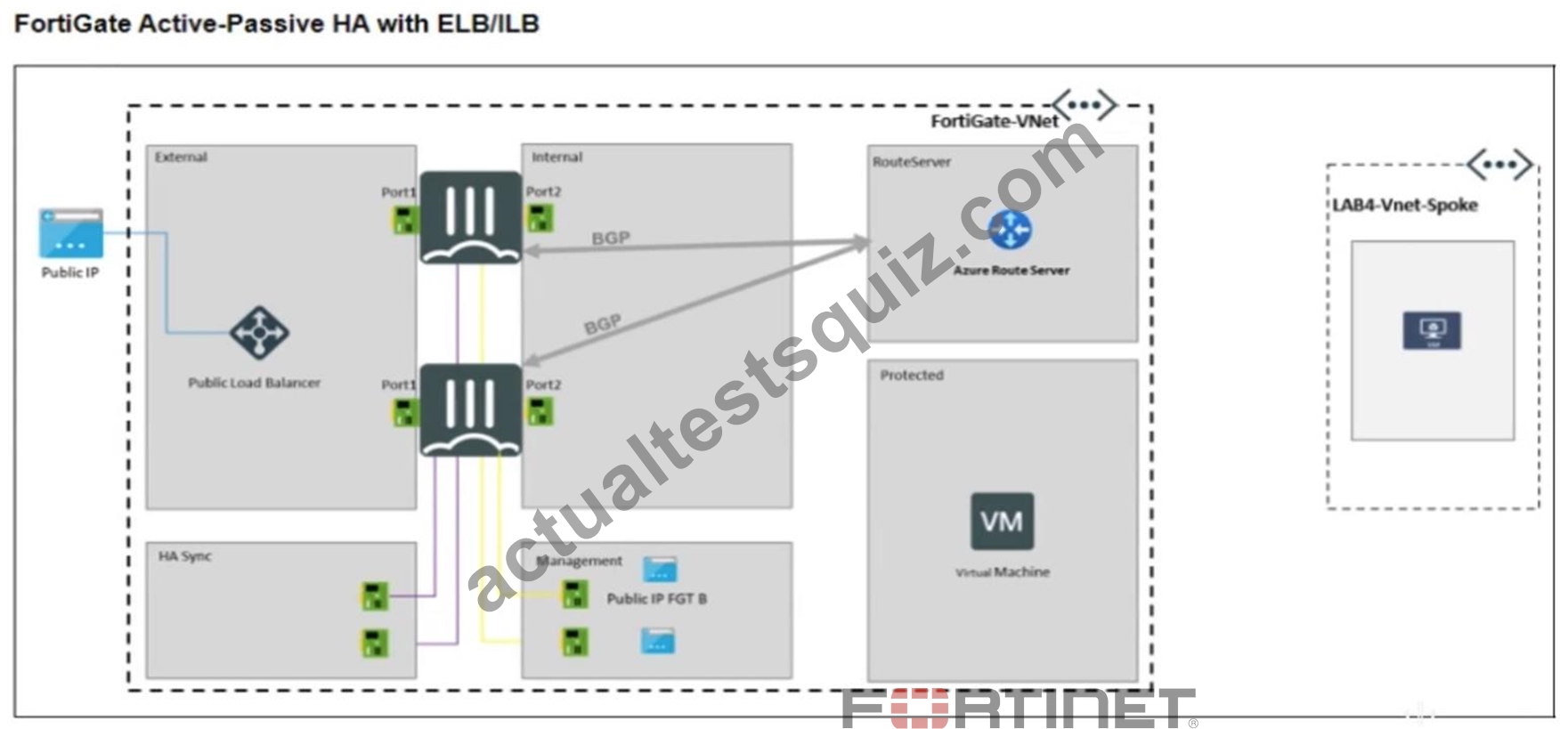
An Azure Route Server and an active-passive FortiGate with Elastic Load Balancing (ELB) and Internal Load Balancing (ILB) have been deployed successfully and they are sharing and populating BGP routes in the Protected VNet.
A Linux server has been deployed in a new VNet spoke. It is expected that Azure Route Server should inject the FortiGate BGP routes into the Linux server but that failed.
How can you diagnose the problem?
- A. Review FortiGate BGP neighbors
- B. Monitor effective routes on the Azure network interface (NIC) of the Linux server
- C. Verify the BGP setup on Azure Route Server
- D. Linux server doesn't support BGP negotiation with Azure Route Server
Answer: B
Explanation:
The Linux server in the spoke VNet cannot directly peer BGP with the Azure Route Server, as it is not a BGP-enabled device. Instead, Azure propagates routes to VMs through the effective route tables associated with their network interfaces (NICs). Therefore, to diagnose why BGP routes are not reaching the Linux VM, you should monitor the effective routes on the NIC to verify if the routes from the FortiGate (via the Route Server) are being injected properly.
NEW QUESTION # 28
Refer to the exhibit.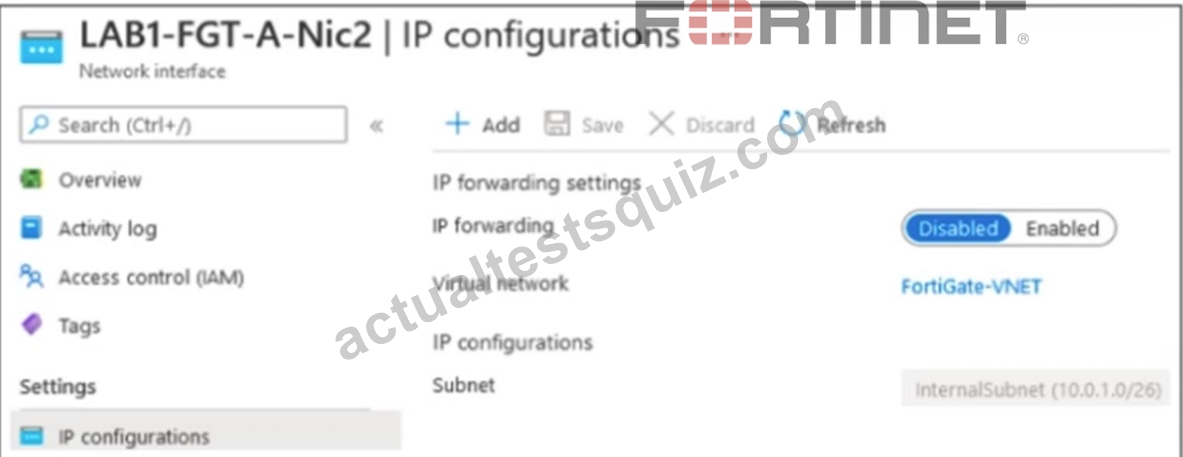
The exhibit shows some of the properties of a virtual NIC that is used by a FortiGate VM deployed in Azure.
The virtual NIC shown is connected to a subnet (10.0.1.0/26) with several VMs that will be accessing the internet through the FortiGate VM.
Which statement is true for this scenario?
- A. You must change the default gateway on the VMs in the Internal Subnet for this to work.
- B. The parameters of the virtual NIC are not configured correctly.
- C. The NIC in the exhibit needs to be assigned a public IP address.
- D. The VMs in the 10.0.1.0/26 subnet can access the internet through FortiGate.
Answer: A
Explanation:
For VMs in the 10.0.1.0/26 subnet to access the internet through the FortiGate VM, their default gateway must be changed to the internal IP address of the FortiGate's NIC in that subnet (e.g., LAB1-FGT-A-Nic2). This ensures traffic is routed through FortiGate for inspection and NAT, rather than directly using Azure's default system routes.
NEW QUESTION # 29
Refer to the exhibit.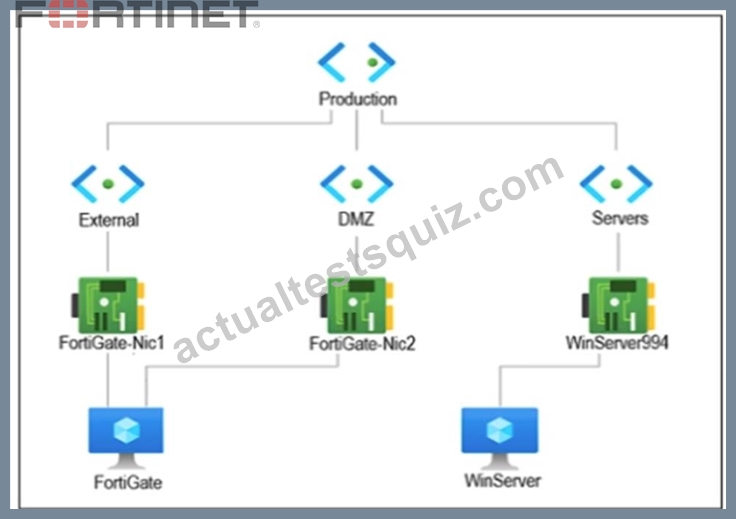
You are troubleshooting a network connectivity issue between two VMs that are deployed in Azure.
One VM is a FortiGate that has one interface in the DMZ subnet, which is in the Production VNet. The other VM is a Windows Server in the Servers subnet, which is also in the Production VNet. You cannot ping the Windows Server from the FortiGate VM.
What is the reason for this?
- A. You have not created a VPN to allow traffic between those subnets
- B. You have not configured a user-defined route for this traffic
- C. The firewall in the Windows VM is blocking the traffic
- D. By default, Azure does not allow ICMP traffic between subnets
Answer: C
Explanation:
The FortiGate VM and the Windows Server VM are in different subnets but within the same Production virtual network, which means they can communicate by default unless restricted. Azure allows ICMP between subnets, but Windows VMs have ICMP blocked by default in their firewall settings. Therefore, the likely reason for the ping failure is that the Windows Server's firewall is blocking ICMP (ping) traffic.
NEW QUESTION # 30
Which type of network virtual appliances (NVAs) are supported by Azure route servers?
Response:
- A. Any network appliance that supports Azure firewall manager.
- B. Any network appliance that supports IPsec VPN protocol.
- C. Any network appliance that supports BGP routing protocol.
- D. Any network appliance that supports Azure virtual WAN.
Answer: C
NEW QUESTION # 31
What feature of FortiGate''s Azure deployment is crucial for protecting against external threats?
Response:
- A. Load balancing
- B. Virtual patching
- C. Next-generation firewall capabilities
- D. Gateway antivirus
Answer: C
NEW QUESTION # 32
What characterizes the branch-to-branch topology in an Azure virtual WAN?
- A. Enhanced security through centralized traffic management
- B. Simplified network architecture with reduced hub dependencies
- C. Improved scalability for branch offices connecting to Azure
- D. Increased redundancy through multiple connections to the central hub
Answer: C
Explanation:
The branch-to-branch topology in Azure Virtual WAN is characterized by direct connectivity between branches through the Virtual WAN backbone, which reduces dependency on centralized hubs. This results in a simplified network architecture, lowering latency and optimizing routing between branch locations.
NEW QUESTION # 33
What capability does Azure Route Server provide to enterprise networks?
Response:
- A. Automated patch management
- B. Seamless route exchange with Azure virtual networks
- C. Intrusion detection and prevention
- D. Data lifecycle management
Answer: B
NEW QUESTION # 34
Which of the following is a benefit of deploying FortiGate within an Azure environment?
Response:
- A. Increased application runtime
- B. Localized data storage
- C. Reduced physical infrastructure costs
- D. Increased physical server security
Answer: C
NEW QUESTION # 35
What is the main purpose of FortiWeb in the context of web applications in Azure?
Response:
- A. To provide a secure content delivery network (CDN) for web applications.
- B. To automatically optimize network latency within Azure virtual networks
- C. To encrypt data at rest within Azure storage
- D. To offer web application firewall (WAF) capabilities for protection against web application attacks
Answer: D
NEW QUESTION # 36
After integrating a FortiGate VM with Azure Route Server, you detect that routes are not propagating successfully.
What initial step could you perform to diagnose the root cause?
- A. Verify that the FortiGate VM is running the latest firmware version
- B. Monitor the network latency between the FortiGate VM and Azure Route Server to identify potential communication delays affecting route propagation
- C. Examine the Azure Microsoft Entra ID permissions associated with the FortiGate VM to ensure that correct authentication is being used for BGP peering
- D. Verify the BGP peering status on both the FortiGate VM and Azure Route Server
Answer: D
Explanation:
The first and most direct diagnostic step is to verify the BGP peering status on both the FortiGate VM and Azure Route Server. If BGP peering is not established or is in an idle or down state, route propagation will fail. This check confirms whether the two systems are communicating and exchanging routes as expected.
NEW QUESTION # 37
In Azure, which of the following are considered scalable resources that can be adjusted based on demand?
(Choose Two)
Response:
- A. Virtual Networks
- B. Physical servers
- C. Compute instances
- D. Office software licenses
Answer: A,C
NEW QUESTION # 38
Which deployment model is suitable for deploying a FortiGate instance in Azure?
Response:
- A. Hybrid cloud
- B. Standalone Virtual Machine
- C. Fully isolated environment
- D. On-premises data center
Answer: B
NEW QUESTION # 39
What is the primary purpose of enabling the IP forwarding setting on FortiGate in Azure?
- A. To prevent source and destination checks on network interfaces
- B. To block incoming and outgoing network traffic
- C. To enable the VM to act as a router
- D. To disable network security group (NSG) rules
Answer: C
Explanation:
Enabling the IP forwarding setting on FortiGate (or any NVA) in Azure allows the VM to route traffic that is not destined for itself, effectively enabling it to act as a router or firewall. This is essential for scenarios where FortiGate inspects or filters traffic between subnets or from on-premises to Azure.
NEW QUESTION # 40
How does FortiGate enhance network security when integrated with Azure SDN?
Response:
- A. By managing virtual machine backups
- B. By enforcing security policies across virtual networks
- C. By providing endpoint security to Azure applications
- D. By optimizing web traffic
Answer: B
NEW QUESTION # 41
What component of Azure is primarily used to enhance data security and privacy through encrypted storage solutions?
Response:
- A. Azure Disk Storage
- B. Azure Blob Storage
- C. Azure Security Center
- D. Azure Key Vault
Answer: D
NEW QUESTION # 42
......
FCP_ZCS_AD-7.4 Premium Files Practice Valid Exam Dumps Question: https://www.actualtestsquiz.com/FCP_ZCS_AD-7.4-test-torrent.html
Practice with FCP_ZCS_AD-7.4 Dumps for Public Cloud Security Certified Exam Questions & Answer: https://drive.google.com/open?id=1925cxXmkLT7JZeMvpwRBU2Hge_bKEBeP
