

C-THR81-2411 Exam Questions - Real & Updated Questions PDF
Pass Guaranteed Quiz 2025 Realistic Verified Free SAP
NEW QUESTION # 32
What actions can you initiate from the Position Org chart?
Note: There are 3 correct answers to this question.
- A. Nominate a successor for a position
- B. Create a job requisition for a vacant position
- C. Mass copy positions
- D. Add a lower-level position
- E. Run a mass change to update positions
Answer: B,C,D
NEW QUESTION # 33
A business rule triggers a transfer event reason when an employee's location is changed. Which base object would you use for this business rule?
- A. Employee Information
- B. Job Information
- C. Job Information Model
- D. Employee Information Model
Answer: C
Explanation:
When creating a business rule to trigger a transfer event reason upon a location change, the Job Information Model is the correct base object. This is because location is a field within the Job Information entity, and changes to fields within this entity are best handled using the Job Information Model base object for related rules.
NEW QUESTION # 34
How should you build the IF condition to indentify the user when the employee is updating their own Personal Information?
- A.

- B.

- C.

- D.

Answer: A
NEW QUESTION # 35
Which of the following are examples of standard one-to-one associations?
Note: There are 2 correct answers to this question.
- A. Department to Division
- B. Pay Range to Legal Entity
- C. Location to Geozone
- D. Location to Legal Entity
Answer: B,C
NEW QUESTION # 36
Which object requires entity-type to be configured in HRIS sync mapping?
- A. compInfo
- B. phoneInfo
- C. personInfo
- D. jobinfo
Answer: B
NEW QUESTION # 37
What is generic object foTranslation used for in SAP SuccessFactors Employee Central?
- A. To translate MDF FO field labels
- B. To translate XML and MDF FO field labels
- C. To translate XML FO field labels
- D. To translate any generic object field labels in the instance
Answer: A
NEW QUESTION # 38
Which mathematical formula must be set in the THEN condition to meet the Jobinfo_FTE_Comp rule requirement?
- A. (Base Salary/Previous FTE Value) X Current FTE Value
- B. (Base Salary/Current FTE Value) X Previous FTE Value
- C. (Previous FTE Value - Current FTE Value) X Base Salary
- D. (Current FTE Value-Previous FTE Value)/Base Salary
Answer: A
NEW QUESTION # 39
How do you configure alert recipients?
- A. Recipients are configured within the EC Alerts business rule.
- B. Recipients are configured in Manage Data.
- C. Recipients are configured as workflow contributors.
- D. Recipients are configured as workflow approvers.
Answer: D
NEW QUESTION # 40
Which of the following API types does SAP recommend to use to achieve clean core integrations? Note:
There are 2 correct answers to this question.
- A. Data
- B. RFC
- C. SOAP
- D. IDoc
Answer: A,C
Explanation:
SAP recommends using SOAP APIs and Data APIs for clean core integrations.
* SOAP APIs: Provide a structured, standardized method of communication for integrations, especially suitable for real-time and synchronous processes.
* Data APIs: Enable smooth data exchange and are preferred for achieving non-intrusive clean core integrations.
* Other methods like IDoc and RFC are older technologies that might compromise the clean core principles by requiring deeper system customizations.
NEW QUESTION # 41
In which order must you assign the rules?
- A. ERD1, ERD2, ERD3, ERD-Catch, WFD
- B. ERD-Calch, ERD1, ERD2, ERD3, WFD
- C. ERD1, ERD2, ERD3, WFD, ERD-Catch
- D. WFD, ERD1, ERD2, ERD3, ERD-Catch
Answer: A
NEW QUESTION # 42
What does SAP SuccessFactors recommend when you create custom associations between foundation objects (FO)?
- A. All custom associations should be built between an XML FO and another XML FO.
- B. All custom associations should be built between an MDF FO and another MDF FO.
- C. All custom associations should be built as one-to-one.
- D. All custom associations should be built as one-to-many.
Answer: D
NEW QUESTION # 43
Due to confidentiality reasons, when the HR Business Partner (maintained in Job Relationship) is creating a change in salary for an employee, this action will need to be approved by the manager of the HR Business Partner creating the request.
How do you define this in the workflow when filling in the Approver Type, Approver Role, Context, and Relationship to Approver? Refer to the screenshot to answer the question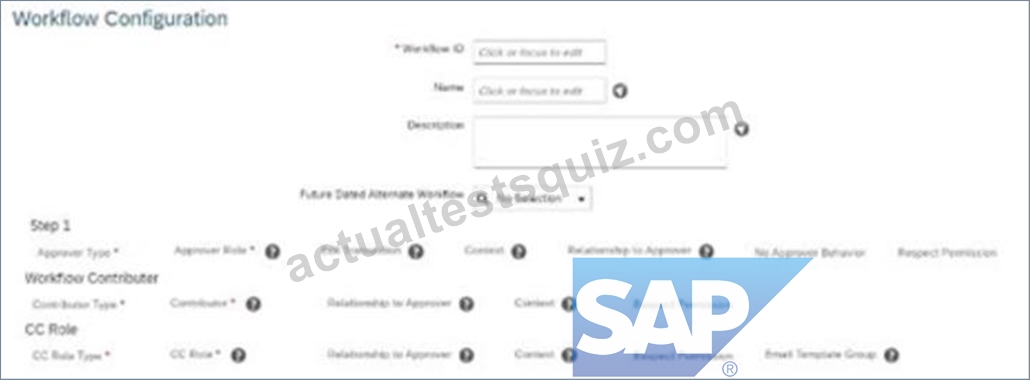
- A. By selecting in Step 1: Role - Employee HR-Source- Initiator
- B. By selecting in Step 1: Role - Employee HR - Source - Employee
- C. By selecting in Step 1: Role - Manager - Source - Initiator
- D. By selecting in Step 1:Role - Self-Source - Initiator
Answer: C
Explanation:
To ensure that the salary change initiated by the HR Business Partner is approved by their manager, you need to configure the workflow with the following details:
* Approver Type: Manager
* Approver Role: Manager
* Context: Initiator (this ensures the approval request is routed to the manager of the person initiating the workflow).
* Relationship to Approver: From the initiator's position, the system derives the relationship to their manager.
SelectingRole: Manager - Source: Initiatorin Step 1 aligns with these requirements.
Scenario 2: Approvals for Self-Service
NEW QUESTION # 44
Due to confidentiality reasons, when the HR Business Partner (maintained in Job Relationship) is creating a change in salary for an employee, this action will need to be approved by the manager of the HR Business Partner creating the request.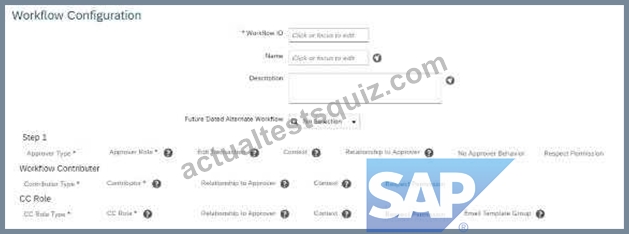
- A. By selecting in Step 1: Role - Self-Source - Initiator
- B. By selecting in Step 1: Role - Employee HR-Source- Initiator
- C. By selecting in Step 1: Role - Employee HR - Source - Employee
- D. By selecting in Step 1: Role - Manager - Source - Initiator
Answer: D
NEW QUESTION # 45
What properties are available when using model base objects in business rules? Note: There are 3 correct answers to this question.
- A. PII
- B. Previous Value
- C. Required
- D. Max-length
- E. Visibility
Answer: B,C,E
Explanation:
When working with model base objects in SAP SuccessFactors Employee Central business rules, the following properties are available:
* B. Visibility
* Visibility determines whether a field is displayed or hidden based on business rules. This is critical for maintaining data confidentiality or streamlining user interfaces.
* C. Previous Value
* This property allows rules to compare the current value of a field with its previous value, enabling conditional logic for actions such as triggering notifications or workflows.
* E. Required
* Required indicates whether a field must be populated before a record can be saved. Business rules can enforce data completeness using this property.
A: PII (Personally Identifiable Information) and D. Max-length are not applicable properties for business rules in the context of model base objects.
NEW QUESTION # 46
Which HRIS elements share the same People Profile block?
Note: There are 2 correct answers to this question.
- A. personInfo and globalinfo
- B. jobinfo and organizationInfo
- C. personalinfo and globalinfo
- D. compInfo and payComponentRecurring
Answer: C,D
NEW QUESTION # 47
Which object supports &&NO_OVERWRITE&& in imports? Note: There are 2 correct answers to this question.
- A. Addresses
- B. Job History
- C. Job Relationships
- D. Employment Details
Answer: B,D
NEW QUESTION # 48
Which HRIS elements share the same People Profile block? Note: There are 2 correct answers to this question.
- A. personInfo and globalinfo
- B. jobinfo and organizationInfo
- C. personalinfo and globalinfo
- D. compInfo and payComponentRecurring
Answer: C,D
Explanation:
In SAP SuccessFactors Employee Central, the People Profile is designed to consolidate related HRIS elements into cohesive blocks for streamlined data management. Specifically, the compInfo (Compensation Information) and payComponentRecurring (Recurring Pay Components) HRIS elements share the same People Profile block. Similarly, the personalinfo (Personal Information) and globalinfo (Global Information) HRIS elements are grouped together within the People Profile. This structured grouping enhances the user experience by providing a unified view of related employee information.
NEW QUESTION # 49
How do you set the Event Reason Derivation rule to ensure event reasons are NOT overwritten?
- A. Set the IF statement to check if the event reason value is NULL and set the THEN statement as blank.
- B. Set the IF statement to check if the event reason value is blank and set the THEN statement to NULL.
- C. Set the IF statement to check if the event reason value is NOT NULL and set the THEN statement as blank.
- D. Set the IF statement to Always True and set the THEN statement as blank.
Answer: D
NEW QUESTION # 50
What are some of the position management application-specific rule scenarios? Note: There are 3 correct answers to this question.
- A. Trigger Rules for Off Cycle Event Batch
- B. Create Right to Return for Incumbent
- C. Update Rule for Mass Change Run
- D. Trigger Rules to Calculate Full-Time Equivalent
- E. Derive Job Requisition Template in Recruiting Integration
Answer: B,C,D
Explanation:
Application-specific rule scenarios in Position Management include:
* A. Create Right to Return for Incumbent:
* This rule supports the creation of a right-to-return record for an incumbent when a position- related action occurs, such as a temporary assignment.
* B. Update Rule for Mass Change Run:
* This rule automates updates during mass position changes, ensuring consistent application of business logic across multiple positions.
* C. Trigger Rules to Calculate Full-Time Equivalent:
* This rule calculates the FTE value based on position or job information attributes, ensuring accurate reporting and compliance.
These rules enhance the flexibility and functionality of position management processes.
NEW QUESTION # 51
Which condition must be used for the jobinfo_FTE_Comp rule?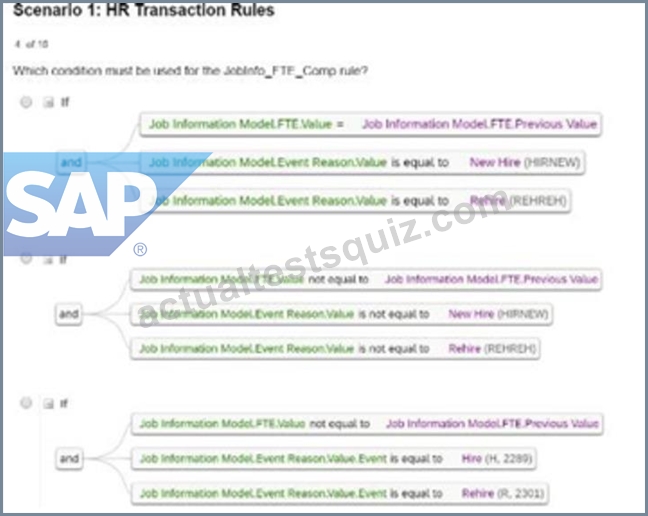
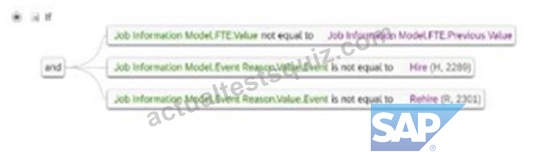
- A. Option C
- B. Option A
- C. Option D
- D. Option B
Answer: C
Explanation:
For theJobinfo_FTE_Comprule, the correct condition to use isOption D. This ensures that the system evaluates changes in FTE values and event reasons to calculate and adjust compensation data accordingly.
The precise conditions are necessary to maintain consistency in how the rule is applied across various HR scenarios.
Scenario 1: HR Transaction Rules
NEW QUESTION # 52
Which object requires entity-type to be configured in HRIS sync mapping?
- A. compInfo
- B. phoneInfo
- C. personInfo
- D. jobinfo
Answer: B
Explanation:
When configuring HRIS sync mappings in SAP SuccessFactors Employee Central, the phoneInfo (Phone Information) object requires the entity-type attribute to be specified. This attribute distinguishes between different types of phone numbers, such as business or personal, ensuring that each phone number is correctly categorized and synchronized within the system. Accurate configuration of the entity-type is essential for maintaining the integrity of contact information across the platform.
NEW QUESTION # 53
What is the recommended practice to start the event reason derivation rules?
- A. The first IF clause must be set to Always True.
- B. The first IF clause must check if the event reason value is NULL, then skip the event reason derivation.
- C. The first IF clause must check if the event reason value is NULL, then skip the event reason derivation.
- D. The first IF clause must be blank
Answer: B
NEW QUESTION # 54
How does the system validate the destination object for composite associations?
- A. The system validates if the destination object has effective dating set to Basic.
- B. The system validates if the destination object has effective dating set to From Parent.
- C. The system validates if the destination object has effective dating set to None.
- D. The system validates if the destination object has effective dating set to Multiple Changes Per Day.
Answer: B
NEW QUESTION # 55
Which events are NOT supported by event reason derivation? Note: There are 2 correct answers to this question.
- A. Transfer
- B. Data change
- C. Termination
- D. Hire
Answer: C,D
NEW QUESTION # 56
Which destination objects do you select for the Valid When and Composite associations? Note: There are 2 correct answers to this question.
- A. Valid When association - Higher level object
- B. Valid When association - Lower level object
- C. Composite association - Child object
- D. Composite association - Parent object
Answer: A,C
Explanation:
Valid When Association:
* This is used to define conditional relationships and is applied to higher-level objects.
Composite Association:
* This is used to create parent-child relationships, where the child object is the destination.
NEW QUESTION # 57
......
SAP C-THR81-2411 Exam Syllabus Topics:
| Topic | Details |
|---|---|
| Topic 1 |
|
| Topic 2 |
|
| Topic 3 |
|
| Topic 4 |
|
| Topic 5 |
|
Get to the Top with C-THR81-2411 Practice Exam Questions: https://www.actualtestsquiz.com/C-THR81-2411-test-torrent.html
Free SAP Certified Associate C-THR81-2411 Ultimate Study Guide: https://drive.google.com/open?id=1LrGM8tJO7JKayr4UvVBOnjRYk8UP_xR3
