

[Aug-2026] Verified Salesforce Exam Dumps with JavaScript-Developer-I Exam Study Guide
Best Quality Salesforce JavaScript-Developer-I Exam Questions ActualTestsQuiz Realistic Practice Exams [2026]
NEW QUESTION # 27
Given the requirement to refactor the code above to JavaScript class format, which class definition is correct?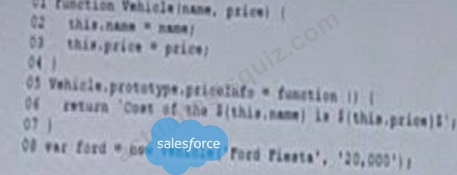
A)
B)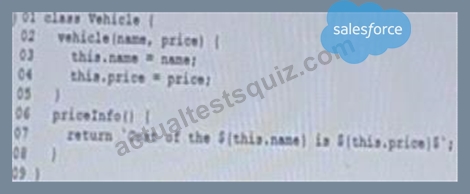
C)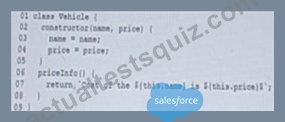
D)
- A. Option D
- B. Option A
- C. Option C
- D. Option B
Answer: B
NEW QUESTION # 28
A developer has the function, shown below, that is called when a page loads.
Where can the developer see the log statement after loading the page in the browser?
- A. Terminal running the web server.
- B. Browser javaScript console
- C. Browser performance tools
- D. On the webpage
Answer: B
NEW QUESTION # 29
A developer implements a function that adds a few values.
Function sum(num) {
If (num == undefined) {
Num =0;
}
Return function( num2, num3){
If (num3 === undefined) {
Num3 =0 ;
}
Return num + num2 + num3;
}
}
Which three options can the developer invoke for this function to get a return value of 10 ?
Choose 3 answers
- A. Sum () (20)
- B. sum() (5, 5)
- C. sum(5)(5)
- D. sum(10) ()
- E. Sum (5, 5) ()
Answer: B,C
NEW QUESTION # 30
Refer to the following object.
How can a developer access the fullName property for dog?
- A. Dog.fullName ( )
- B. Dog, get, fullName
- C. Dog.fullName
- D. Dog, function, fullName
Answer: C
NEW QUESTION # 31
Refer to the code below: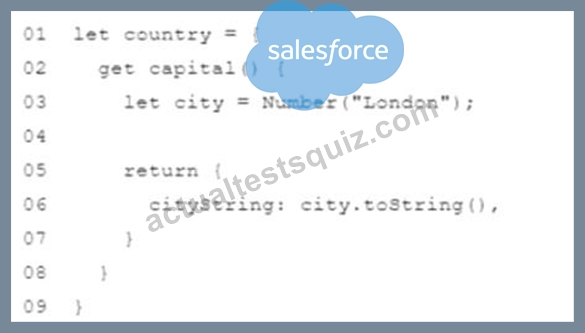
Which value can a developer expect when referencing country,capital,cityString?
- A. 'London'
- B. An error
- C. 'NaN'
- D. undefined
Answer: C
NEW QUESTION # 32
Refer to the code below: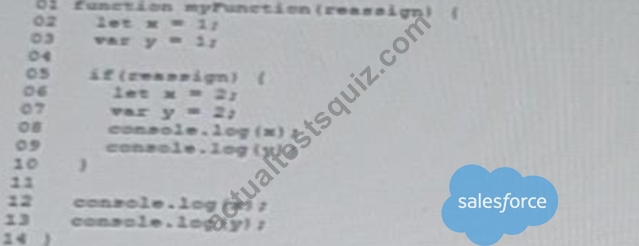
What is displayed when myfunction(true) is called?
- A. 2 2 1 2
- B. 2 2 1 1
- C. 2 2 undefined undefined
- D. 2 2 2 2
Answer: B
NEW QUESTION # 33
A developer has a web server running with Node.js. The command to start the web server is node server.js. The web server started having
latency issues. Instead of a one second turnaround for web requests, the developer now sees a five second turnaround.
Which command can the web developer run to see what the module is doing during the latency period?
- A. NODE_DEBUG=http,https node server.js
- B. NODE_DEBUG=true node server.js
- C. DEBUG=true node server.js
- D. DEBUG=http, https node server.js
Answer: C
NEW QUESTION # 34
A Node.js server library uses events and callbacks. The developer wants to log any issues the server has at boot time.
Which code logs an error with an event?
- A. server.on( ' error ' , (error) = > {
console.log( ' ERROR ' , error);
}); - B. server.error( ' error) = > {
console.log( ' ERROR ' , error);
}); - C. server.catch( ' error) = > {
console.log( ' ERROR ' , error);
}); - D. try {
server.start();
} catch(error) {
console.log( ' ERROR ' , error);
}
Answer: A
Explanation:
Node.js event-based modules use the EventEmitter pattern.
The correct syntax for listening to events is:
emitter.on( ' eventName ' , callback)
The server library emits an ' error ' event, which must be listened to using .on.
Option analysis:
* A: .catch is for Promises, not EventEmitters.
* B: .error is not an EventEmitter method.
* C: Correct. Listens to the ' error ' event.
* D: try...catch only captures synchronous errors, not event-based asynchronous errors.
Therefore, the correct answer is option C .
JavaScript Knowledge References (text-only)
* The EventEmitter API uses on(event, handler) to listen for events.
* Errors emitted asynchronously cannot be caught with try...catch.
* The ' error ' event is standard for Node.js modules to signal operational errors.
NEW QUESTION # 35
Given the HTML below:
Which statement adds the priority-account CSS class to the Unversal Containers row?
- A. Document. querySelectorAll ( '# row-uc ') .classList. add ('priority-account');
- B. Document. querySelector ( 'row-uc') . classList. Add ( 'pariority-account') ;
- C. Document. getElementById ( 'row-uc') addClass ( ' priority-account');
- D. Document. queryselector ('# row-uc') ,classes. Push (' priority-account');
Answer: B
NEW QUESTION # 36
A developer writes the code below to calculate the factorial of a given number function sum(number){ return number * sum(number-1);
}
sum(3);
what is the result of executing the code.
- A. 0
- B. -Infinity
- C. Error
- D. 1
Answer: C
NEW QUESTION # 37
Refer to the code below:
What is the result of running line 05?
- A. Only apromise runs.
- B. Apromise and bpromise run in parallel.
- C. Neither aPromise or bPromise runs.
- D. aPromise and bPromise run sequentially.
Answer: C
NEW QUESTION # 38
Given the JavaScript below: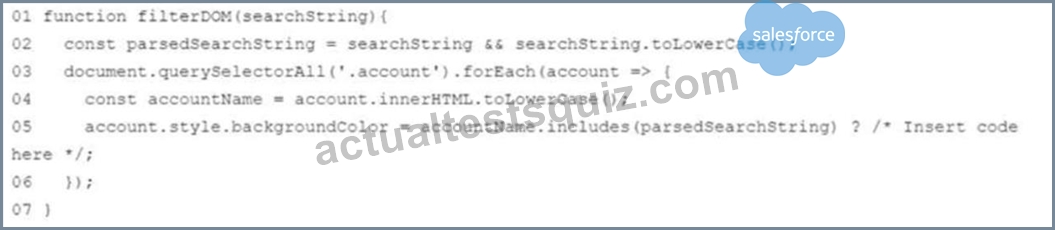
Which code should replace the placeholder comment on line 05 to highlight accounts that match the search string'
- A. 'yellow' : null
- B. 'yellow : 'none'
- C. null : 'yellow'
- D. 'none1 : "yellow'
Answer: B
NEW QUESTION # 39
Original code:
01 let requestPromise = client.getRequest;
03 requestPromise().then((response) = > {
04 handleResponse(response);
05 });
The developer wants to gracefully handle errors from a Promise-based GET request.
Which code modification is correct?
- A. Use finally handler for errors
- B. (duplicate of A)
- C. Add .catch to the Promise chain
- D. try/catch around requestPromise().then(...)
Answer: C
Explanation:
Key JavaScript Promise rule:
try...catch does not catch asynchronous errors that occur in Promise chains.
Therefore, the correct way to handle errors in a Promise is:
promise.then(...).catch(...);
Analysis of options:
* A and B: Both wrap asynchronous code in try...catch, which does not catch Promise rejections. try...
catch only catches errors thrown synchronously inside the block.
* C: Correct. A .catch() on the Promise chain handles any error from the Promise returned by requestPromise().
* D: .finally() executes regardless of success or failure, but it does not receive the error object , so it cannot handle the error.
Thus the only valid solution is option C .
JavaScript Knowledge References (text-only)
* Promise rejections must be handled with .catch().
* try...catch only handles synchronous code.
* .finally() does not receive a rejection reason.
NEW QUESTION # 40
Which statement accurately describes the behaviour of the async/ await keyworks ?
- A. The associated function will always return a promise
- B. The associated sometimes returns a promise.
- C. Theassociated function can only be called via asynchronous methods
- D. The associated class contains some asynchronous functions.
Answer: B
NEW QUESTION # 41
Refer to the following code: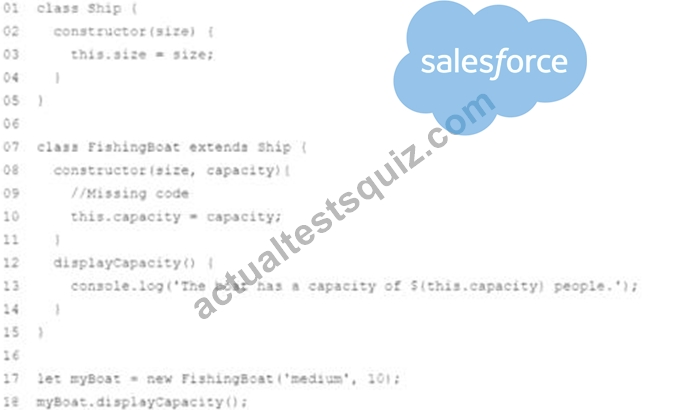
Which statement should be added to line 09 for the code to display. The boat has a capacity of 10 people?
- A. ship.size size;
- B. this.size = size;
- C. super (size);
- D. super.size = size;
Answer: B
NEW QUESTION # 42
A developer tries to retrieve all cookies, then sets a certain key value pair in the cookie. These statements are used:
What is the behavior?
- A. Cookies are not read because line 01 should be document, cookies, but the key value is set and all cookies are wiped.
- B. A Cookies are read andthe key value is set, the remaining cookies are unaffected.
- C. Cookies are read and the key value is set, and all cookies are wiped.
- D. Cookies are read, but the key value is not set because the value is not URL encoded.
Answer: B
NEW QUESTION # 43
......
Salesforce Certified JavaScript Developer I exam is a computer-based test that consists of 60 multiple-choice questions that the candidates need to complete within 105 minutes. JavaScript-Developer-I exam is designed to assess the candidate's understanding of the key aspects of JavaScript development on the Salesforce platform, including the architecture of Salesforce Lightning, the Apex programming language, and the use of Visualforce and other web technologies.
Authentic Best resources for JavaScript-Developer-I: https://www.actualtestsquiz.com/JavaScript-Developer-I-test-torrent.html
JavaScript-Developer-I Test Engine Practice Exam: https://drive.google.com/open?id=10zfXl3t7z31EvLb3MkH-cTTHQ3d_TG-Q
