

[Aug-2026] Free Financial-Management Exam Questions Financial-Management Actual Free Exam Questions
Verified Financial-Management dumps and 86 unique questions
NEW QUESTION # 43
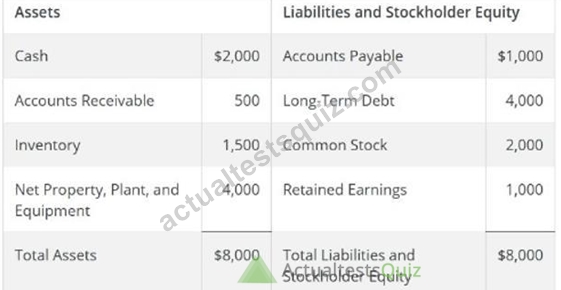
Use Whole Pine Inc.'s financial statements for 20X3 below to answer the following question.
What is Whole Pine Inc.'squick ratiofor 20X3?
- A. 0.65
- B. 4.00
- C. 0.15
- D. 2.50
Answer: D
Explanation:
The quick ratio, also known as the acid-test ratio, measures a firm's ability to meet short-term obligations using its most liquid assets. It is calculated as:
(Cash + Accounts Receivable + Marketable Securities) ÷ Current Liabilities.
For Whole Pine Inc., quick assets include cash of $2,000 and accounts receivable of $500, totaling
$2,500. Inventory is excluded because it is less liquid and may not be easily converted into cash.
Current liabilities consist of accounts payable of $1,000. Dividing $2,500 by $1,000 yields a quick ratio of 2.50. This indicates that the firm has $2.50 in highly liquid assets for every $1.00 of short-term obligations, suggesting strong short-term liquidity. Option C correctly reflects this calculation and interpretation.
NEW QUESTION # 44
How does country risk affect global financial management decisions?
- A. It necessitates strategies to mitigate potential losses from instability or unfavorable policies.
- B. It is typically considered irrelevant in financial planning since it is unpredictable.
- C. It only affects firms with domestic operations facing international competition.
- D. It reduces the complexity of international investments.
Answer: A
Explanation:
Country risk refers to the possibility that political, economic, legal, or social conditions in a foreign country will negatively affect a firm's operations and cash flows. In global financial management, this risk directly influences investment appraisal, financing choices, and risk management policies. For capital budgeting, higher country risk can lower expected cash flows (e.g., through capital controls, expropriation risk, supply disruptions, or taxation changes) and/or increase the discount rate applied to foreign projects. For financing, lenders and investors demand higher returns in riskier jurisdictions, affecting borrowing costs and feasible capital structures. Firms respond by using mitigation strategies such as diversification across countries, contractual protections, political risk insurance, careful partner selection, staging investments, and hedging currency exposures when relevant. Country risk also drives decisions about where to locate production, how to structure subsidiaries, and whether to denominate contracts and debt in local or hard currencies. Because country conditions can materially change expected outcomes, it is a core planning input rather than irrelevant or simplifying, making option A the correct statement.
NEW QUESTION # 45
Why might a firm use a combination of methods to calculate the cost of common equity?
- A. To account for one method being significantly more complex
- B. To comply with regulatory requirements
- C. To achieve a more accurate and comprehensive estimate
- D. To focus exclusively on dividend policies
Answer: C
Explanation:
No single model perfectly estimates the cost of common equity under all conditions. CAPM focuses on systematic risk, the Gordon growth model emphasizes dividends and growth, and other approaches may rely on market comparables. Each method has strengths and weaknesses depending on firm characteristics and market conditions. Financial management best practice therefore recommends using multiple approaches and comparing results to arrive at a more reliable estimate. This triangulation reduces model-specific bias and highlights potential inconsistencies in assumptions.
Managers then apply judgment to select a reasonable cost of equity that reflects risk, growth prospects, and investor expectations. Option A correctly reflects this practical, widely accepted approach.
NEW QUESTION # 46
Why might a firm use a combination of methods to calculate the cost of common equity?
- A. To account for one method being significantly more complex
- B. To comply with regulatory requirements
- C. To achieve a more accurate and comprehensive estimate
- D. To focus exclusively on dividend policies
Answer: C
Explanation:
No single model perfectly estimates the cost of common equity under all conditions. CAPM focuses on systematic risk, the Gordon growth model emphasizes dividends and growth, and other approaches may rely on market comparables. Each method has strengths and weaknesses depending on firm characteristics and market conditions. Financial management best practice therefore recommends using multiple approaches and comparing results to arrive at a more reliable estimate. This triangulation reduces model-specific bias and highlights potential inconsistencies in assumptions.
Managers then apply judgment to select a reasonable cost of equity that reflects risk, growth prospects, and investor expectations. Option A correctly reflects this practical, widely accepted approach.
NEW QUESTION # 47
What is the relationship between the length of the cash cycle and the amount of cash a firm needs to operate?
- A. Shorter cash cycles require more cash to handle rapid transactions.
- B. A longer cash cycle reduces the need for operational cash due to increased efficiency.
- C. Companies must keep more cash on hand if they maintain a longer cash cycle.
- D. The cash cycle length has no impact on operational cash needs.
Answer: C
Explanation:
The cash conversion cycle measures the time between cash outflows for production and cash inflows from customer payments. A longer cash cycle means that cash is tied up for a longer period in inventory and receivables before being recovered through sales. As a result, firms with longer cash cycles require larger cash balances or greater access to short-term financing to support ongoing operations. Financial managers aim to shorten the cash cycle by improving inventory turnover, accelerating collections, and managing payables efficiently. Option D correctly reflects this fundamental relationship emphasized in working capital management.
NEW QUESTION # 48
What is the goal of just-in-time (JIT) inventory management?
- A. To extend the cash conversion cycle
- B. To increase the quantity of on-hand inventory
- C. To maximize the storage space utilized
- D. To minimize holding costs by reducing inventory levels
Answer: D
Explanation:
Just-in-time (JIT) inventory management aims to minimize inventory levels by synchronizing production and deliveries closely with demand. By receiving materials only when needed, firms reduce holding costs such as storage, insurance, spoilage, and obsolescence. JIT also improves cash flow by freeing capital previously tied up in inventory and shortening the cash conversion cycle. Financial management literature highlights JIT as a strategy that enhances efficiency but requires reliable suppliers and precise demand forecasting. Option B accurately captures the core objective of JIT systems.
NEW QUESTION # 49
What is systematic risk in the capital asset pricing model (CAPM)?
- A. The market-wide risk that affects all securities
- B. The risk associated with specific companies
- C. The risk associated with poor diversification
- D. The risk of losing the entire investment
Answer: A
Explanation:
Systematic risk is the portion of total risk that affects the entire market or a broad group of securities and cannot be eliminated through diversification. It arises from economy-wide factors such as changes in interest rates, inflation, recessions, geopolitical events, and overall market sentiment. In the Capital Asset Pricing Model, systematic risk is the only type of risk for which investors are compensated because unsystematic, or firm-specific, risk can be diversified away by holding a well-balanced portfolio. Choice D is correct because it defines systematic risk as market-wide risk that influences virtually all securities to some degree. Choice C refers to company-specific risk, which is unsystematic risk. Choice B is incorrect because poor diversification may leave an investor exposed to more firm-specific risk, but that does not define systematic risk itself.
Choice A is far too extreme and does not capture the finance definition. Financial management uses the CAPM framework to connect systematic risk to required return through beta, which measures a security's sensitivity to movements in the market portfolio. Therefore, D is the correct answer because systematic risk is broad market risk that cannot be removed through diversification.
========
NEW QUESTION # 50
Rusty RoboTech, a robotics technology company, has provided the following financial information for the year 20X3:
* Sales Revenue: $500,000
* Net Income: $50,000
* Dividend Payout: 40% of Net Income
* Total Assets at the beginning of 20X3: $300,000
* Total Liabilities at the beginning of 20X3: $150,000
* Equity at the beginning of 20X3: $150,000
* Historical Cash-to-Sales Ratio: 5%
* Accounts Receivable-to-Sales Ratio: 15%
* Inventory-to-Sales Ratio: 25%
* Cost of Goods Sold-to-Sales Ratio: 43%
For the year 20X4, Rusty RoboTech projects a 20% increase in sales revenue. Other ratios and the dividend policy are expected to remain the same.
What is the projected inventory value for Rusty RoboTech at the beginning of 20X4?
- A. $140,000
- B. $130,000
- C. $150,000
- D. $120,000
Answer: C
Explanation:
Projected sales for 20X4 equal $500,000 × 1.20 = $600,000. With the inventory-to-sales ratio expected to remain constant at 25%, projected inventory equals 25% of projected sales. Thus, inventory = 0.25 ×
$600,000 = $150,000. This approach reflects common financial planning techniques where balance sheet items are forecast using stable ratios tied to sales growth. Such pro forma analysis helps managers anticipate future asset needs and financing requirements. Option D correctly applies the inventory-to- sales ratio to projected sales.
NEW QUESTION # 51
A building owner is undertaking a weatherization project. The owner will make a one-time investment of
$410,000 for caulking, sunshades, and smart thermostats. Annual utility savings are projected to be:
* Year 1: $125,000
* Year 2: $125,000
* Year 3: $140,000
* Year 4: $140,000
* Year 5: $160,000
What is thepayback period, in years?(Round up)
- A. 0
- B. 1
- C. 2
- D. 3
Answer: D
Explanation:
The payback period measures how long it takes for a project's cumulative cash inflows to recover the initial investment. It is a simple capital budgeting technique commonly used as a preliminary screening tool.
Although it does not account for the time value of money or cash flows beyond the cutoff period, it is useful for assessing liquidity and risk exposure.
Cumulative cash flows are calculated as follows:
* End of Year 1: $125,000
* End of Year 2: $250,000
* End of Year 3: $390,000
* End of Year 4: $530,000
The initial investment of $410,000 is recovered sometime during Year 4. Because the question instructs to round up, the payback period is reported as 4 years. Financial management textbooks emphasize that while payback should not be used alone to accept or reject projects, it provides insight into how quickly invested capital is recovered, which is especially relevant for projects with uncertainty or liquidity constraints.
NEW QUESTION # 52
Synesthor is a company developing artificial intelligence (AI) to improve the searchability of medical research and make it easier for physicians to access the best knowledge for healthcare. As the company is setting its key objectives for the next period, it recognizes there are many stakeholders it serves.
If Synesthor focuses on what has traditionally been the primary goal of most companies, where will Synesthor center its efforts?
- A. Focusing solely on customer satisfaction
- B. Expanding the company globally
- C. Maximizing shareholder value
- D. Increasing employee satisfaction
Answer: C
Explanation:
Traditional corporate finance defines the primary objective of most firms-especially publicly held corporations-as maximizing shareholder wealth (shareholder value). This goal is operationalized by making decisions that increase the present value of expected future cash flows available to owners, adjusted for risk. While stakeholders such as employees, customers, communities, and regulators matter, the "shareholder value" framework treats them as critical constraints and drivers of long-term cash flow rather than the ultimate objective itself. For example, investing in employee satisfaction can improve productivity and retention; investing in customer satisfaction can increase revenues and reduce churn; and expanding globally can open new markets. However, under the traditional view, these actions are chosen because they enhance long-run free cash flow or reduce risk-thereby raising firm value-rather than because they are the final goal. In practice, managers translate this objective into measurable targets: profitable growth, margin improvement, efficient capital allocation, and disciplined investment appraisal (positive NPV projects). Therefore, the most accurate answer is that Synesthor will center its efforts on maximizing shareholder value, while balancing stakeholder considerations as part of sustaining competitive advantage and protecting the firm's future cash flows.
NEW QUESTION # 53
In the statement of cash flows, how should an increase in accounts receivable be treated when calculating cash collected from customers?
- A. It should be subtracted from revenue.
- B. It should be added to revenue.
- C. It should be subtracted from cost of goods sold.
- D. It should be added to the cost of goods sold.
Answer: A
Explanation:
When calculating cash collected from customers, an increase in accounts receivable must be subtracted from revenue. This is because revenue includes both cash sales and credit sales, but cash collected reflects only the amount actually received during the period. If accounts receivable increased, it means some portion of reported sales has not yet been collected in cash. Therefore, that increase must be deducted to convert accrual- based revenue into a cash basis amount. The general relationship is: Cash Collected from Customers = Sales Revenue # Increase in Accounts Receivable, assuming no other unusual adjustments. This treatment is important in preparing or interpreting the operating section of the statement of cash flows, especially under the direct method. Financial management relies on this distinction because firms may appear profitable on the income statement while still facing liquidity pressure if collections are slow. The other answer choices are incorrect because accounts receivable relates to sales revenue, not cost of goods sold. Therefore, A is the correct answer because subtracting the increase in receivables properly adjusts reported revenue to the actual cash collected from customers during the accounting period.
========
NEW QUESTION # 54
A recent news article reported that a popular tech start-up has not yet reached profitability or experienced a period of positive cash flows from operations. Instead, the company has been focused primarily on capturing market share and attracting new customers.
What does the continued negative cash flow from operations (CFO) signal about this firm?
- A. It shows the firm is generating too much cash from operations and will not be able to continue to do so.
- B. It indicates the firm is effectively managing its assets and using them to generate earnings for the firm.
- C. It implies the firm is investing minimally in the future growth of the company and its operations.
- D. It suggests the firm is burning cash in its operations and may eventually run out of funding sources.
Answer: D
Explanation:
Cash flow from operations reflects the cash generated (or consumed) by a firm's core business activities. When CFO is consistently negative, it indicates that operating expenses and working capital needs exceed cash inflows from sales. For start-ups, this is common during early growth phases, as firms spend heavily on marketing, technology, and customer acquisition to build scale and future revenue potential. However, from a financial management perspective, negative CFO also signals cash burn. Unless offset by financing inflows (equity or debt) or expected future positive cash flows, continued operating losses can threaten liquidity and solvency. Analysts closely monitor burn rate, funding runway, and the firm's ability to transition to sustainable operations. Option C accurately captures this risk-focused interpretation, whereas the other options either mischaracterize negative CFO or contradict its fundamental meaning.
NEW QUESTION # 55
What does a high inventory turnover ratio indicate about a company's inventory management?
- A. The company has too little inventory.
- B. The company has efficient inventory management.
- C. The company's inventory is obsolete.
- D. The company has excess inventory.
Answer: B
Explanation:
Inventory turnover measures how many times a company sells and replaces its inventory during a given period. A high inventory turnover ratio generally indicates that inventory is being sold quickly and efficiently, minimizing holding costs such as storage, insurance, and obsolescence. From a financial management perspective, efficient inventory management improves cash flow by reducing capital tied up in unsold goods and shortens the cash conversion cycle. While an extremely high turnover could signal stockouts or lost sales, financial management texts typically interpret higher turnover-relative to industry norms-as a positive indicator of operational efficiency. Option B correctly reflects this standard interpretation.
NEW QUESTION # 56
Ratios for Freedom Rock Bicycles are shown below, along with industry average ratios.
What are appropriate recommendations for Freedom Rock Bicycles based on this analysis?
- A. To maintain current operating expenses and reduce asset levels to be in line with the industry
- B. To reduce non-production expenses and evaluate the company's fixed costs
- C. To focus solely on increasing gross margins to match industry levels
- D. To increase production expenses and invest in more assets
Answer: B
Explanation:
The data show that Freedom Rock Bicycles has gross margins comparable to or slightly above the industry but significantly lower operating margins. This indicates that the problem is not production efficiency or cost of goods sold, but rather operating expenses such as selling, general, and administrative costs or fixed overhead. Additionally, asset turnover is roughly in line with industry averages, suggesting that asset utilization is not the primary issue. From a financial management perspective, when gross margin is healthy but operating margin lags, the logical focus is on controlling non-production costs and evaluating fixed cost structures. Reducing unnecessary overhead, improving operating efficiency, or restructuring fixed expenses can directly improve operating margin and overall profitability. Option C best reflects this targeted, ratio-driven recommendation. The other options either misdiagnose the problem or focus on areas already performing adequately relative to peers.
NEW QUESTION # 57
What is a limitation of using the capital asset pricing model (CAPM) to estimate the cost of common equity?
- A. It does not consider the market return.
- B. It requires historical financial data.
- C. It is overly simplistic in its assumptions.
- D. It applies only to technology companies.
Answer: C
Explanation:
The Capital Asset Pricing Model (CAPM) is widely used to estimate the cost of common equity because of its clear risk-return framework. However, a major limitation is that it relies on several simplifying assumptions that may not hold in real-world markets. CAPM assumes investors are rational, markets are frictionless, all investors have the same expectations, and that a single factor-systematic risk measured by beta-fully explains expected returns. In reality, markets are affected by taxes, transaction costs, information asymmetry, and multiple sources of risk. Empirical evidence also suggests that factors such as firm size, value characteristics, and momentum can influence returns beyond beta alone. Because of these limitations, CAPM may underestimate or overestimate the true cost of equity for certain firms. Financial managers therefore often supplement CAPM with other models or judgment when estimating required returns. Option C correctly captures this fundamental limitation recognized in financial management theory.
NEW QUESTION # 58
What is a holding cost in inventory management?
- A. The time incurred until accounts receivable are collected from inventory sold
- B. The expense associated with the potential damage or price changes of inventory
- C. The discount given to customers for bulk purchases of inventory
- D. The purchase of equipment to turn material into finished inventory
Answer: B
Explanation:
Holding cost, also called carrying cost, refers to the costs a firm incurs by keeping inventory on hand over time. These costs include storage, insurance, obsolescence, deterioration, spoilage, and the risk of price declines or damage. In addition, financial management often includes the opportunity cost of capital tied up in inventory as part of carrying cost. The key idea is that inventory is not free to hold; it uses space, requires protection, and can lose value while sitting unsold. Choice D is correct because it captures an important category of holding cost: the expense related to damage or unfavorable price changes. Choice A is incorrect because a discount to customers is a selling decision, not a holding cost. Choice B describes a production investment rather than an inventory carrying cost. Choice C relates more to receivables collection than to inventory holding. Effective inventory management aims to balance holding costs against ordering costs and stockout risk. Therefore, D is the correct answer because holding costs arise from maintaining inventory and facing the risk that stored goods may deteriorate, become obsolete, or lose value over time.
========
NEW QUESTION # 59
Which ratio measures a company's ability to convert its receivables into cash?
- A. Receivables turnover
- B. Inventory turnover
- C. Current ratio
- D. Working capital ratio
Answer: A
Explanation:
Receivables turnover measures how efficiently a firm collects cash from its credit customers. It is calculated as Credit Sales ÷ Average Accounts Receivable and indicates how many times receivables are collected during the period. A higher receivables turnover ratio suggests faster collection, improved liquidity, and lower risk of bad debts. Effective receivables management reduces the firm's need for external financing and supports smoother cash flows. Financial managers closely monitor this ratio to evaluate credit policies and collection efficiency. Option B correctly identifies the ratio designed specifically to assess receivables conversion into cash.
NEW QUESTION # 60
How does the use of historical returns to estimate the cost of common equity differ from the Gordon growth model?
- A. It uses market risk as the primary factor.
- B. It focuses on the company's dividend policy.
- C. It is based on past stock performance.
- D. It considers the future growth rate of dividends.
Answer: C
Explanation:
The historical-return approach differs from the Gordon growth model because it is based primarily on past stock performance rather than on expected future dividends and growth. Under the historical-return method, analysts estimate the cost of common equity by examining the returns investors earned on the firm's stock over prior periods. The Gordon growth model, by contrast, is a forward-looking dividend-based approach that estimates the cost of equity as the expected dividend yield plus the constant growth rate of dividends. Choice D is correct because it captures the defining feature of the historical-return method. Choice B and choice C describe the Gordon growth model rather than the historical-return approach. Choice A is more closely associated with CAPM, which uses market risk and beta. Financial management often uses multiple methods to estimate the cost of equity because each approach has limitations. Historical returns can be useful as a reference point, but they may not reflect current risk or investor expectations. The Gordon growth model can be useful for stable dividend-paying firms, but it is less suitable for firms without predictable dividends.
Therefore, D correctly explains the main difference between these two valuation methods.
========
NEW QUESTION # 61
What is the Securities and Exchange Commission's (SEC's) Electronic Data Gathering, Analysis, and Retrieval (EDGAR) system used for?
- A. Insuring deposit accounts
- B. Electronic trading of securities
- C. Regulating the Federal Reserve
- D. Online filing and retrieval of company filings
Answer: D
Explanation:
The SEC's EDGAR system is used for the electronic filing, storage, and retrieval of company disclosures and reports. Public companies submit documents such as annual reports, quarterly reports, registration statements, proxy materials, and other required filings through this system. Investors, analysts, regulators, and the general public can then access these filings online to review financial statements, management discussion, risk disclosures, and other important corporate information. Choice C is correct because EDGAR's core function is to make company filings available in an organized electronic database. Choice A is incorrect because EDGAR is not a trading platform. Choice B is unrelated because the SEC does not regulate the Federal Reserve through EDGAR. Choice D is incorrect because deposit insurance is associated with the FDIC, not the SEC. From a financial management and corporate governance perspective, EDGAR promotes transparency, timely disclosure, and informed decision-making in capital markets. Easy access to reliable financial information helps reduce information asymmetry between firms and investors. Therefore, C is the correct answer because EDGAR is specifically designed for online filing and retrieval of public company disclosures.
NEW QUESTION # 62
In the capital asset pricing model (CAPM), what does a beta (#) greater than 1 signify for a portfolio?
- A. The portfolio is expected to move in the opposite direction of the market.
- B. The portfolio has less risk than the market.
- C. The portfolio has more risk than the market.
- D. The portfolio will always outperform the market.
Answer: C
Explanation:
Within the CAPM framework, beta quantifies the degree of systematic risk relative to the market portfolio, which by definition has a beta of 1. A portfolio with a beta greater than 1 carries more systematic risk than the market, meaning its returns are expected to be more sensitive to market movements. This higher sensitivity increases both upside potential and downside exposure. According to CAPM, investors require a higher expected return for bearing this additional risk. Importantly, a higher beta does not guarantee superior performance; it simply reflects greater volatility relative to the market. Option B accurately captures this risk-based interpretation.
NEW QUESTION # 63
How does asset tangibility affect a company's capital structure?
- A. By influencing the company's ability to secure debt financing
- B. By influencing the company's ability to issue convertible bonds
- C. By influencing the company's dividend payout ratio
- D. By influencing the company's decision to enter new markets
Answer: A
NEW QUESTION # 64
A start-up company's lender is concerned that the company may not be able to meet its financial obligations.
It asks the company to provide it with information regarding its current assets and current liabilities.
Which information would the start-up company need to provide to the lender?
- A. Investments that the firm plans to hold for more than one year
- B. Long-term debt obligations payable to the bank
- C. Depreciation of equipment the firm uses for its daily operations
- D. Obligations that require cash within the next year
Answer: D
Explanation:
Current liabilities are obligations that a firm must settle within one operating cycle or one year, whichever is longer. When a lender evaluates a firm's short-term financial health, the primary concern is liquidity-whether the firm has sufficient short-term resources to meet near-term obligations as they come due. Examples of current liabilities include accounts payable, short-term loans, accrued expenses, and current portions of long-term debt. This information allows lenders to compute liquidity ratios such as the current ratio and quick ratio, which measure the firm's ability to cover short-term obligations with current assets. Long-term investments, long-term debt, and depreciation relate more to long-term solvency and accounting allocation rather than immediate cash requirements. Because the lender is specifically concerned about the company's ability to meetfinancial obligations in the near term, obligations requiring cash within the next year are the most relevant. Thus, option B accurately reflects the definition and purpose of current liabilities in financial statement analysis.
NEW QUESTION # 65
What is the main responsibility of the Financial Industry Regulatory Authority (FINRA)?
- A. Overseeing the issuance of currency
- B. Regulating the Federal Reserve
- C. Regulating brokerage firms and exchange markets
- D. Insuring investor deposits
Answer: C
Explanation:
The Financial Industry Regulatory Authority (FINRA) is a self-regulatory organization responsible for overseeing brokerage firms and registered securities representatives in the United States. Its primary mission is to protect investors and ensure market integrity by enforcing rules governing ethical conduct, disclosure, trading practices, and licensing. FINRA operates under the oversight of the Securities and Exchange Commission (SEC), creating a regulatory structure that combines federal authority with industry expertise. Unlike the FDIC, FINRA does not insure deposits, and unlike the Federal Reserve, it does not manage monetary policy or issue currency. Financial management texts emphasize FINRA's role in supervising broker-dealers, administering qualification exams, and resolving disputes through arbitration and mediation. Option A correctly identifies FINRA's core responsibility.
NEW QUESTION # 66
How is the cash ratio calculated?
- A. Current Assets ÷ Current Liabilities
- B. Cash + Accounts Payable
- C. Cash and Cash Equivalents ÷ Total Liabilities
- D. Cash and Cash Equivalents ÷ Current Liabilities
Answer: D
Explanation:
The cash ratio is a strict liquidity ratio that measures a company's ability to pay its current liabilities using only its most liquid assets: cash and cash equivalents. The formula is Cash and Cash Equivalents divided by Current Liabilities. This makes answer A correct. Unlike the current ratio, which includes all current assets, or the quick ratio, which includes cash, marketable securities, and receivables, the cash ratio focuses only on immediately available funds. Because it excludes inventory and accounts receivable, it is the most conservative measure of short-term liquidity. Financial analysts use the cash ratio to evaluate whether a firm could meet near-term obligations even under stressful conditions where receivables are not collected quickly and inventory cannot be sold promptly. A very low cash ratio may indicate liquidity risk, while an extremely high cash ratio may suggest inefficient use of idle funds. Choice B is incorrect because total liabilities include long-term obligations. Choice C defines the current ratio, not the cash ratio. Choice D is not a meaningful ratio formula. Therefore, A correctly states the formula used to calculate the cash ratio in financial statement analysis and working capital management.
NEW QUESTION # 67
......
Latest 100% Passing Guarantee - Brilliant Financial-Management Exam Questions PDF: https://www.actualtestsquiz.com/Financial-Management-test-torrent.html
Financial-Management Dumps for Pass Guaranteed - Pass Financial-Management Exam: https://drive.google.com/open?id=1VFU_xyjRJvMHE6cjwnxLvi-vdDuM-uP4
