

[Aug 04, 2026] Free UiPath Certified Professional - Developer Track UiPath-ADPv1 Official Cert Guide PDF Download
UiPath UiPath-ADPv1 Official Cert Guide PDF
UiPath UiPath-ADPv1 Exam Syllabus Topics:
| Topic | Details |
|---|---|
| Topic 1 |
|
| Topic 2 |
|
| Topic 3 |
|
| Topic 4 |
|
NEW QUESTION # 87
Suppose you have the following workflow that verifies if the text value of an element is equal to "Work Items":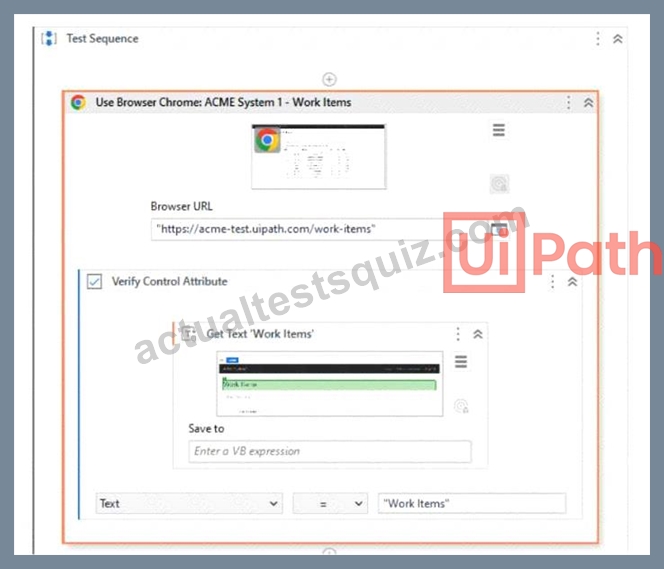
The configuration for the Verify Control Attribute and Get Text activities is shown below: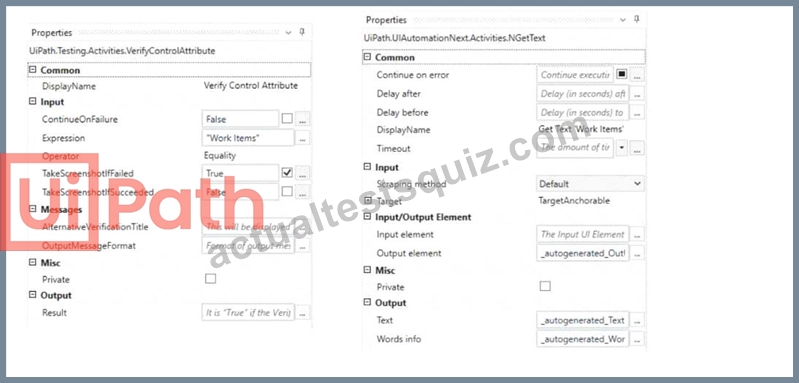
The element and its selector are highlighted in the image below: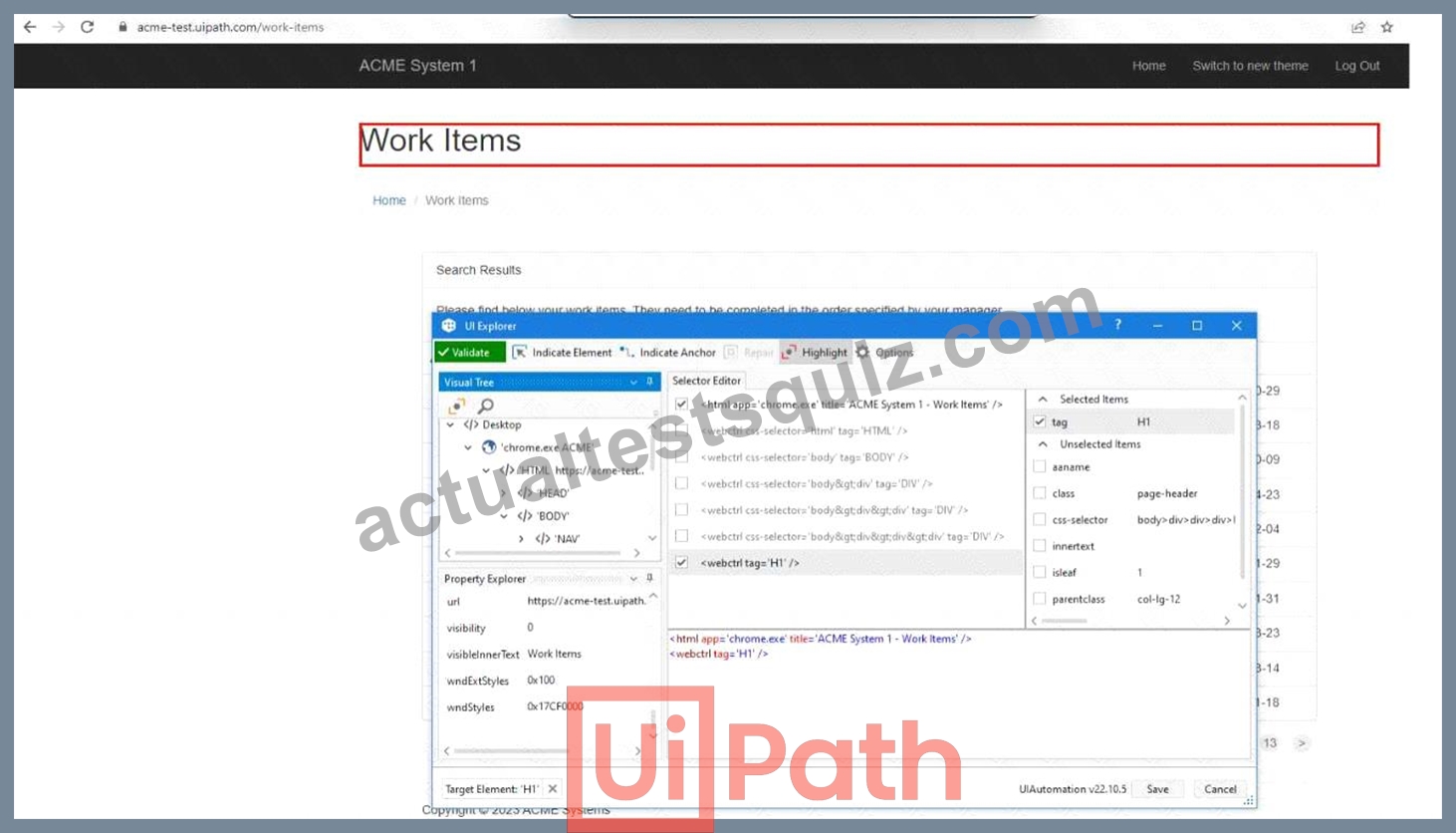
Taking into consideration that the page shown above will be present on screen at execution time, what will be the result of the Verify Control Attribute activity?
- A. An exception will be thrown because there is no variable set in the Save to property of the Get text activity.
- B. Verification will not be executed.
- C. Verification will be failed because the actual value is different than expected value.
- D. Verification will be passed.
Answer: D
Explanation:
The workflow in question uses a 'Verify Control Attribute' activity to check if the text value of a UI element is equal to "Work Items". The Get Text activity is used to retrieve the text from the specified UI element, and the result of this activity is compared against the expected value "Work Items".
From the provided information, the 'Verify Control Attribute' activity has been set up with the Expression
"Work Items" and the Operator set to Equality. The 'Get Text' activity is configured to extract the text from the UI element with the visible text "Work Items", as indicated by the selector shown in the image.
Since the actual value of the UI element's text is "Work Items" (which matches the expected value in the
'Verify Control Attribute' activity), and provided that the 'Get Text' activity successfully retrieves this value, the verification will pass. The configuration indicates that the activity should take a screenshot only if the verification fails (TakeScreenshotIfFailed is set to True), which will not be the case here.
Therefore, assuming that there are no other issues such as incorrect selectors or unexpected changes to the UI element at execution time, the result of the 'Verify Control Attribute' activity will be a pass.
References:
UiPath Documentation: Verify Control Attribute Activity
NEW QUESTION # 88
Which LINQ method is used to filter data in a List or DataTable based on a condition?
- A. OrderBy
- B. Where
- C. Select
- D. GroupBy
Answer: B
Explanation:
LINQ (Language Integrated Query) is a feature of .NET that allows you to write queries to manipulate data from various sources, such as arrays, collections, databases, or XML files. LINQ provides a set of methods that can be used to perform different operations on the data, such as filtering, sorting, grouping, aggregating, or transforming.
The LINQ method that is used to filter data in a List or DataTable based on a condition is Where. The Where method returns a new collection that contains only the elements that satisfy the specified condition. The condition is usually a lambda expression or a delegate that takes an element as a parameter and returns a Boolean value. For example, if you have a List of integers called numbers, you can write:
var evenNumbers = numbers.Where (x => x % 2 == 0);
This expression returns a new List that contains only the even numbers from the original List. Similarly, if you have a DataTable called employees, you can write:
var highSalary = employees.AsEnumerable ().Where (row => row.Field<decimal> (\"Salary\") > 100000); This expression returns a new DataTable that contains only the rows where the Salary column is greater than
100000. The AsEnumerable () method is used to convert the DataTable into an IEnumerable<DataRow>, which is required for using LINQ methods.
The other options are not LINQ methods that are used to filter data in a List or DataTable based on a condition. Option A, Select, is a LINQ method that is used to project or transform data from one form to another. It returns a new collection that contains the result of applying a function to each element of the source collection. Option B, GroupBy, is a LINQ method that is used to group data by a common key or attribute. It returns a new collection that contains groups of elements that share the same key value. Option C, OrderBy, is a LINQ method that is used to sort data in ascending order by a specified criterion. It returns a new collection that contains the elements of the source collection in sorted order.
References: LINQ - Introduction - Microsoft Docs, Enumerable.Where Method (System.Linq) - Microsoft Docs, LINQ query to filter datatable - Studio - UiPath Community Forum, LINQ Tutorial - Learn - UiPath Community Forum
NEW QUESTION # 89
While troubleshooting a process developed using the Robotic Enterprise (RE) Framework, you have placed a breakpoint at the " Invoke InitAllSettings " workflow activity.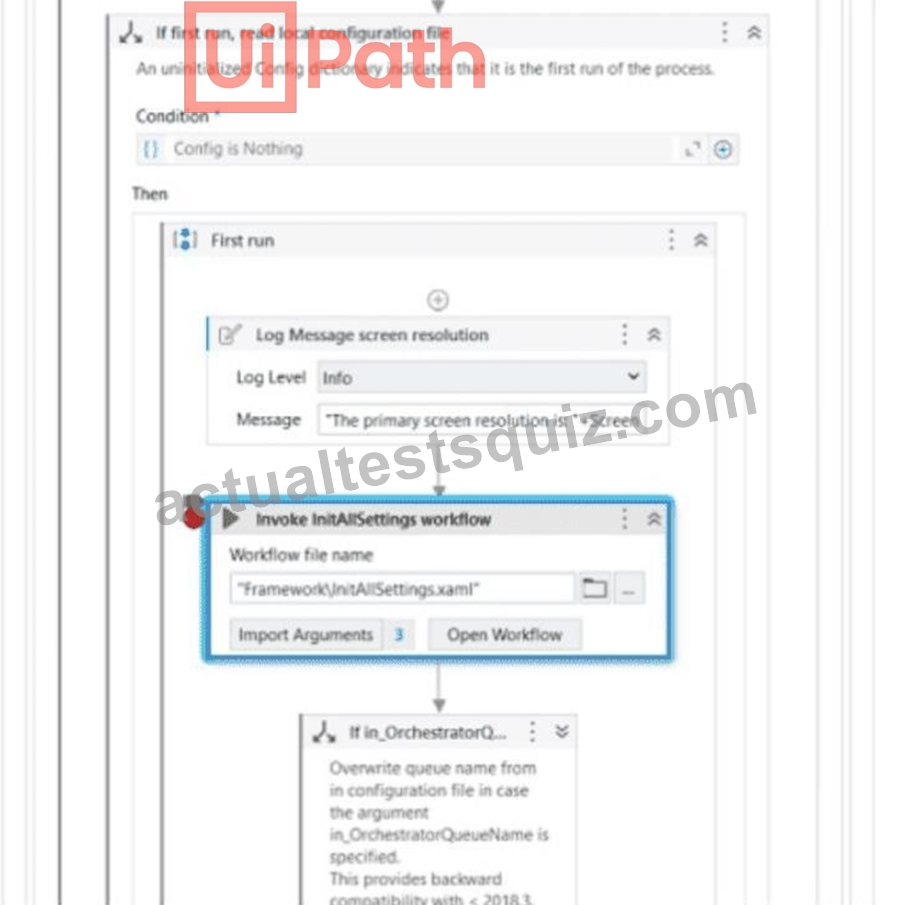
Given the current state of the Executor, what will occur when you click on the Step Over button?
- A. Executor directs to the " First Run " sequence
- B. Executor directs to the first InitAllSettings workflow activity
- C. Executor directs to the first activity outside " If first run, read local configuration "
- D. Executor directs to the " If in_OrchestratorQ ... " activity
Answer: B
Explanation:
When a breakpoint is placed at a particular activity within the workflow and the Step Over function is used, the Executor will move to the next activity in the sequence. Given the context of the REFramework, after stepping over the " Invoke InitAllSettings " workflow, the next activity that would execute is the " If in_OrchestratorQueueName ... " activity, assuming there are no activities in between within the " InitAllSettings " workflow itself. Step Over will not go into the invoked workflow but will move to the next activity at the same level of the workflow where the breakpoint was placed.References:
* UiPath Studio Guide: Debugging
NEW QUESTION # 90
While troubleshooting a process developed using the Robotic Enterprise (RE) Framework, you have placed a breakpoint at the "Invoke InitAllSettings" workflow activity.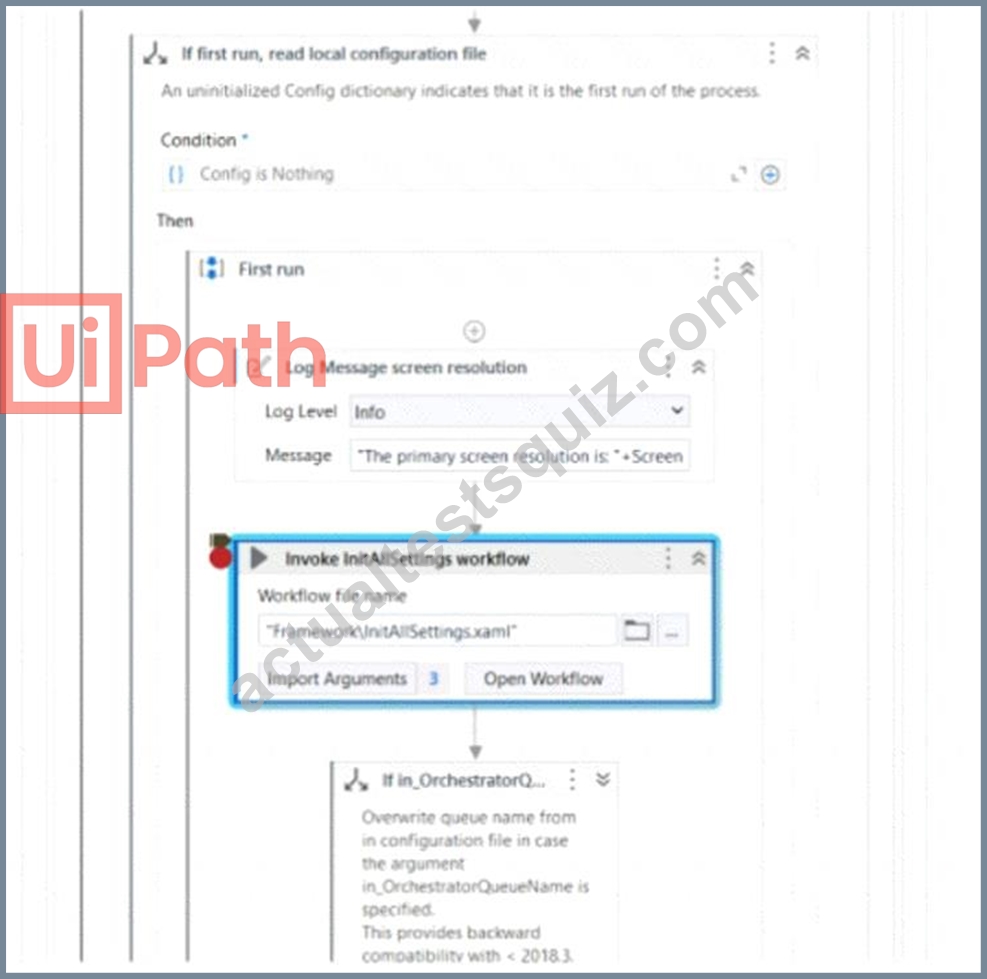
Given the current state of the Executor, what will occur when you click on the Step Over button?
Executor directs to the "If in_OrchestratorQ ... " activity
Executor directs to the first InitAllSettings workflow activity
Executor directs to the first activity outside "If first run, read local configuration" Executor directs to the "First Run" sequence Explanation:
Answer:
Explanation:
When a breakpoint is placed at a particular activity within the workflow and the Step Over function is used, the Executor will move to the next activity in the sequence. Given the context of the REFramework, after stepping over the "Invoke InitAllSettings" workflow, the next activity that would execute is the "If in_OrchestratorQueueName ..." activity, assuming there are no activities in between within the
"InitAllSettings" workflow itself. Step Over will not go into the invoked workflow but will move to the next activity at the same level of the workflow where the breakpoint was placed.References:
UiPath Studio Guide: Debugging
NEW QUESTION # 91
Review the following graphics: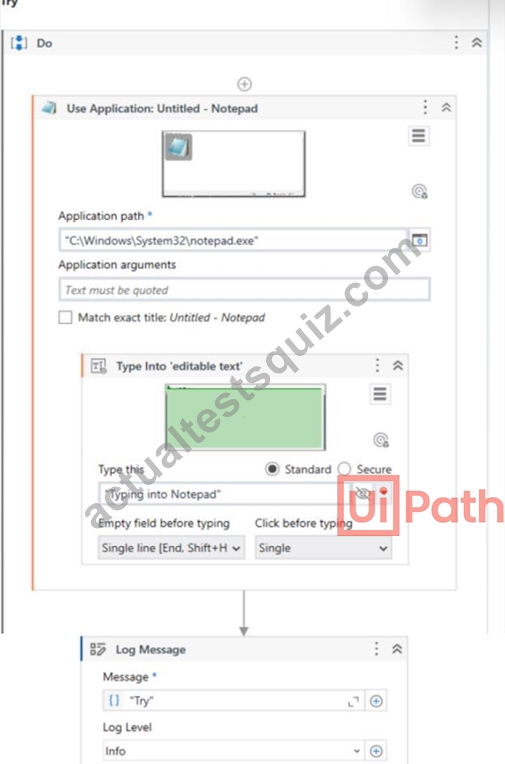
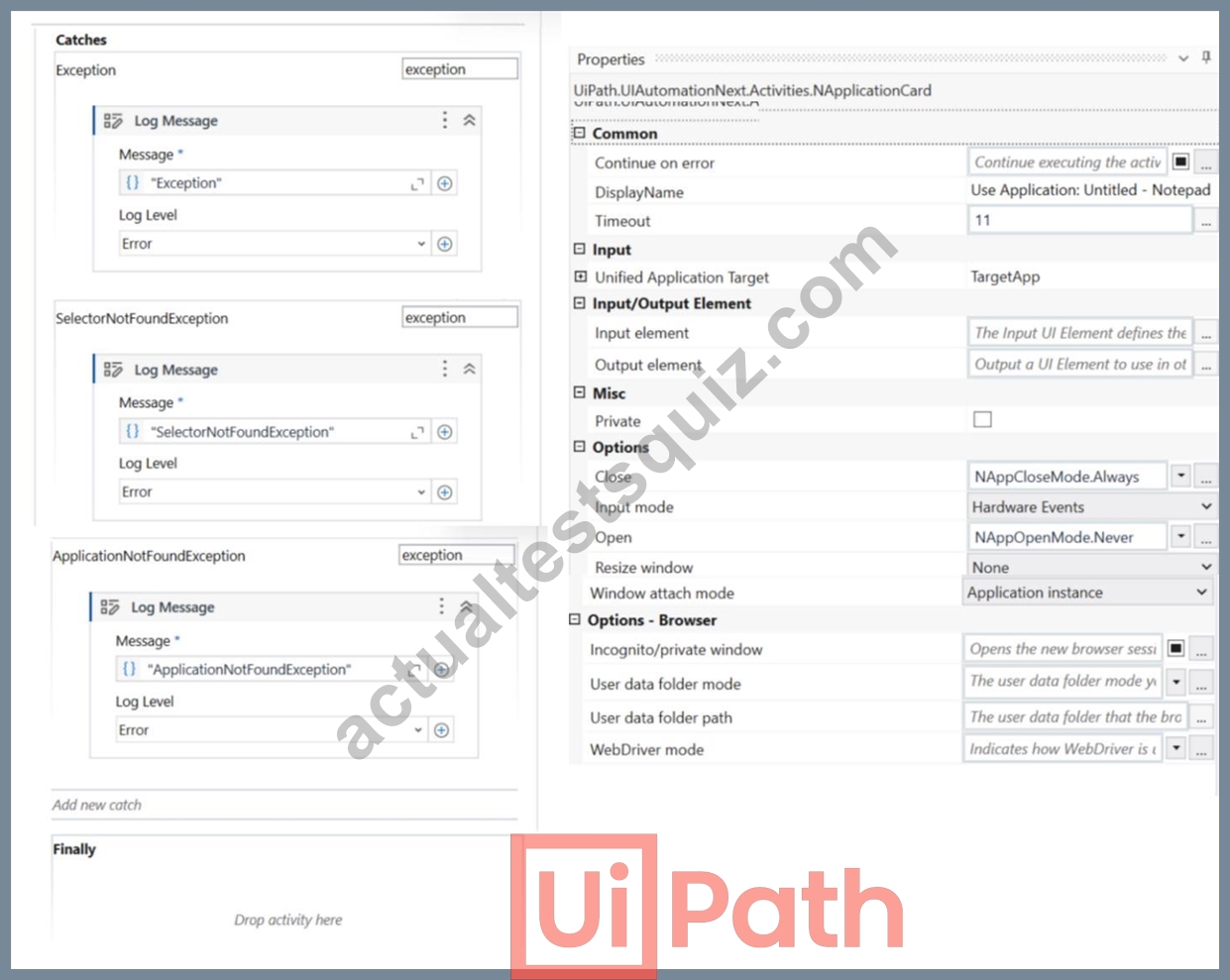
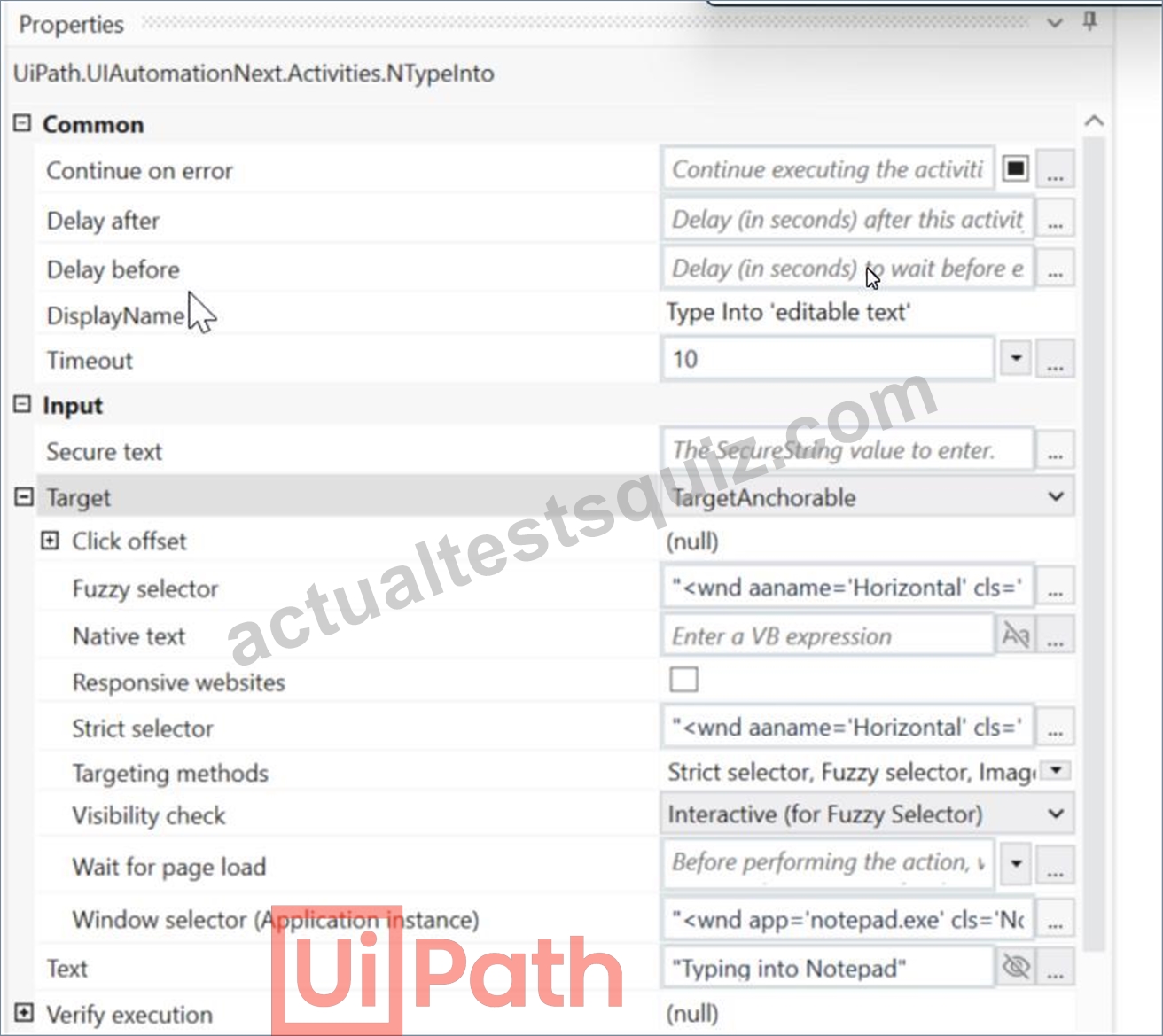
If the automation is executed and Notepad.exe is not running, which Log Message text value is contained in the Output panel?
- A. Exception
- B. Try
- C. SelectorNotFoundException
- D. ApplicationNotFoundException
Answer: D
Explanation:
The graphics show a UiPath workflow that contains a Try Catch activity with a Type Into activity inside the Try block and a Log Message activity inside the Catch block. The Type Into activity is configured to type
"Typing into Notepad" into a Notepad window with the selector "<wnd app='notepad.exe' cls='Notepad' title='Untitled - Notepad' />". The Log Message activity is configured to log the exception message in the Output panel.
If the automation is executed and Notepad.exe is not running, the Type Into activity will fail to find the target UI element and throw an exception. The exception will be caught by the Catch block and the Log Message activity will log the exception message in the Output panel. The exception message will contain the name of the exception type, which is ApplicationNotFoundException. This exception is thrown when the application that is specified in the selector is not found or not running. Therefore, the Log Message text value that is contained in the Output panel is ApplicationNotFoundException.
The other options are not correct, as they are not the exception type that is thrown by the Type Into activity when the application is not running. Option A is incorrect, because Exception is a generic term for any error or problem that occurs during the execution of a program, not a specific exception type. Option C is incorrect, because Try is not an exception type, but a keyword that marks the beginning of a block of code that may throw an exception. Option D is incorrect, because SelectorNotFoundException is not an exception type, but a possible error message that is displayed when the selector is invalid or does not match any UI element.
References: Activities - Type Into - UiPath Documentation Portal, Activities - Log Message - UiPath Documentation Portal, Studio - Try Catch - UiPath Documentation Portal, UiPath.Core.Activities.
ApplicationNotFoundException Class - UiPath Documentation Portal
NEW QUESTION # 92
Which of the following statements is true about the existing UiPath Studio installation packages?
- A. The Attended Robot installation package installs only UiPath Studio, and Robot.
- B. The Attended Robot installation package installs only the UiPath Robot.
- C. The Unattended Robot installation package installs only UiPath Studio, Assistant, and Robot.
- D. The Automation Developer installation package installs only UiPath Studio, Assistant, and Robot.
Answer: B
NEW QUESTION # 93
A developer has created a string array variable as shown below:
UserNames = {"Jane", "Jack", "Jill", "John"}
Which expression should the developer use in a Log Message activity to print the elements of the array separated by the string ","?
- A. String.Join(UserNames, ", ")
- B. String.Join(", ", UserNames)
- C. String.Concat(UserNames,",")
- D. String.Concat(",", UserNames)
Answer: B
Explanation:
To print the elements of a string array separated by a specific string, the String.Join method is used in C#.
This method takes two parameters: the first is the separator string and the second is the array to join into a single string.
Given the options and the requirement to separate array elements with a comma and a space (", "), the correct expression to use in a Log Message activity would be:
C: String.Join(", ", UserNames)
This will produce a single string with each element of the UserNames array separated by ", " (a comma followed by a space).
NEW QUESTION # 94
To retrieve all Outlook emails with the word "UiPath" in the subject, which filtering property and filter schema should a developer use?
- A. Property: Filter
Schema: "@SQL=""urn:schemas:httpmail:subject"" like '%UiPath%'" - B. Property: FilterByMessageIds
Schema: "@SQL=""urn:schemas:httpmail:subject"" like '%UiPath%'" - C. Property: Filter
Schema: "@SQL=""urn:schemas:httpmail:subject"" like 'UiPath%'" - D. Property: FilterByMessageIds
Schema: "@SQL=""urn:schemas:httpmail:subject'"' like 'UiPath%'"
Answer: A
Explanation:
o retrieve all Outlook emails with the word "UiPath" in the subject, the developer should use the Filter property and the filter schema "@SQL=""urn:schemas:httpmail:subject"" like '%UiPath%'". The Filter property allows the developer to specify a condition for retrieving the emails based on the email properties.
The filter schema is a string that follows the SQL syntax and uses the urn:schemas:httpmail namespace to access the email properties. The subject property is accessed by using "urn:schemas:httpmail:subject". The like operator is used to match the value of the subject property with a pattern that contains the word "UiPath".
The percent sign (%) is a wildcard that matches any sequence of characters. Therefore, the filter schema
"@SQL=""urn:schemas:httpmail:subject"" like '%UiPath%'" will match any email that has the word
"UiPath" anywhere in the subject. References: Get Outlook Mail Messages
NEW QUESTION # 95
How does UiPath handle different dependency versions for multiple running processes that run at the same time?
- A. Running processes use the earliest compatible dependency version.
- B. Each running process uses its own required version of the dependency.
- C. Each running process automatically adapts to the available dependency version.
- D. All running processes use the latest version of the dependency available.
Answer: B
Explanation:
UiPath handles different dependency versions for multiple running processes that run at the same time by using the concept of isolation. This means that each running process uses its own required version of the dependency, without affecting or being affected by other processes. This ensures that the processes run smoothly and consistently, regardless of the dependency versions. The isolation is achieved by using the NuGet protocol, which allows the robot to download and store the dependencies in a local cache folder. The robot then loads the dependencies from the cache folder into separate application domains for each process, creating isolated environments for each process. References: [Managing Dependencies], [About the NuGet Protocol]
NEW QUESTION # 96
Assume we have the Verify Expression with Operator activity from the UiPath. Testing.Activities package with the properties configured as follows: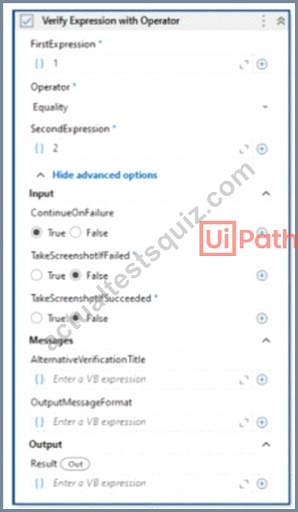
The activity is used within a Try-Catch activity. The Catch block is set to System.Exception and UiPath.Testing.Exception.TestingActivitiesException as shown in the screenshot below: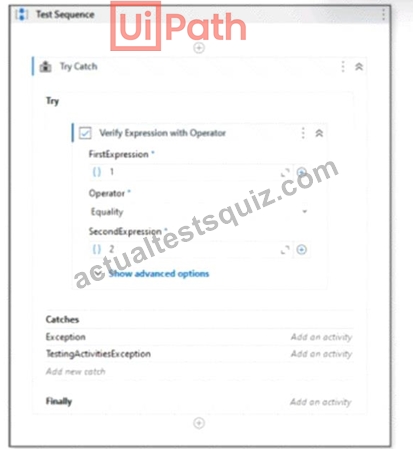
During the execution of the sequence shown above, which block from the Try-Catch activity will be entered first, after the Verify Expression with Operator activity is executed?
- A. None of the other blocks within the Try-Catch activity will be executed.
- B. The TestingActivitiesException sequence from the Catches block within the Try-Catch activity.
- C. The Exception sequence from the Catches block within the Try-Catch activity.
- D. The Finally block within the Try-Catch activity.
Answer: C
Explanation:
The Verify Expression with Operator activity is used to verify an expression by asserting it in relation to a given expression with an operator1. The expressions tested with this activity must be inserted in their respective property fields. In this case, the activity is configured to verify if the expression "1" is equal to the expression "2". The result of this verification is stored in the Result property, which reflects the state of the verification activity1. If the verification fails, the activity throws a TestingActivitiesException, which is a custom exception type defined by the UiPath.Testing.Activities package2.
The Try-Catch activity is used to catch a specified exception type in a sequence or activity, and either displays an error notification or dismisses it and continues the execution3. The activity has three main sections: Try, Catches, and Finally. The Try section holds the activity or set of activities that could throw an exception. The Catches section indicates the exception type and holds the activity or set of activities to be performed when the specified exception is thrown. The Finally section holds the activity or set of activities to be performed after the Try and Catches blocks are executed, regardless of the result3.
In this scenario, the Verify Expression with Operator activity is placed in the Try section of the Try-Catch activity. The Catches section has two exceptions caught: System.Exception and TestingActivitiesException.
The Finally section is empty. During the execution of the sequence, the Verify Expression with Operator activity will throw a TestingActivitiesException, because the expressions 1 and 2 are not equal. The Try-Catch activity will catch this exception and enter the TestingActivitiesException sequence from the Catches section, where the appropriate actions can be performed to handle the error. Therefore, the correct answer is C. The Exception sequence from the Catches block within the Try-Catch activity will be entered first, after the Verify Expression with Operator activity is executed.
The other options are incorrect because:
Option A is incorrect because the Try-Catch activity will execute one of the blocks within the Catches section, depending on the type of exception thrown by the Verify Expression with Operator activity. In this case, the TestingActivitiesException sequence will be executed.
Option B is incorrect because the Finally block within the Try-Catch activity will be executed only after the Try and Catches blocks are executed, not before. The Finally block is used to perform any cleanup or final actions that are needed regardless of the outcome of the Try and Catches blocks3.
Option D is incorrect because the TestingActivitiesException sequence from the Catches block within the Try-Catch activity will be entered second, not first, after the Verify Expression with Operator activity is executed. The first block to be entered is the Try block, where the Verify Expression with Operator activity is placed.
References:
Activities - Verify Expression With Operator - UiPath Documentation Portal UiPath.Testing.Activities Namespace Activities - Try Catch - UiPath Documentation Portal
NEW QUESTION # 97
A developer plans to build an automation process using the REFramework with Orchestrator queues. Based on UiPath best practice, what is the recommended sequence of steps to update the template and create/update Queues and Values?
Instructions: Drag the Description found on the left and drop on the correct Step Sequence found on the right.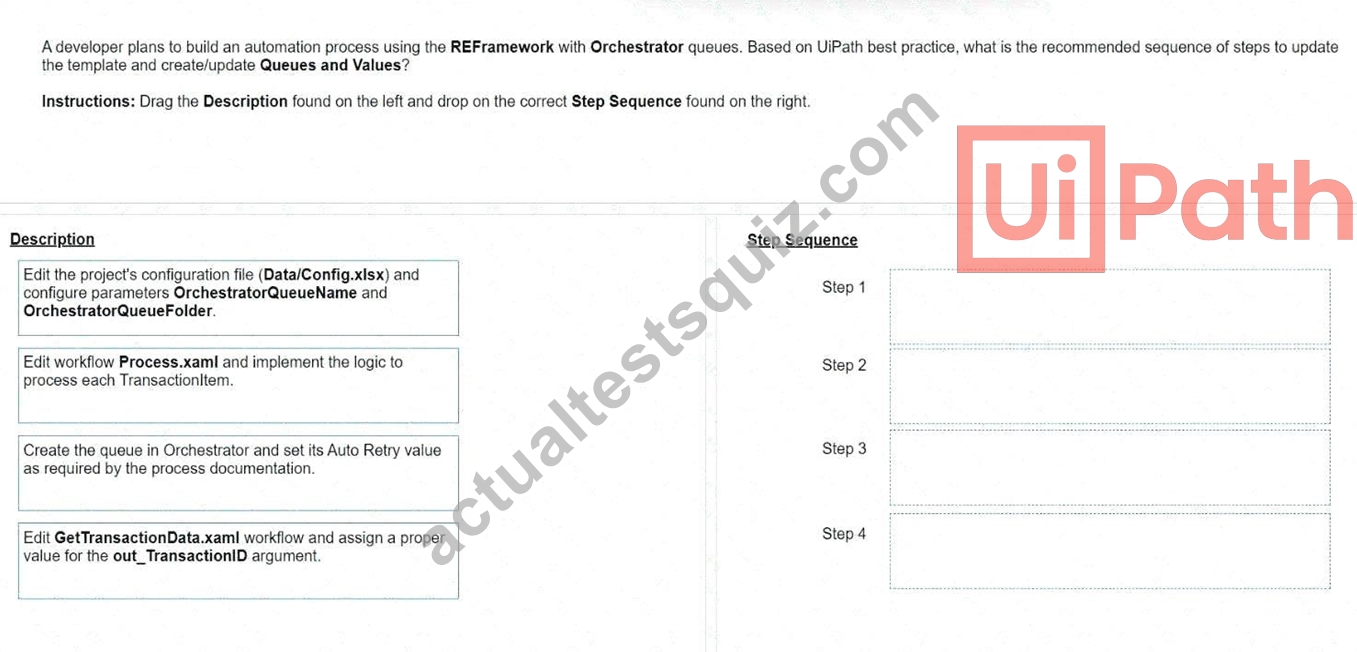
Answer:
Explanation: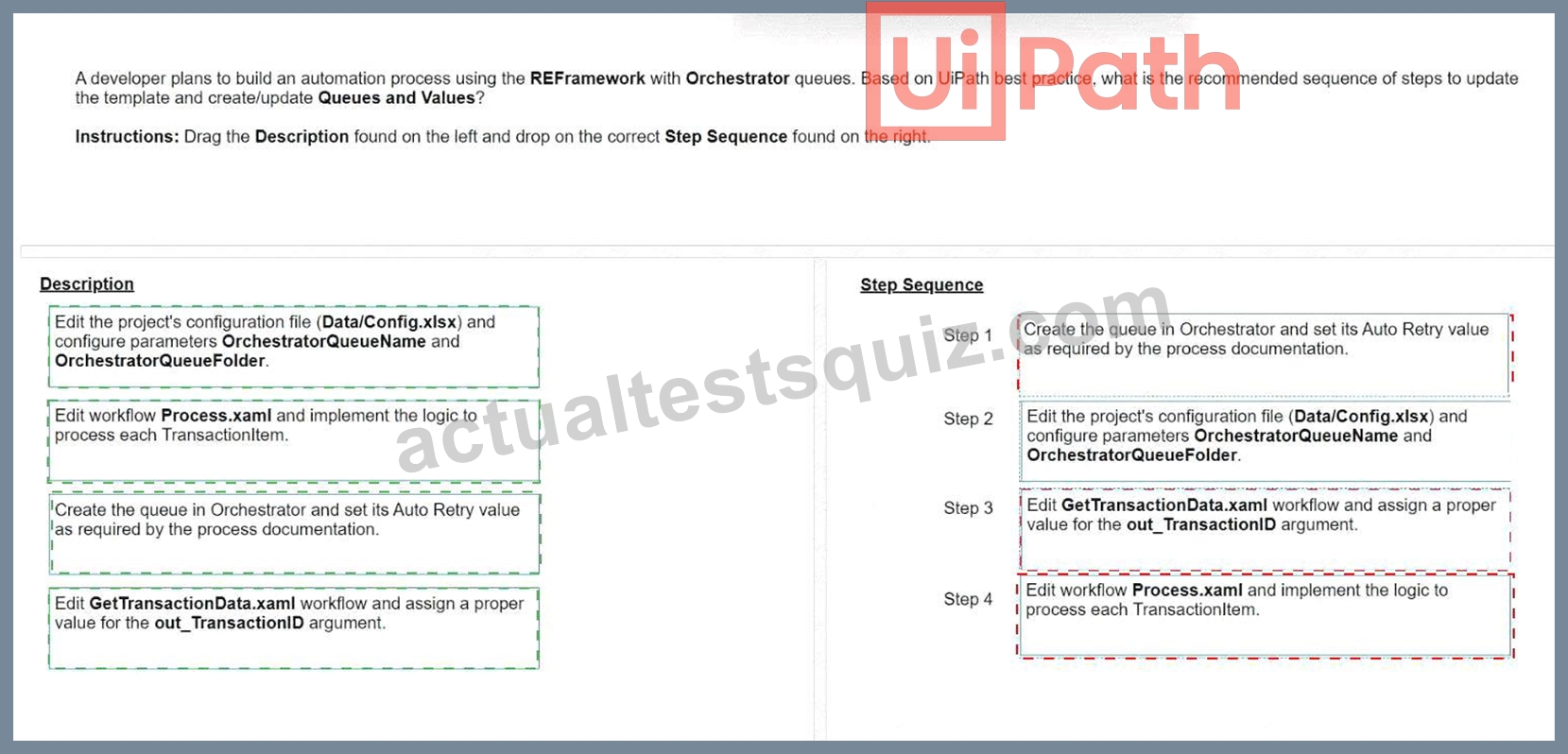
Explanation:
A screenshot of a computer program Description automatically generated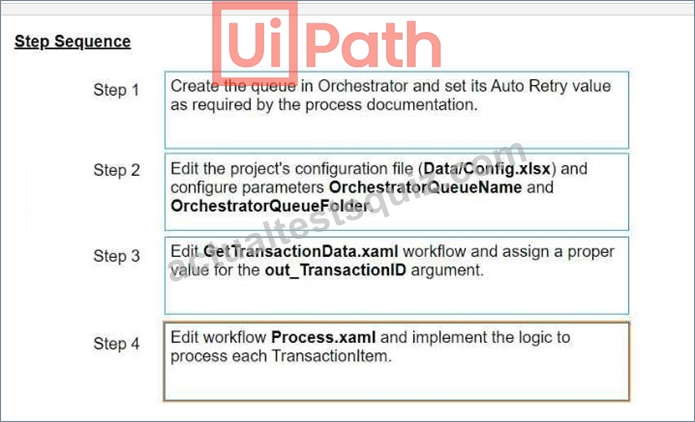
To align with UiPath's best practices when updating the REFramework template for use with Orchestrator queues, the sequence of steps should ensure proper setup of the queues in Orchestrator, configuration of the project to interact with these queues, and implementation of the business logic to process items from the queues.
Here's how the steps should be sequenced:
Step 1: Create the queue in Orchestrator and set its Auto Retry value as required by the process documentation.This step ensures that the queue is available in Orchestrator with the correct settings before the automation attempts to interact with it.
Step 2: Edit the project's configuration file (Data/Config.xlsx) and configure parameters OrchestratorQueueName and OrchestratorQueueFolder.Once the queue is created, the next step is to ensure that the automation project is configured to reference the correct queue and folder within Orchestrator.
Step 3: Edit GetTransactionData.xaml workflow and assign a proper value for the out_TransactionID argument.This configuration allows the workflow to correctly fetch transaction items from the Orchestrator queue for processing.
Step 4: Edit workflow Process.xaml and implement the logic to process each TransactionItem.Finally, the core processing logic that operates on each queue item is implemented, allowing the automation to perform the necessary actions for each transaction.
NEW QUESTION # 98
The following table is stored in a variable called "dt".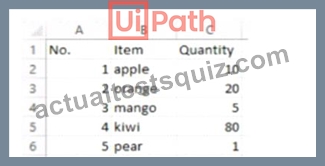
Which query can be used to extract the table column names and store them in a list?
- A. dt.Columns.Cast(Of Datacolumn).Select(function(col) col).ToList()
- B. dt.Columns.Cast(Of Datacolumn).Select(function(x) x.ColumnName).ToList()
- C. dt.AsEnumerable.Select(function(x) x.ColumnName).ToList()
- D. dt.Columns.Select(function(x) x.ColumnName).ToList()
Answer: B
Explanation:
The DataTable object in UiPath is a representation of a table with rows and columns that can store data of various types. It has a Columns property that returns a collection of DataColumn objects that describe the schema of the table1. To extract the column names from a DataTable and store them in a list, you can use the following query:
dt.Columns.Cast(Of Datacolumn).Select(function(x) x.ColumnName).ToList() This query does the following:
It casts the Columns collection to a generic IEnumerable(Of DataColumn) using the Cast(Of T) extension method2. This is necessary because the Columns collection is a non-generic IEnumerable that cannot be used with LINQ methods directly3.
It selects the ColumnName property of each DataColumn object using the Select extension method and a lambda expression4. The ColumnName property returns the name of the column as a string5.
It converts the resulting IEnumerable(Of String) to a List(Of String) using the ToList extension method6.
The other options are incorrect because:
Option B does not cast the Columns collection to a generic IEnumerable(Of DataColumn), which will cause a runtime error.
Option C uses the AsEnumerable extension method, which returns a collection of DataRow objects, not DataColumn objects7. Therefore, the ColumnName property will not be available.
Option D selects the whole DataColumn object instead of its ColumnName property, which will result in a list of DataColumn objects, not strings.
References:
DataTable Class (System.Data) | Microsoft Docs
Enumerable.Cast(Of TResult) Method (System.Linq) | Microsoft Docs
DataColumnCollection Class (System.Data) | Microsoft Docs
Enumerable.Select(Of TSource, TResult) Method (System.Linq) | Microsoft Docs DataColumn.ColumnName Property (System.Data) | Microsoft Docs Enumerable.ToList(Of TSource) Method (System.Linq) | Microsoft Docs DataTableExtensions.AsEnumerable Method (System.Data) | Microsoft Docs
NEW QUESTION # 99
A developer plans to build an automation process using the REFramework with Orchestrator queues. Based on UiPath best practice, what is the recommended sequence of steps to update the template and create/update Queues and Values?
Instructions: Drag the Description found on the left and drop on the correct Step Sequence found on the right.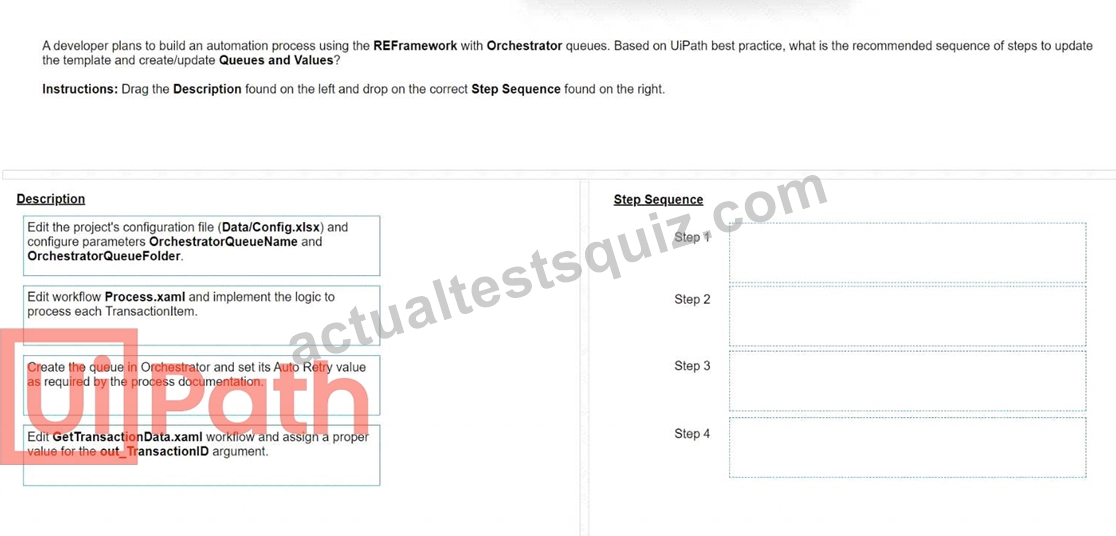
Answer:
Explanation: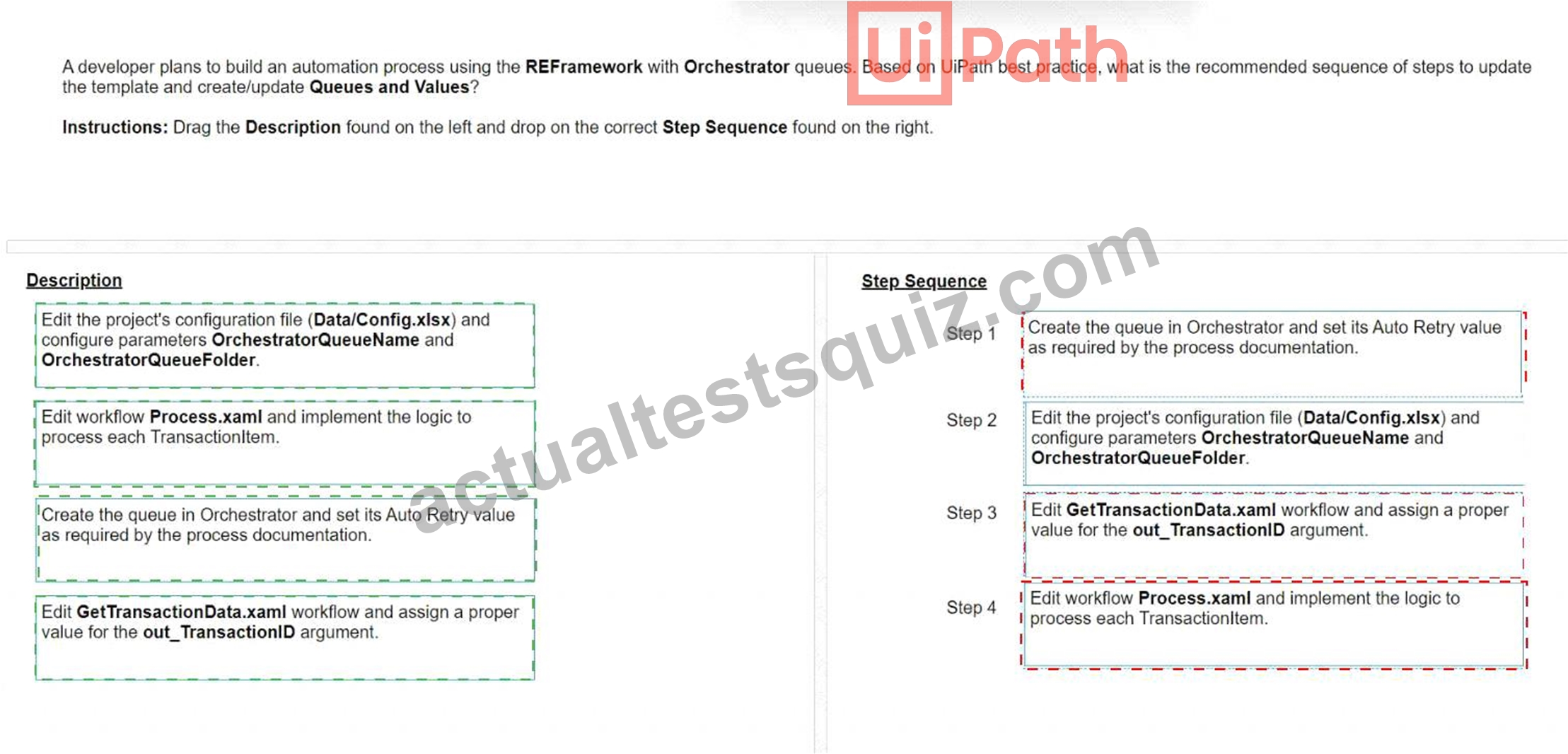
Explanation:
A screenshot of a computer program Description automatically generated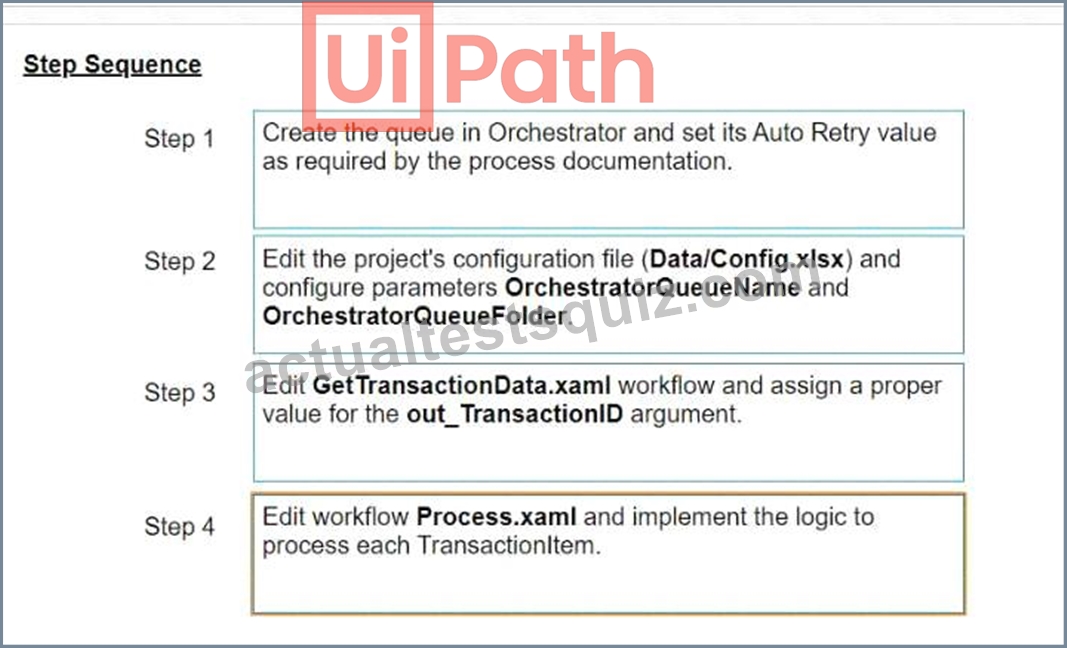
To align with UiPath's best practices when updating the REFramework template for use with Orchestrator queues, the sequence of steps should ensure proper setup of the queues in Orchestrator, configuration of the project to interact with these queues, and implementation of the business logic to process items from the queues.
Here's how the steps should be sequenced:
Step 1: Create the queue in Orchestrator and set its Auto Retry value as required by the process documentation.This step ensures that the queue is available in Orchestrator with the correct settings before the automation attempts to interact with it.
Step 2: Edit the project's configuration file (Data/Config.xlsx) and configure parameters OrchestratorQueueName and OrchestratorQueueFolder.Once the queue is created, the next step is to ensure that the automation project is configured to reference the correct queue and folder within Orchestrator.
Step 3: Edit GetTransactionData.xaml workflow and assign a proper value for the out_TransactionID argument.This configuration allows the workflow to correctly fetch transaction items from the Orchestrator queue for processing.
Step 4: Edit workflow Process.xaml and implement the logic to process each TransactionItem.Finally, the core processing logic that operates on each queue item is implemented, allowing the automation to perform the necessary actions for each transaction.
NEW QUESTION # 100
How are custom log fields used in the REFramework?
- A. Customlog fieldsareusedto automatically retry failed transactions with real-time updates.
- B. Customlog fieldsareusedto store sensitive information like credentials and personal data of users.
- C. Customlog fieldsareusedto define the variable types for transactions, replacing the default Queueitemtype.
- D. Customlog fieldsareincluded in log messages and used to add more data about each transaction for reporting and troubleshooting purposes.
Answer: D
Explanation:
Custom log fields are additional fields that can be added to the Robot Execution Logs using the Add Log Fields activity1. The REFramework is a template for creating robust and scalable automation projects that uses the State Machine workflow type2. The REFramework leverages the custom log fields feature to include more information about each transaction in the log messages, such as the transaction number, the transaction item, the business process name, etc. This helps to improve the reporting and troubleshooting capabilities of the automation project, as the custom log fields can be easily viewed and filtered in the Output panel, the Orchestrator Logs page, or any external logging tool3.
Option A is incorrect, because custom log fields are not used to automatically retry failed transactions, but rather to provide more details about them. The REFramework uses the Retry Scope activity and the Set Transaction Status activity to handle the retry mechanism for failed transactions4. Option B is incorrect, because custom log fields are not used to store sensitive information, but rather to enhance the log messages.
Storing sensitive information like credentials and personal data of users in the log fields is not recommended, as it may pose a security risk. Option C is incorrect, because custom log fields are not used to define the variable types for transactions, but rather to add more data about them. The REFramework uses the TransactionItem argument to store the transaction data, which can be of any type, such as QueueItem, DataRow, String, etc.
References: 1: Add Log Fields 2: The UiPath ReFramework 3: Add Log Field Advantages 4: Retry Scope :
[Logging and Log Levels] : [TransactionItem Argument]
NEW QUESTION # 101
What are the three main components of UiPath Integration Service?
- A. Connectors, Connections, Orchestrator.
- B. Connectors, API Tokens, Triggers.
- C. Connectors, Connections, Triggers.
- D. Activities, Connections, Triggers.
Answer: A
NEW QUESTION # 102
Which of the following is a tag in a selector?
- A. id='selMonth'
- B. <html app-msedge.exe' title-Find Unicorn Name' />
- C. aaname='FirstName'
- D. class-down-chevron set-font'
Answer: B
Explanation:
A tag in a selector is a node that represents a UI element or a container of UI elements. A tag has the following format: <ui_system attr_name_1='attr_value_1' ... attr_name_N='attr_value_N'/>. A tag can have one or more attributes that help identify the UI element uniquely and reliably1. For example, the tag <html app-msedge.exe' title-Find Unicorn Name' /> represents the HTML document of a web page opened in Microsoft Edge browser, with the title "Find Unicorn Name". The attributes app-msedge.exe and title-Find Unicorn Name help distinguish this tag from other HTML documents.
The other options are not tags, but attributes. An attribute is a property of a UI element that has a name and a value. For example, id='selMonth' is an attribute that indicates the ID of a UI element is
"selMonth". Attributes are used inside tags to specify the UI element or container1.
References:
1: Studio - About Selectors - UiPath Documentation Portal
NEW QUESTION # 103
A developer implemented a process using the REFramework and an Orchestrator queue. The
"OrchestratorQueueFolder" was defined in the "Config.xlsx" file, but the folder does not exist in Orchestrator What is the behavior at runtime?
- A. The process throws an exception in the "Process Transaction" state because the queue folder is not found, and then the process is stopped.
- B. No exception is thrown and neither will a message be logged and the process continues.
- C. A warning message stating that the queue folder is missing is logged, and then the process continues.
- D. The process throws an exception in the "Get Transaction Data" state because the queue folder is not found, and then the process is stopped.
Answer: D
Explanation:
The REFramework (Robotic Enterprise Framework) is a template that provides a standard structure and best practices for building automation projects using UiPath Studio1. It uses the State Machine workflow type to handle different scenarios and exceptions in a robust and scalable way2. One of the states in the REFramework is the Get Transaction Data state, which is responsible for fetching the next transaction item from the Orchestrator queue and assigning it to a variable3. The Orchestrator queue is a data structure that stores multiple items that need to be processed by the robots4. The queue can be organized into folders, which are logical containers that help group and manage the queues and other Orchestrator entities5.
If a developer implemented a process using the REFramework and an Orchestrator queue, they need to specify the name of the queue and the folder where it is located in the Config.xlsx file, which is an Excel workbook that stores the configuration settings and constants for the project6. The name of the queue should be entered in the Settings sheet, under the OrchestratorQueueName key, and the name of the folder should be entered in the Constants sheet, under the OrchestratorQueueFolder key6. These values are then read by the InitAllSettings workflow, which is invoked in the Init state of the REFramework, and assigned to the in_Config argument, which is a dictionary that holds all the configuration data7.
At runtime, the Get Transaction Data state invokes the GetTransactionData workflow, which takes the in_Config argument as an input and uses it to get the queue item from the Orchestrator queue8. The workflow uses the Get Queue Items activity, which requires the QueueName and FolderPath properties to be specified9. The QueueName property is set to in_Config("OrchestratorQueueName").ToString, and the FolderPath property is set to in_Config("OrchestratorQueueFolder").ToString8. If the folder specified in the Config.xlsx file does not exist in Orchestrator, the Get Queue Items activity will throw an exception with the message "Folder does not exist" and the process will be stopped10. Therefore, the correct answer is B. The process throws an exception in the "Get Transaction Data" state because the queue folder is not found, and then the process is stopped.
The other options are incorrect because:
Option A is incorrect because the process will not continue if the queue folder is missing. The Get Queue Items activity will fail and the exception will be caught by the Try Catch block in the GetTransactionData workflow, which will set the out_TransactionItem argument to Nothing and the out_TransactionID argument to "No more data"8. This will cause the transition condition from the Get Transaction Data state to the Process Transaction state to evaluate to False, and the transition condition from the Get Transaction Data state to the End Process state to evaluate to True3. The End Process state will invoke the SetTransactionStatus workflow, which will log the exception message and the process will be stopped11.
Option C is incorrect because an exception will be thrown and a message will be logged if the queue folder is missing. The exception will be thrown by the Get Queue Items activity, as explained above, and the message will be logged by the SetTransactionStatus workflow, which uses the Log Message activity to write the exception message to the Output panel and the Orchestrator logs11.
Option D is incorrect because the process will not reach the Process Transaction state if the queue folder is missing. The Process Transaction state is responsible for executing the business logic for each transaction item and invoking the SetTransactionStatus workflow to update the status of the item in the Orchestrator queue12. However, if the queue folder is missing, the Get Queue Items activity will throw an exception and the out_TransactionItem argument will be set to Nothing, which will prevent the transition from the Get Transaction Data state to the Process Transaction state83.
References:
Studio - Robotic Enterprise Framework Template - UiPath Documentation Portal Studio - State Machines - UiPath Documentation Portal Studio - REFramework - UiPath Documentation Portal Orchestrator - Queues - UiPath Documentation Portal Orchestrator - Folders - UiPath Documentation Portal Studio - Config File - UiPath Documentation Portal Studio - InitAllSettings - UiPath Documentation Portal Studio - GetTransactionData - UiPath Documentation Portal Activities - Get Queue Items - UiPath Documentation Portal Orchestrator - Troubleshooting - UiPath Documentation Portal Studio - SetTransactionStatus - UiPath Documentation Portal Studio - Process Transaction - UiPath Documentation Portal
NEW QUESTION # 104
A developer is using the REFramework template to automate a process. In " SetTransactionStatus " file, there is the following sequence of activities, where the last Log Message activity was added by the developer: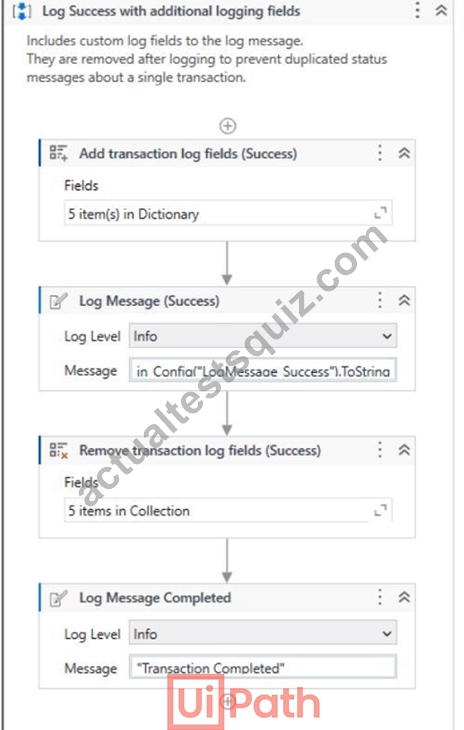
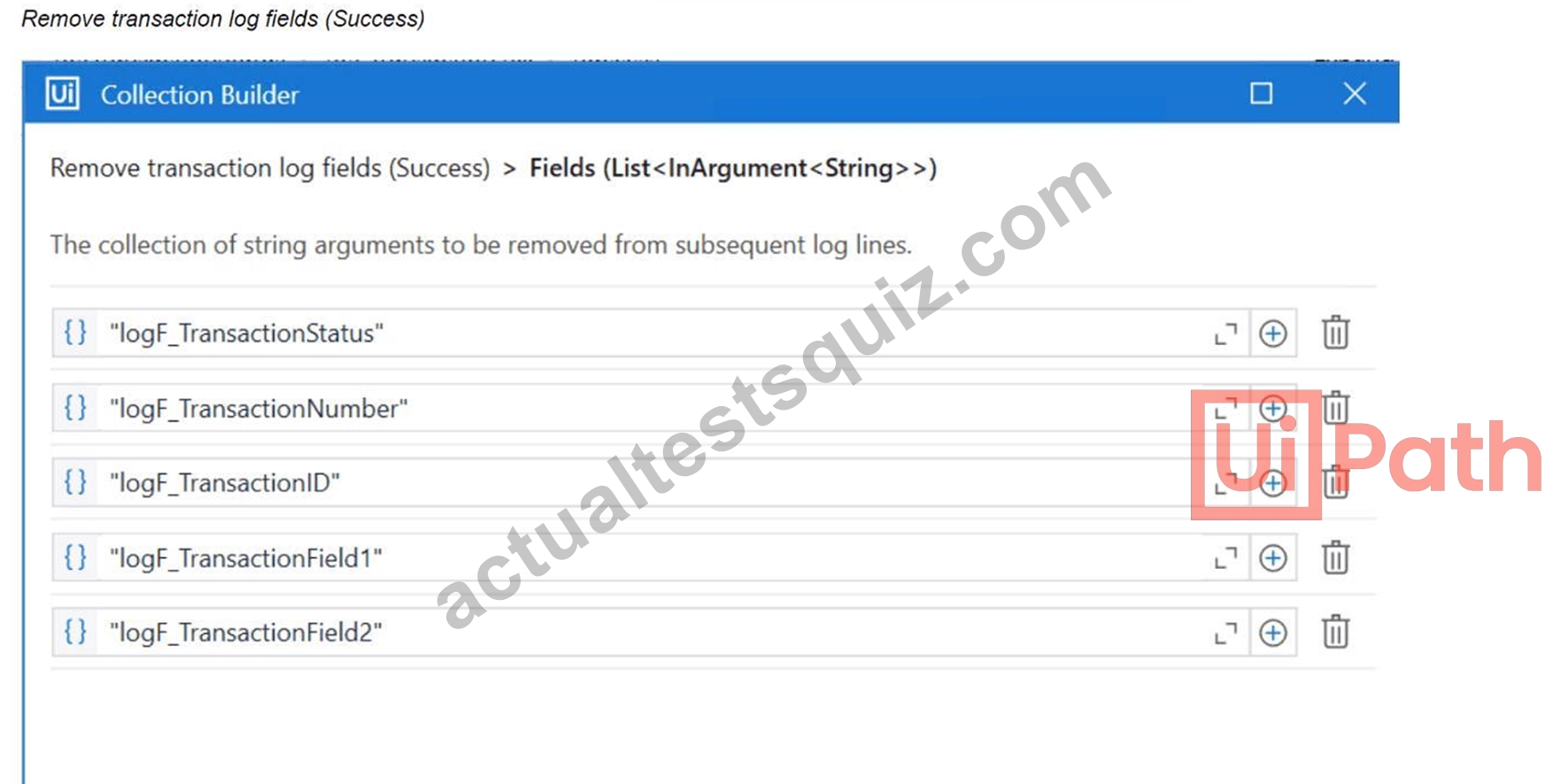
The configuration for Add Log Fields and Remove Log Fields activities are shown below:
Add transaction log fields (Success)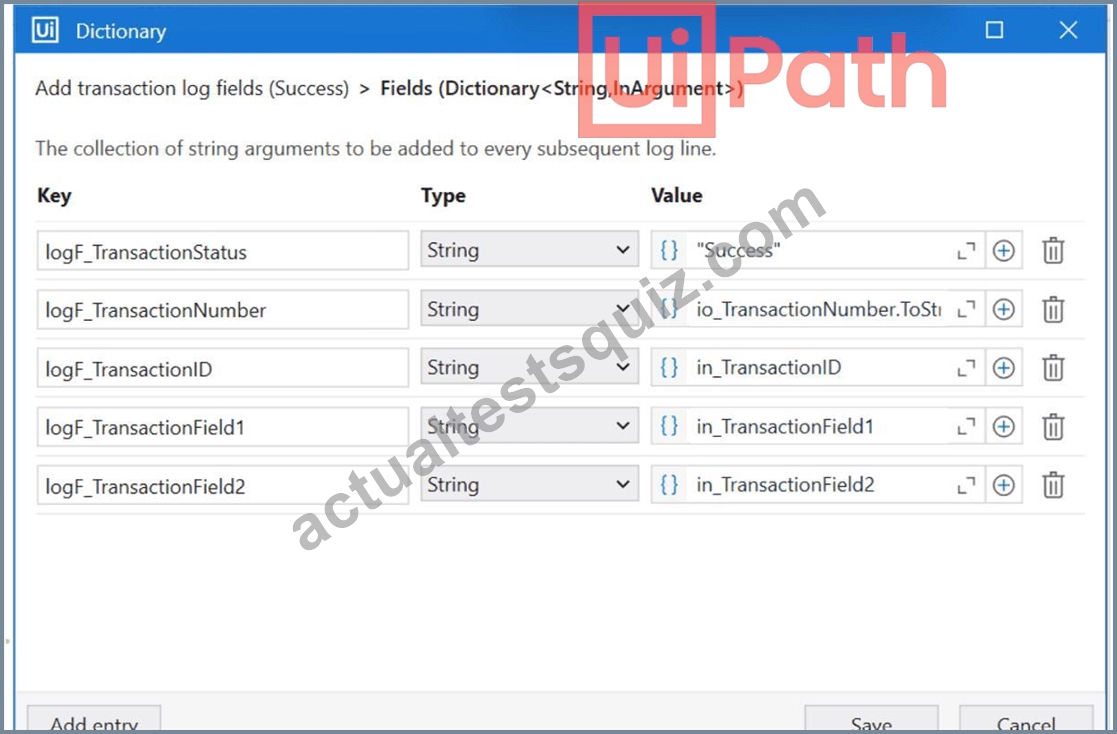
The developer runs the process and notices the argument values for the first transaction are:
in_TransactionID = " 07/18/2023 10:27:29 "
io_TransactionNumber = 1
in_TransactionField1 = " UI235-80 "
in_TransactionField2 = " Update Request "
Which of the following Log Message Details will be displayed when executing the activity Log Message Completed for the first transaction, considering it is successful?
- A. { " message " : " Transaction Completed " , " level " : " Information " , " logType " : " User " , " timeStamp " : " 10:30:19 " , " fileName " : " SetTransactionStatus " , " processVersion " : " 1.0.0 " , " jobId " : " f8a36a46-8ebc-40df-8f71-26b39087ebee " , " robotName " : " test.robot " , " machineId " : 0,
" logF_BusinessProcessName " : " Framework " } - B. { " message " : " Transaction Completed " , " level " : " Information " , " logType " : " User " , " timeStamp " : " 10:30:19 " , " fileName " : " SetTransactionStatus " , " processVersion " : " 1.0.0 " , " jobId " : " 59325301-680a-4d55-a81b-56ca1f369c12 " , " robotName " : " test.robot " , " machineId " :
0, " logF_TransactionField2 " : " " , " logF_TransactionStatus " : " " , " logF_TransactionID " : " logF_BusinessProcessName " : " Framework " , " logF_TransactionNumber " : " " , " logF_TransactionField1 " : " " } - C. { " message " : " Transaction Completed " , " level " : " Information " , " logType " : " User " , " timeStamp " : " 10:30:19 " , " fileName " : " SetTransactionStatus " , " processVersion " : " 1.0.0 " , " jobId " : " cb865477-35f8-4c0a-93e9-e4f4246223f2 " , " robotName " : " test.robot " , " machineId " : 0,
" logF_TransactionField2 " : " Update Request " , " logF_TransactionID " : " 07/18/2023 10:27:29 " , " logF_BusinessProcessName " : " Framework " , " logF_TransactionNumber " : " 1 " , " logF_TransactionField1 " : " UI235-80 " , " logF_TransactionStatus " : " Success " } - D. { " message " : " Transaction Completed " , " level " : " Information " , " logType " : " User " , " timeStamp " : " 10:30:19 " , " fileName " : " SetTransactionStatus " , " processVersion " : " 1.0.0 " , " jobId " : " 59325301-680a-4d55-a81b-56ca1f369c12 " , " robotName " : " test.robot " , " machineId " :
0, " logF_TransactionField2 " : empty, " logF_TransactionStatus " : empty, " logF_TransactionID " :
empty, " logF_BusinessProcessName " : " Framework " , " logF_TransactionNumber " : empty, " logF_TransactionField1 " : empty}
Answer: A
Explanation:
In the REFramework, the Add Log Fields activity is used to append additional information to the log messages. This information is stored in the form of custom fields. In this scenario, Add Log Fields (Success) activity is adding several fields with the transaction details whenever a transaction is successful.
The Remove Log Fields activity is then used to delete these custom fields to prevent them from appearing in subsequent log messages. This is important to ensure that only relevant information is logged for each transaction and to avoid cluttering the logs with outdated information.
When the Log Message Completed activity is executed after the Remove Log Fields activity, it should log the message without the additional fields that were added by the Add Log Fields activity since they have been removed. This means that the log message should only include the standard fields like message, level, logType, timeStamp, fileName, processVersion, jobId, robotName, and machineId, without the custom fields like logF_TransactionStatus, logF_TransactionNumber, etc.
Based on the options provided and the understanding of the REFramework ' s logging mechanism, the correct answer should be:
D). { " message " : " Transaction Completed " , " level " : " Information " , " logType " : " User " , " timeStamp
" : " 10:30:19 " , " fileName " : " SetTransactionStatus " , " processVersion " : " 1.0.0 " , " jobId " : " f8a36a46-
8ebc-40df-8f71-26b39087ebee " , " robotName " : " test.robot " , " machineId " : 0, " logF_BusinessProcessName " : " Framework " } This option is correct because it shows a log message after the removal of custom fields, retaining only the logF_BusinessProcessName field, which wasn ' t specified to be removed according to the provided information.
NEW QUESTION # 105
Under what conditions will a trigger be automatically disabled upon failure in Integration Service?
- A. When the job is not able to start after 11 attempts for a single event or the job does not start for the last
100 events. - B. When the job is not able to start after 3 attempts for a single event or the job does not start for the last
25 events. - C. When the job is not able to start after 20 attempts for a single event or the job does not start for the last
200 events. - D. When the job is not able to start after 5 attempts for a single event or the job does not start for the last
50 events.
Answer: B
Explanation:
In UiPath Integration Service, a trigger will be automatically disabled upon failure under specific conditions to prevent continuous failure and unnecessary resource consumption. This typically happens when the job associated with the trigger fails to start after a predefined number of attempts for a single event, or when it consistently fails to start across a series of events. The condition of failing to start after 3 attempts for a single event or not starting for the last 25 events is designed to safeguard against persistent issues that could disrupt the automation flow or lead to resource wastage.References:
* UiPath Integration Service Documentation: Triggers and Events
NEW QUESTION # 106
Which activity Is specific tor Ul synchronization in UlPath Studio?
- A. Use Applicationy/Browser
- B. Process Start Trigger
- C. Get Processes
- D. Check App State
Answer: D
Explanation:
The Check App State activity is specifically designed for UI synchronization. It checks the state of a UI element, ensuring that subsequent actions are performed when the UI element is in the desired state.
NEW QUESTION # 107
Given a dataiable "dt" with the following header:
"Surname. Address. Zip Code, Given Name, Phone Number.
What is the correct configuration of the Invoke Method activity so that the resulting header will be:
"Surname. Given Name. Address. Zip Code. Phone Number".
- A.
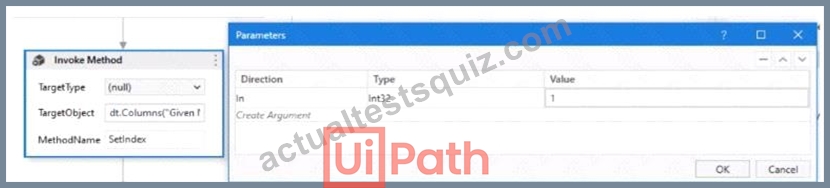
- B.
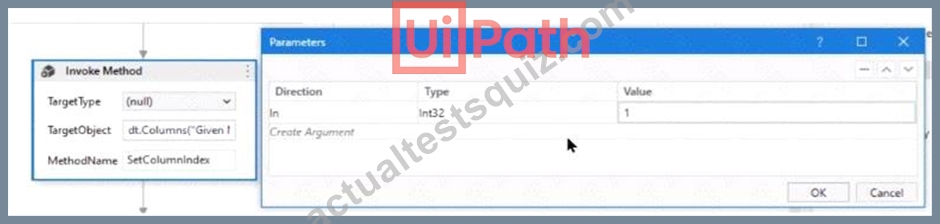
- C.
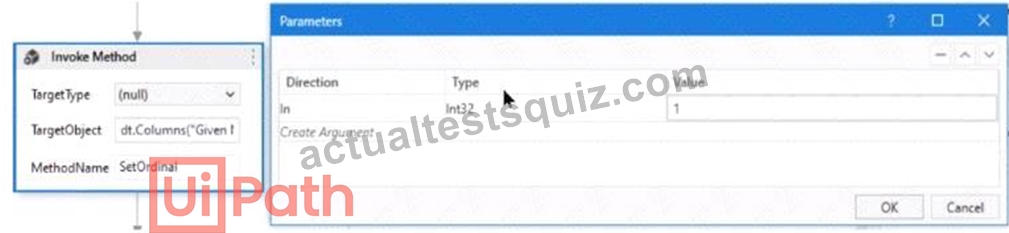
- D.
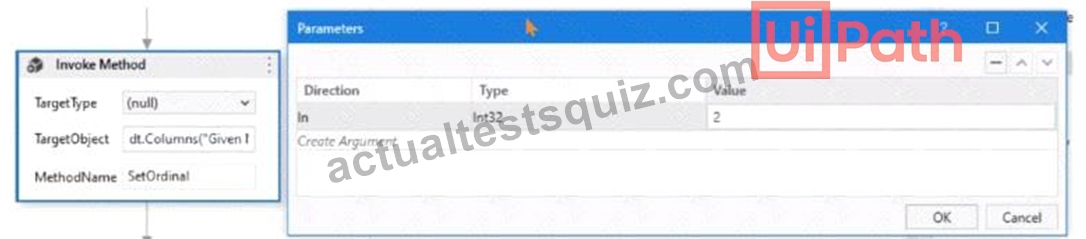
Answer: C
NEW QUESTION # 108
What are the steps to publish a project from UiPath Studio?
Instructions: Drag the Description found on the "Left" and drop on the correct Step Sequence found on the "Right".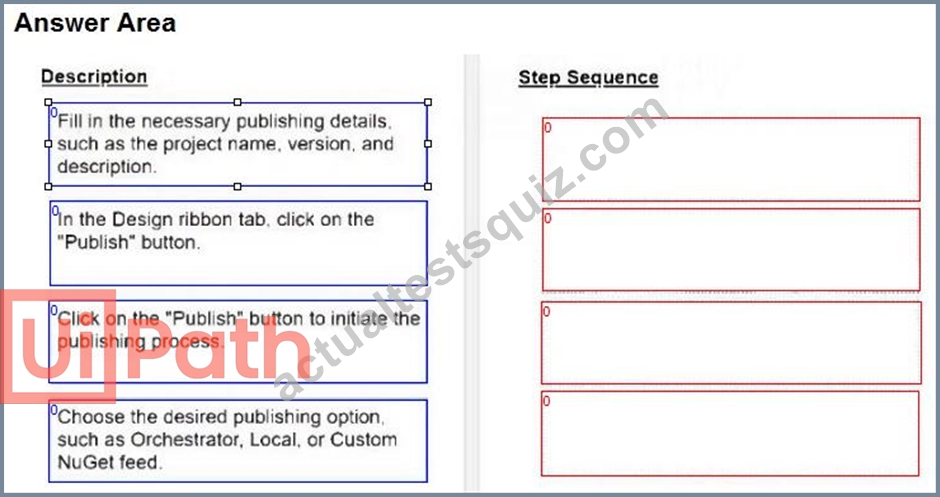
Answer:
Explanation: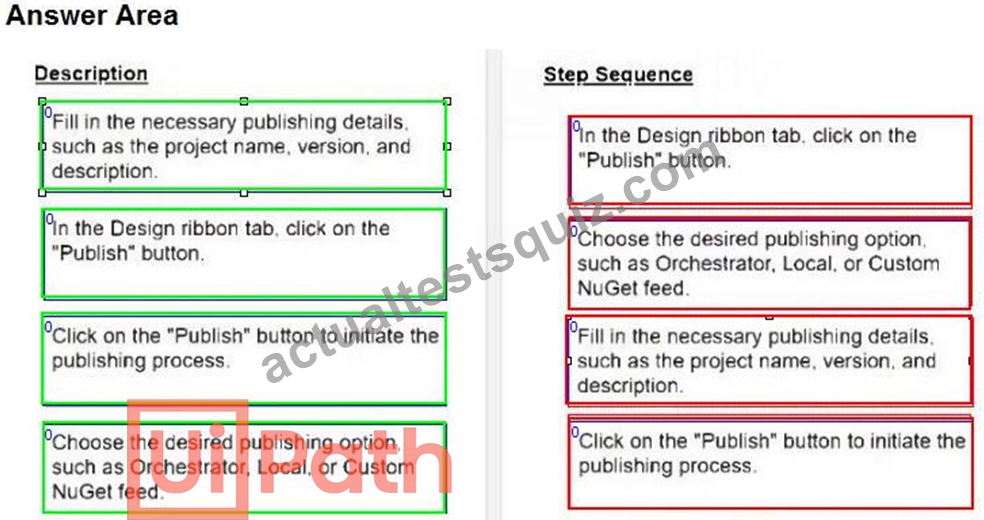
NEW QUESTION # 109
In UlPath Orchestrator. when managing multiple Jobs in a queue, which feature allows operators to dictate the execution sequence by assigning the importance of each Job?
- A. Job Queuing Strategy
- B. Job Execution Order
- C. Jab Dependency Settings
- D. Job Priority Levels
Answer: D
Explanation:
In UiPath Orchestrator, the Job Priority Levels feature allows operators to assign priority to jobs in a queue, thereby dictating their execution sequence based on their importance.
NEW QUESTION # 110
What is the default URL of the OCR server that runs the Computer Vision service?
- A. https://cv.uipath.com/
- B. https://server.uipath.com/
- C. https://computervision.uipath.com/
- D. https://cvserver.uipath.com/
Answer: A
Explanation:
The default URL of the OCR server that runs the Computer Vision service is https://cv.uipath.com/. The Computer Vision service is a cloud-based service that provides OCR and AI capabilities for UiPath automation projects. The service can be accessed by using the Computer Vision activities in UiPath Studio, such as CV Screen Scope, CV Click, CV Type Into, and more. The service requires an API key and a URL to connect to the OCR server. The default URL is https://cv.uipath.com/, but it can be changed to a custom URL if the developer has a self-hosted OCR server. The API key can be obtained from the UiPath Automation Cloud portal or from the UiPath Marketplace. References: [About Computer Vision], [Computer Vision Activities]
NEW QUESTION # 111
When should the Show Elements button be used in the Computer Vision wizard?
- A. Filtering out specific Ul elements from being processed by the Computer Vision engine.
- B. Highlighting all Ul elements that have been identified by the Computer Vision analysis.
- C. Activating a real-time view of the target agp^s Ul during automation.
- D. Displaying a list of all available Ul elements and their properties.
Answer: B
NEW QUESTION # 112
......
Free UiPath-ADPv1 Exam Dumps to Improve Exam Score: https://www.actualtestsquiz.com/UiPath-ADPv1-test-torrent.html
Exam UiPath-ADPv1: New Brain Dump Professional - ActualTestsQuiz: https://drive.google.com/open?id=15R9Msq4MogaCNvKv8hjSCMyO8nA7gDvN
