

100% Real 3V0-23.25 dumps - Brilliant 3V0-23.25 Exam Questions PDF
3V0-23.25 Exam PDF [2026] Tests Free Updated Today with Correct 79 Questions
NEW QUESTION # 31
A Storage Administrator is troubleshooting erratic latency on a vSAN ESA cluster. Skyline Health indicates the system is healthy, but the Administrator suspects a Top-of-Rack switch buffer issue.
The Administrator executes the "vSAN Network Performance Test" (Proactive Test) across the cluster.
```
[Architecture Diagram: Network Perf Test]
Host 1 (Iperf Client) --> Switch --> Host 2 (Iperf Server)
Test Result: Target 25 Gbps. Achieved: 14 Gbps. Retransmits: 5,400.
```
How does this specific proactive test help the Administrator diagnose the HCI storage bottleneck?
(Select all that apply.)
- A. The test automatically adjusts the Storage Policy Based Management (SPBM) IOPS limits on the cluster to match the 14 Gbps actual bandwidth.
- B. The test proves that the ESA DOM logic is incorrectly duplicating parity bits, causing network saturation.
- C. The test runs entirely in the hypervisor memory network stack (using iperf), explicitly bypassing the physical NVMe drives; this proves the 11 Gbps loss is strictly a network fabric problem, not a slow hard drive problem.
- D. The high number of "Retransmits" (5,400) definitively confirms packet drops on the physical switch, strongly pointing to buffer overflows during the micro-bursts generated by the test.
- E. The diagnostic output allows the Administrator to provide definitive proof to the Network team that the "25 GbE" ports are actually severely degraded under real-world TCP stress.
Answer: C,D,E
NEW QUESTION # 32
An L3 Support Engineer is analyzing the state of a VM scheduled for imminent SRM migration.
The VM uses both Local Protection (vSAN FTT=1) and Remote Protection (vSphere Replication).
The engineer runs an esxcli query on the local host to check the object health.
```
[root@esx-03:~] esxcli vsan debug object list -u 554350...
Object UUID: 554350... (SRM-Web-01)
Policy: FTT=1 (RAID-1)
Component 1: ACTIVE (esx-03)
Component 2: ABSENT (esx-05 - Host Unreachable)
Witness: ACTIVE (esx-06)
vSphere Replication State: OK (RPO 15m)
```
Based on the intersection of the local vSAN state and the remote vSphere Replication mechanics, which TWO operational behaviors are accurate for this degraded object? (Choose 2.)
- A. The ESXi host must wait for the ABSENT component to finish rebuilding (60-minute CLOM timer) before standard I/O resumes.
- B. SRM can still successfully failover this VM to the remote site, because the asynchronous vSphere Replication engine continues copying data from the ACTIVE Component 1.
- C. The SRM failover is blocked because the local "ABSENT" flag prevents the vCenter database from un-registering the VM.
- D. vSphere Replication is automatically suspended because the replication agent cannot read from degraded FTT=1 components.
- E. The VM remains fully operational on the primary site because the local vSAN object maintains quorum (2 of 3 votes are ACTIVE).
Answer: B,E
NEW QUESTION # 33
A VCF Deployment Specialist is configuring a new Tanzu Kubernetes Grid (TKG) cluster. The developers require a StorageClass that provisions volumes on the vSAN datastore using an existing SPBM policy named "K8s-Gold-Policy".
```
# Kubernetes StorageClass Definition
apiVersion: storage.k8s.io/v1
kind: StorageClass
metadata:
name: vsan-gold-sc
provisioner: csi.vsphere.vmware.com
parameters:
[ ? ] : "K8s-Gold-Policy"
reclaimPolicy: Delete
volumeBindingMode: WaitForFirstConsumer
```
Which parameter key MUST be inserted at the [ ? ] placeholder to correctly bind this StorageClass to the vSphere storage policy?
- A. vmfs.policy.id
- B. vsan.spbm.policy
- C. storagepolicyname
- D. datastorename
Answer: C
NEW QUESTION # 34
A VCF Deployment Specialist is sizing a vSAN ESA Stretched Cluster for VCF 9.0 to support a massive cross-site Disaster Recovery requirement.
```
[SDDC Manager - Workload Domain Configuration]
Topology: Stretched Cluster
Witness: Dedicated Witness Appliance (Third Site)
Max Scale Supported: [ ? ]
```
What are the officially supported maximum scale limits for a standard vSAN 8.0/9.0 Stretched Cluster topology? (Select all that apply.)
- A. The maximum supported RTT (Round Trip Time) network latency between the Preferred and Secondary sites is strictly 5 milliseconds to support the synchronous Write I/O operations.
- B. A single Stretched Cluster requires a minimum of 2 separate Witness Appliances (one for each site) to handle the 60-host metadata load.
- C. Stretched clusters strictly require the vSphere Enterprise Plus and vSAN Advanced licenses; vSAN Standard is not sufficient.
- D. A Stretched Cluster topology supports a maximum of 1 active Witness Appliance per cluster.
- E. The maximum size of the Stretched Cluster is 60 data hosts in total, evenly divided into 30 hosts in the Preferred Site and 30 hosts in the Secondary Site.
Answer: A,D,E
NEW QUESTION # 35
A VMware Cloud Foundation (VCF) Management Domain is requested to be deployed with the following information:
* 6 blade style hosts with no local storage beyond the operating system.
* 4 25 Gb networking cards installed in each host.
* A 30 TB external array configured to support NVMe/TCP only.
* 2 dVS switches, one configured for storage isolation and one for all other traffic.
* Aria Operations is not currently deployed in the environment.
Place the general steps in sequence for converging VCF on to this configuration.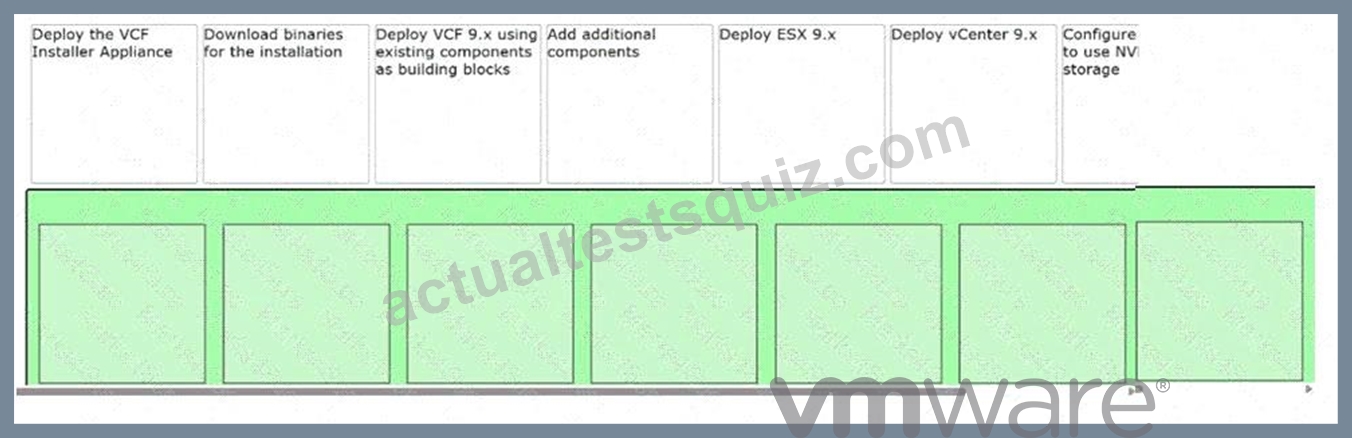
Answer:
Explanation: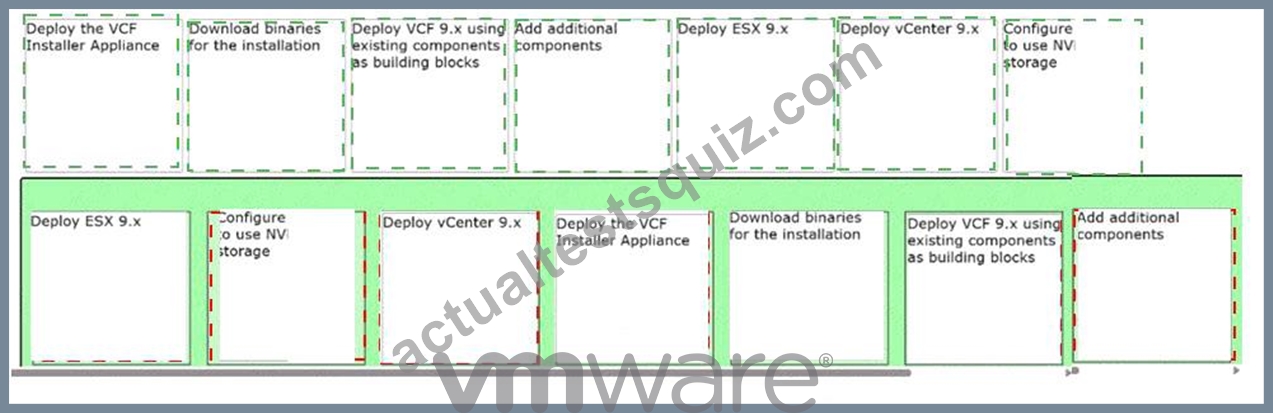
Explanation:
Deploy ESX 9.x
Configure to use NVMe storage
Deploy vCenter 9.x
Deploy the VCF Installer Appliance
Download binaries for the installation
Deploy VCF 9.x using existing components as building blocks
Add additional components
The sequence begins with deploying ESX 9.x on the blade hosts because the hosts are the physical foundation for the future management domain. Since there is no local storage beyond the operating system and the external array supports NVMe/TCP only, the hosts must then be configured to use NVMe storage before vCenter is deployed. This provides the required shared datastore for the vCenter deployment and for later VCF management component placement. After the NVMe storage is accessible, vCenter 9.x is deployed to manage the ESX hosts and form the existing vSphere building block. The convergence process then moves into the VCF workflow: deploy the VCF Installer Appliance, download the required binaries to the installer appliance, and deploy VCF 9.x by using the existing vCenter and ESX hosts as starting building blocks. Because Aria Operations is not currently deployed, VCF Installer deploys the required missing components during the converge process, and remaining additional components are added after the core platform deployment is complete. Reference topics: Converging Existing Virtual Infrastructure, VCF Installer, Existing Components as Building Blocks, NVMe Storage Preparation.
NEW QUESTION # 36
A six-node vSAN ESA cluster contains multiple Virtual Machines (VMs), and a vSAN storage policy with the rule "Failures to tolerate" set to "1 failure - RAID-5 (Erasure Coding)" is assigned. A vSAN administrator has changed the rule in the assigned policy to "2 failures - RAID-6 (Erasure Coding)." What is the result of this change?
- A. The policy change is rejected immediately.
- B. No changes occur until the policy is reapplied.
- C. The changes are queued for 60 minutes.
- D. The updated policy is serially applied to the Virtual Machines.
Answer: B
Explanation:
The policy edit is valid for a six-node vSAN ESA cluster because RAID-6 with Failures to tolerate set to
2 requires at least six ESX hosts in the vSphere cluster. However, editing a VM storage policy that is already associated with virtual machine objects does not automatically communicate the new requirements to those objects. vSphere marks the compliance status as Out of Date, indicating that the policy has been edited but the new requirements have not yet been communicated to the datastore where the VM objects reside. The administrator must reapply the VM Storage Policy to the affected objects before vSAN evaluates the new RAID-6 requirement and begins any layout changes or resynchronization needed to bring objects into compliance. The change is not rejected because the cluster satisfies the minimum host count. It is not automatically applied serially to the VMs, and the 60- minute timer is related to repair-delay behavior after failures, not normal storage policy changes.
Reference topics: Reapply Virtual Machine Storage Policy, Out-of-Date Compliance, vSAN ESA RAID-
5, vSAN ESA RAID-6.
NEW QUESTION # 37
An administrator is tasked with attaching an FC-based VMFS datastore to an existing Workload Domain cluster.
Which option reflects the correct process?
- A. Present the LUNs from the storage array > Rescan HBAs on each host > Create a new VMFS datastore on each host > Verify visibility on all hosts > Confirm in vCenter.
- B. Present the LUNs from the storage array > Rescan HBAs on one host > Create a new VMFS datastore on one host > Verify visibility on all hosts > Confirm in vCenter.
- C. Present the LUNs from the storage array > Rescan HBAs on each host > Create a new VMFS datastore on one host > Verify visibility on all hosts > Confirm in vCenter.
- D. Present the LUNs from the storage array > Rescan HBAs on one host > Create a new VMFS datastore on each host > Verify visibility on all hosts > Confirm in vCenter.
Answer: C
Explanation:
The correct process is to present the Fibre Channel LUNs from the storage array, rescan HBAs on each ESX host, create the VMFS datastore once, verify that the datastore is visible on all hosts, and confirm the result in vCenter. Fibre Channel storage requires correct SAN fabric zoning, LUN masking, host registration, and HBA discovery so that all hosts in the workload domain cluster can see the same shared LUN. After the array presents the LUN, each host must rescan its HBAs to discover the new storage device. VMFS is a clustered file system, so the datastore is created only once on the shared LUN. The datastore then becomes available to all hosts that have access to that device; it must not be independently formatted on each host. Creating the VMFS datastore separately on each host would risk datastore corruption or duplicate formatting. The final validation step is confirming datastore visibility and accessibility for all cluster hosts in vCenter. Reference topics: Fibre Channel Storage Model, HBA Rescan, Create VMFS Datastore, Shared VMFS Datastore Visibility.
NEW QUESTION # 38
A Compliance Auditor is analyzing the data governance capabilities of an organization using a traditional 3-tier Fibre Channel SAN. The organization must comply with strict regulations requiring Data-at-Rest Encryption (DARE) and variable replication frequencies.
```
# SPBM Policy Simulation: "Compliance-High-Profile"
Constraint 1: Financial VM DKs must be encrypted.
Constraint 2: Non-financial VM DKs must NOT be encrypted (for
performance).
Constraint 3: Financial VMs must replicate every 15 minutes.
Constraint 4: Non-financial VMs must replicate every 24 hours.
```
All VMs are currently hosted on a single 50 TB VMFS-6 Datastore backed by a traditional FC LUN. How does the traditional LUN architecture inherently limit or complicate the implementation of these compliance policies compared to a vSAN HCI architecture? (Select all that apply.)
- A. Traditional SAN replication operates at the LUN level. Replicating the Financial VMs every 15 minutes forces the array to also replicate the massive Non-financial data every 15 minutes, wasting WAN bandwidth.
- B. To achieve this compliance in a traditional architecture, the admin must carve out multiple smaller LUNs (one for Financial, one for Non-Financial), leading to datastore sprawl and wasted free space.
- C. vSAN HCI resolves this by applying policies at the Virtual Machine Disk (VMDK) object level, allowing different encryption and replication rules for two VMs sitting on the same datastore.
- D. VMFS-6 datastores inherently reject AES-256 encryption keys unless the physical Fibre Channel switches are upgraded to Gen 7 with native crypto offload.
- E. The traditional array encrypts the entire physical LUN; therefore, the storage admin cannot encrypt Financial VMs while leaving Non-financial VMs on the same datastore unencrypted.
Answer: A,B,C,E
NEW QUESTION # 39
A Solutions Architect is designing the hardware bill of materials (BOM) for a new VCF 9.0 implementation. The customer has a strict budget and wants to reuse some existing legacy hardware, specifically 10 GbE network switches and SATA SSDs.
```
[Proposed Architecture Diagram]
Network: 10 GbE Top-of-Rack Switches
Host Storage: 2x 400 GB NVMe (Intel Optane) + 6x 3.84 TB SATA SSDs
```
The architect must choose between deploying vSAN OSA or vSAN ESA for this specific BOM.
Which TWO statements accurately describe the compatibility and compliance of this hardware with the two architectures? (Choose 2.)
- A. The 10 GbE network is a hard blocker for both OSA and ESA in VCF 9.0; the architect must upgrade to 100 GbE switches to deploy any HCI solution.
- B. vSAN ESA can support this hardware if the SATA SSDs are bypassed and the environment uses the 10 GbE network for "vSAN Direct" mode only.
- C. vSAN ESA supports the SATA SSDs for the capacity tier, but only if they are formatted with the VMFS- L filesystem prior to the cluster bootstrap.
- D. This hardware profile is strictly non-compliant with vSAN ESA, which explicitly requires a minimum 25 GbE network fabric and an All-NVMe storage pool.
- E. vSAN OSA fully supports this configuration by utilizing the NVMe devices for the Cache Tier and the SATA SSDs for the Capacity Tier, connected via the 10 GbE network.
Answer: D,E
NEW QUESTION # 40
A VMware Cloud Foundation (VCF) Workload Domain is requested to be deployed with the following information:
* 6 blade style hosts with no local storage beyond the operating system.
* 4 25 Gb networking cards installed in each host.
* A 30 TB external array configured to support NVMe/TCP only.
* 2 dVS switches, one configured for storage isolation and one for all other traffic.
* NVMe/TCP multi-path configuration required.
* Existing Management Domain is deployed with VCF.
Place the steps for importing VCF on to this configuration.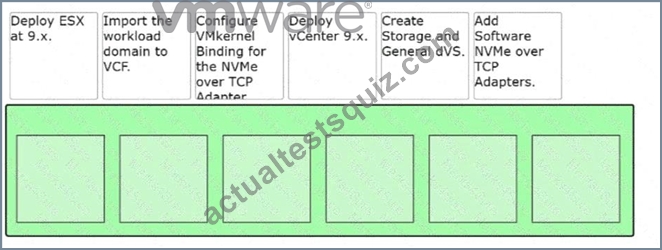
Answer:
Explanation: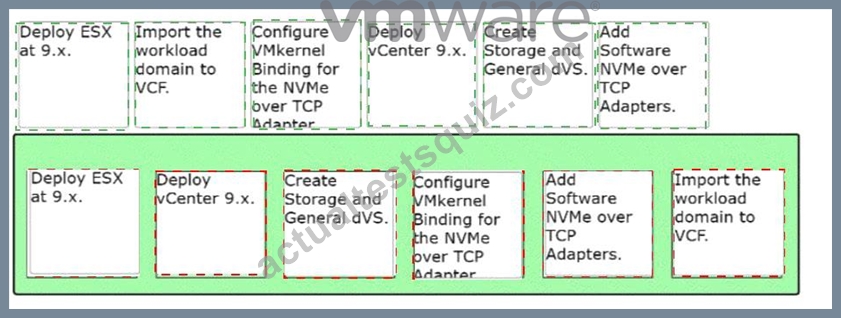
Explanation:
Deploy ESX at 9.x
Deploy vCenter 9.x
Create Storage and General dvS
Configure VMkernel Binding for the NVMe over TCP Adapter
Add Software NVMe over TCP Adapters
Import the workload domain to VCF
The correct sequence starts by preparing the vSphere environment that will later be imported into VMware Cloud Foundation. ESX 9.x must be deployed first on the six blade hosts because the hosts provide the compute foundation for the workload domain. After the hosts are available, vCenter 9.x is deployed to manage the cluster and provide the required vSphere inventory. The two distributed switches are then created: one for storage isolation and one for general host and workload traffic.
Because the external array supports NVMe/TCP only and multipathing is required, VMkernel binding must be configured for the NVMe over TCP adapter before the software NVMe over TCP adapters are added. This ensures the NVMe/TCP storage paths are correctly associated with the intended storage network. After the software NVMe over TCP adapters are created and the hosts can access the external storage, the prepared workload domain can be imported into the existing VCF environment. Reference topics: NVMe over TCP Configuration, VMkernel Binding, Software NVMe/TCP Adapters, Existing vCenter Import, VCF Workload Domain Import.
NEW QUESTION # 41
A SOC Analyst is reviewing the Ruby vSphere Console (RVC) output for a 12-node VCF cluster to verify Key Provider consistency.
```
[RVC Output: vsan.encryption_info ~cluster]
Host Encryption KMS Server KEK ID
esx-01 Enabled VCF-KMS-HA a1b2c3d4...
esx-02 Enabled VCF-KMS-HA a1b2c3d4...
esx-03 Enabled <Unreachable> a1b2c3d4...
```
esx-03 recently experienced a management network partition.
Why do the Virtual Machines hosted on esx-03 continue to read and write encrypted data seamlessly despite the Unreachable KMS status shown in RVC? (Select all that apply.)
- A. The KEK is persistently cached on the physical NVMe drives; ESXi reads the key from the disk during isolation.
- B. The vsan.encryption_info command only reports the control plane status of the vCenter-to-Host linkage; the dataplane inside esx-03 functions independently of the management network.
- C. esx-03 automatically negotiated a peer-to-peer key exchange with esx-01 over the vSAN VMkernel network to retrieve the missing KEK.
- D. esx-03 disabled encryption dynamically to maintain availability during the partition.
- E. ESXi stores the KEK in secure volatile memory (RAM); since the host was running when the network dropped, the key is already loaded, and standard I/O pipelines do not require active KMS polling.
Answer: B,E
NEW QUESTION # 42
An administrator has deployed a three-host vSphere cluster with a small amount of VMFS storage and wants to add additional capacity from a vSAN ESA cluster located in the same vCenter Server.
When the administrator selects the vSphere cluster and navigates to the Configure tab, the Datastore Management option is missing under the vSAN section.
What prerequisite must be met before the administrator can mount the remote datastore?
- A. vSAN must be enabled on the non-vSAN cluster to act as a compute cluster.
- B. A fourth host must be commissioned for the vSphere cluster.
- C. The vSAN Storage cluster must have a minimum of 80% free space.
- D. The vSphere cluster must be deployed to a different VCF Workload Domain.
Answer: A
Explanation:
The prerequisite is to enable vSAN on the non-vSAN cluster so it can operate as a vSAN compute cluster. A vSAN compute cluster is a vSphere cluster that does not contribute local vSAN capacity, but it has vSAN functionality enabled so it can mount a remote vSAN datastore provided by a vSAN Storage Cluster. The Datastore Management option under the vSAN section appears only when the consuming cluster is prepared for vSAN datastore sharing. Without vSAN enabled in compute-cluster mode, the vSphere cluster remains a conventional VMFS-backed cluster and cannot use the vSAN remote datastore management workflow. The cluster does not need to be in a different VCF Workload Domain, and there is no requirement that the storage cluster maintain exactly 80% free space before the option appears. A fourth host is also not required simply to mount remote vSAN capacity. The key requirement is enabling vSAN capability on the client cluster so it can communicate with and consume the remote ESA datastore. Reference topics: vSAN Compute Cluster, Remote vSAN Datastore, Datastore Management, vSAN Storage Cluster.
NEW QUESTION # 43
A VCF Architect is designing the Supplemental Storage topology for a hybrid-cloud implementation.
The design uses VMFS Datastore Clusters with Storage DRS (SDRS).
```
# SPBM Policy: "DB-Gold-Policy"
Tag: "Gold-Tier-FC"
Datastore Cluster: "DS-Cluster-Gold" (LUNs 1, 2, 3)
# VM Anti-Affinity Rule: "DB-App-Separation"
VMs: [DB-Node-01, DB-Node-02]
Rule Type: Intra-VM Anti-Affinity (Separate VMDKs)
```
To meet compliance, the Database VMDK and the Log VMDK for the same VM MUST reside on physically different LUNs.
How does the deep integration between SPBM tagging, SDRS, and VMFS LUN presentation execute this complex compliance requirement? (Select all that apply.)
- A. The "Intra-VM Anti-Affinity" rule tells SDRS to actively separate the VMDKs. It will place the DB-VMDK on LUN 1 and the Log-VMDK on LUN 2 during initial provisioning.
- B. The "Gold-Tier-FC" tag ensures that SDRS only considers LUNs 1, 2, and 3 for placement, ignoring cheaper SATA LUNs that might have more free space.
- C. SPBM automatically creates separate sub-folders on a single VMFS datastore to simulate LUN separation if the anti-affinity rule cannot be met physically.
- D. Storage DRS executes a Deep Rekey on the Log VMDK to ensure cryptographic separation matches the physical separation of the LUNs.
- E. If LUN 1 fills up, SDRS will move the DB-VMDK to LUN 3, but it will NOT move it to LUN 2, because doing so would violate the anti-affinity rule with the Log-VMDK already on LUN 2.
Answer: A,B,E
NEW QUESTION # 44
A Solutions Architect is consolidating several independent Fibre Channel LUN-backed VMFS datastores into a Datastore Cluster to utilize Storage DRS (SDRS) in a VCF Workload Domain.
```
[SDDC Manager - Storage Summary]
Target SDRS Cluster: WLD01-DS-Cluster
DS-01: VMFS-5 (10TB, Array-1)
DS-02: VMFS-6 (10TB, Array-2)
DS-03: VMFS-6 (10TB, Array-1)
```
The architect attempts to add these three datastores into the new Datastore Cluster, but vCenter blocks the operation for DS-01. Furthermore, the architect is concerned about performance degradation during Storage vMotion operations within the cluster.
How do the underlying LUN attributes and VMFS configurations dictate the success and performance of this Datastore Cluster design? (Select all that apply.)
- A. Storage DRS requires that all underlying LUNs be mapped (masked) and accessible to all ESXi hosts in the Compute Cluster to facilitate VM mobility.
- B. A Datastore Cluster logically merges the underlying LUNs into a single 30TB namespace, destroying the original LUN isolation.
- C. To ensure hardware-accelerated Storage vMotion (VAAI XCOPY) between datastores, the underlying LUNs must reside on the same physical storage array.
- D. DS-01 cannot be included in the Datastore Cluster because SDRS strictly forbids mixing VMFS-5 and VMFS-6 datastores in the same cluster to prevent filesystem capability mismatches.
Answer: A,C,D
NEW QUESTION # 45
A SOC Analyst is investigating an SDRS anomaly in a traditional storage VCF Workload Domain. A
10 TB Datastore (DS-01) within a Datastore Cluster reached 95% capacity. Storage DRS is set to "Fully Automated" with a Space Utilization Threshold of 80%.
Despite the critical space exhaustion, SDRS failed to trigger any Storage vMotion operations to evacuate VMs to DS-02 (which has 8 TB free space).
The analyst reviews the vpxd.log:
```
2026-11-22T10:00:15Z INFO vpxd - [SDRS] Running space load balancing for Datastore Cluster 'WLD- Tier1-DS-Cluster'.
2026-11-22T10:00:15Z WARN vpxd - [SDRS] Datastore 'DS-01' exceeds space threshold (95% > 80%).
2026-11-22T10:00:16Z INFO vpxd - [SDRS] Analyzing VM 'Archive-DB-01' for evacuation. VM size: 4 TB.
2026-11-22T10:00:17Z WARN vpxd - [SDRS] Target 'DS-02' violates capability constraints for VM
'Archive-DB-01'. Migration aborted.
2026-11-22T10:00:18Z INFO vpxd - [SDRS] No candidates found to resolve space threshold on 'DS-01'.
```
Based on SDRS mechanics and the log evidence, which TWO scenarios explain why SDRS aborted the migration? (Choose 2.)
- A. DS-02 has a different VMFS block size (1MB vs 4MB) which prevents the storage vMotion engine from aligning the destination metadata.
- B. Archive-DB-01 is assigned a Storage Policy requiring "Data-at-Rest Encryption," but DS-02 is mapped to an unencrypted backend LUN that lacks the required storage capability.
- C. The VM Archive-DB-01 is attached to a VMFS-6 ISO file stored locally on DS-01, preventing the storage stack from releasing the file lock.
- D. DS-02 is backed by a different Storage Array type than DS-01, and VAAI offloading is required but unavailable between the arrays.
- E. DS-01 and DS-02 reside on different ESXi management network subnets, breaking the Storage vMotion network replication path.
Answer: B,D
NEW QUESTION # 46
......
Verified & Correct 3V0-23.25 Practice Test Reliable Source Sep 09, 2026 Updated: https://www.actualtestsquiz.com/3V0-23.25-test-torrent.html
VMware 3V0-23.25 Exam Preparation Guide and PDF Download: https://drive.google.com/open?id=1MSWfjY2uuuo93ykR-TokYZNgIdAWeZ7O
