
Pass with professional EX407 actual quiz materials

Choosing our RedHat EX407 study material, choosing success. Choosing us, choosing high efficiency!
Last Updated: Nov 22, 2026
No. of Questions: 42 Questions & Answers with Testing Engine
Download Limit: Unlimited
The professional and latest EX407 actual quiz materials with high-quality core knownledge help you pass exam easily!
Choosing ActualTestsQuiz EX407 actual quiz materials, Pass exam one-shot. The core knowledge of our EX407 actual test torrent is compiled based on the latest real questions and similiar with the real test. Also we provide simulation function to help you prepare better. You will feel the real test type and questions style, so that you will feel casual while in the real test after preparing with our EX407 actual quiz materials.
100% Money Back Guarantee
ActualTestsQuiz has an unprecedented 99.6% first time pass rate among our customers.  We're so confident of our products that we provide no hassle product exchange.
- Best exam practice material
- Three formats are optional
- 10 years of excellence
- 365 Days Free Updates
- Learn anywhere, anytime
- 100% Safe shopping experience
- Instant Download: Our system will send you the products you purchase in mailbox in a minute after payment. (If not received within 12 hours, please contact us. Note: don't forget to check your spam.)
RedHat EX407 Practice Q&A's

- Printable EX407 PDF Format
- Prepared by EX407 Experts
- Instant Access to Download
- Study Anywhere, Anytime
- 365 Days Free Updates
- Free EX407 PDF Demo Available
- Download Q&A's Demo
RedHat EX407 Online Engine

- Online Tool, Convenient, easy to study.
- Instant Online Access
- Supports All Web Browsers
- Practice Online Anytime
- Test History and Performance Review
- Supports Windows / Mac / Android / iOS, etc.
- Try Online Engine Demo
RedHat EX407 Self Test Engine

- Installable Software Application
- Simulates Real Exam Environment
- Builds EX407 Exam Confidence
- Supports MS Operating System
- Two Modes For Practice
- Practice Offline Anytime
- Software Screenshots
A RedHat certification keeps paying dividends long after the exam ends, and the RedHat Red Hat Certified Specialist in Ansible Automation exam is the only toll gate. The 42 practice questions at ActualTestsQuiz get you through it efficiently.
RedHat EX407 Exam Overview:
| Certification Vendor: | Red Hat |
|---|---|
| Exam Name: | Red Hat Certified Specialist in Ansible Automation Exam (EX407) |
| Exam Number: | EX407 |
| Exam Format: | Performance-based lab exam, Hands-on configuration and troubleshooting tasks |
| Related Certifications: | Red Hat Certified System Administrator (RHCSA) Red Hat Certified Engineer (RHCE) |
| Real Exam Qty: | Performance-based exam (number of tasks varies) |
| Exam Price: | USD 400 (varies by region) |
| Certificate Validity Period: | 3 years |
| Passing Score: | 210/300 |
| Available Languages: | English |
| Exam Duration: | 240 minutes |
| Recommended Training: | Red Hat Ansible Automation Courses |
| Exam Registration: | Red Hat Certification Portal |
| Sample Questions: | DOWNLOAD DEMO |
| Exam Way: | Hands-on practical lab exam (onsite or remote depending on Red Hat testing provider availability) |
| Pre Condition: | Basic Linux administration skills recommended; familiarity with command line and system configuration is expected. |
| Official Syllabus URL: | https://www.redhat.com/en/services/certification |
RedHat EX407 Exam Syllabus Topics:
| Section | Objectives |
|---|---|
| Advanced Automation | - Roles and reuse
|
| Ansible Fundamentals | - Architecture and components
|
| Playbook Development | - Playbook structure
|
Everything Candidates Ask About RedHat Red Hat Certified Specialist in Ansible Automation
RedHat Red Hat Certified Specialist in Ansible Automation is an official Red Hat certification exam, registered under the code EX407. Passing it awards the Red Hat Certified Specialist in Ansible Automation certification, a credential at the Specialist level. It also connects to Red Hat Certified System Administrator (RHCSA), Red Hat Certified Engineer (RHCE). Successfully passing matters to every candidate because the credential keeps working for your career long after exam day.
You will answer Performance-based exam (number of tasks varies) questions within 240 minutes on the RedHat Red Hat Certified Specialist in Ansible Automation exam. That combination rewards candidates who practiced under realistic timing, so make timed sessions in the ActualTestsQuiz engine a daily habit; one to two hours a day is enough when every minute rehearses the real thing.
RedHat Red Hat Certified Specialist in Ansible Automation requires 210/300 to pass, and official registration costs USD 400 (varies by region). Since every retake charges USD 400 (varies by region) again, diligent daily practice is the cheapest strategy available. Let your ActualTestsQuiz practice scores confirm readiness across several consecutive sessions before you book.
Red Hat recommends the following training for RedHat Red Hat Certified Specialist in Ansible Automation candidates.
Training broadens your technology knowledge; the 42 practice questions in the ActualTestsQuiz EX407 package sharpen it into exam-day scoring ability.
Sign-up for RedHat Red Hat Certified Specialist in Ansible Automation runs through the official channels below.
One logistics note: the exam is delivered Hands-on practical lab exam (onsite or remote depending on Red Hat testing provider availability).
Basic Linux administration skills recommended; familiarity with command line and system configuration is expected.
Vendor requirements do change, so verify the current conditions before registering on the official exam page.
The RedHat Red Hat Certified Specialist in Ansible Automation blueprint covers 3 domains, with the largest being Playbook Development, Ansible Fundamentals, and Advanced Automation. The full topic list is above on this page; it tells you exactly where your daily hour or two earns the most marks.
Yes, download the free demo of the RedHat Red Hat Certified Specialist in Ansible Automation questions before deciding, and read former customers' comments for an independent verdict. After purchase, new versions download free for one year, and when your product expires you can extend the update service at a 50% discount. Returning customers also enjoy bountiful discounts on future exams.
Your purchase carries a 100% money-back guarantee with defined conditions. Take the RedHat Red Hat Certified Specialist in Ansible Automation exam within 60 days of purchase; if you fail, you may claim a full refund, provided the exam matches your product. Attempts within 3 days of purchase are ineligible, as are downloaded-but-unused products, free materials, and expired orders; the candidate name must match the payer name. Submit a scanned enrollment slip and the official Score Report PDF within 2 days of the exam, and claims are processed within 7 days. Alternatively, exchange for two other exam products of equal value, free, with your original purchase keeping its update service.
Delivery is instant: download upon payment, with an email copy arriving within one minute. If nothing arrives within 2 hours, check spam and contact our 24/7 agents, who solve problems with infinite patience. Installation is unlimited across your computers.
RedHat Red Hat Certified Specialist in Ansible Automation Sample Questions:
Create a role called sample-apache in /home/sandy/ansible/roles that enables and starts httpd, enables and starts the firewall and allows the webserver service. Create a template called index.html.j2 which creates and serves a message from /var/www/html/index.html Whenever the content of the file changes, restart the webserver service.
Welcome to [FQDN] on [IP]
Replace the FQDN with the fully qualified domain name and IP with the ip address of the node using ansible facts. Lastly, create a playbook in /home/sandy/ansible/ called apache.yml and use the role to serve the index file on webserver hosts.
Correct Answer:
/home/sandy/ansible/apache.yml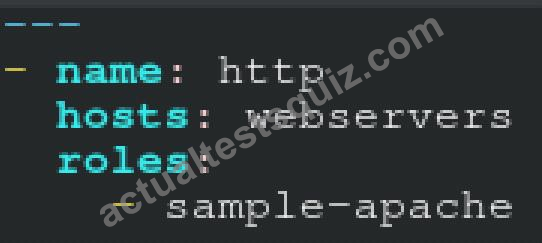
/home/sandy/ansible/roles/sample-apache/tasks/main.yml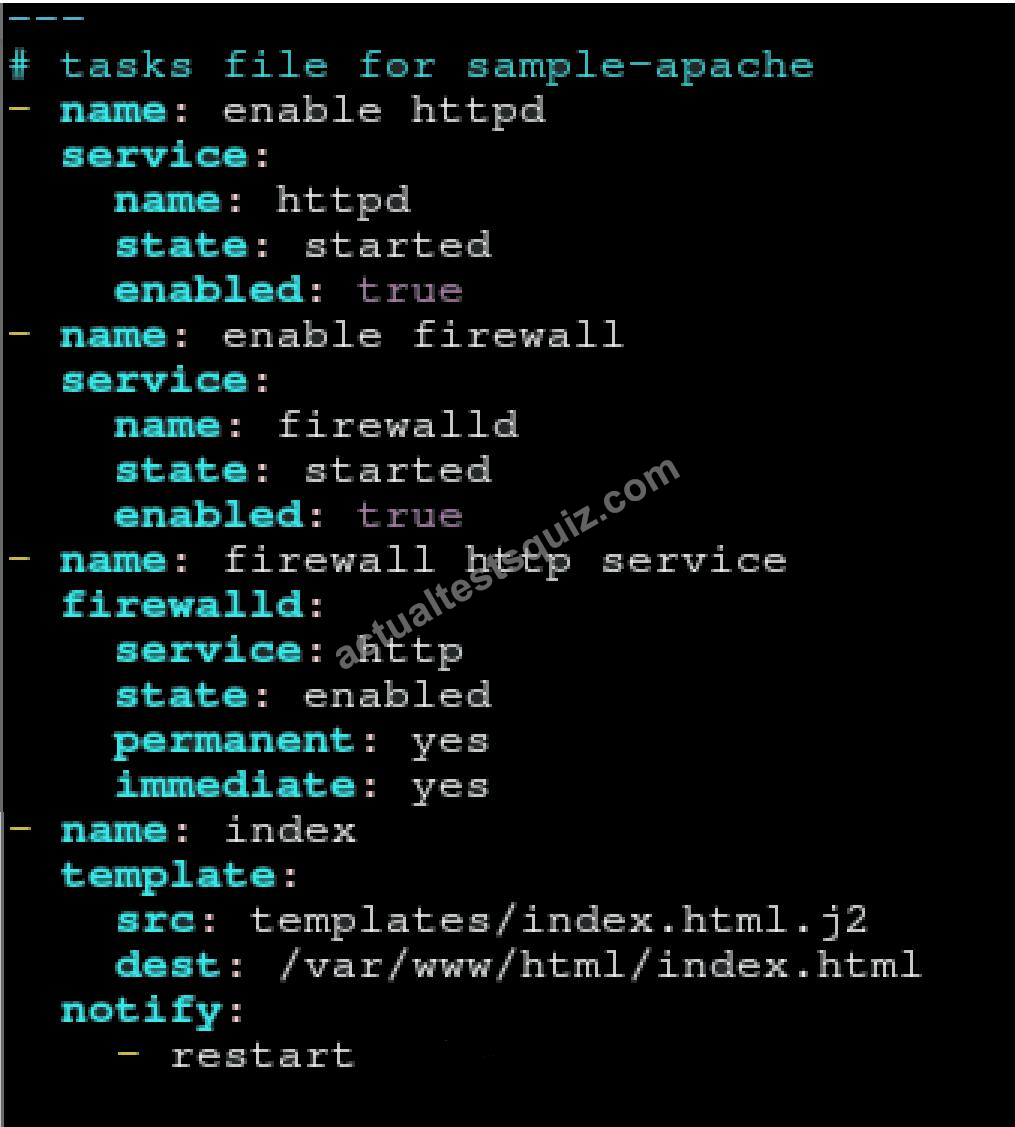
/home/sandy/ansible/roles/sample-apache/templates/index.html.j2
In /home/sandy/ansible/roles/sample-apache/handlers/main.yml
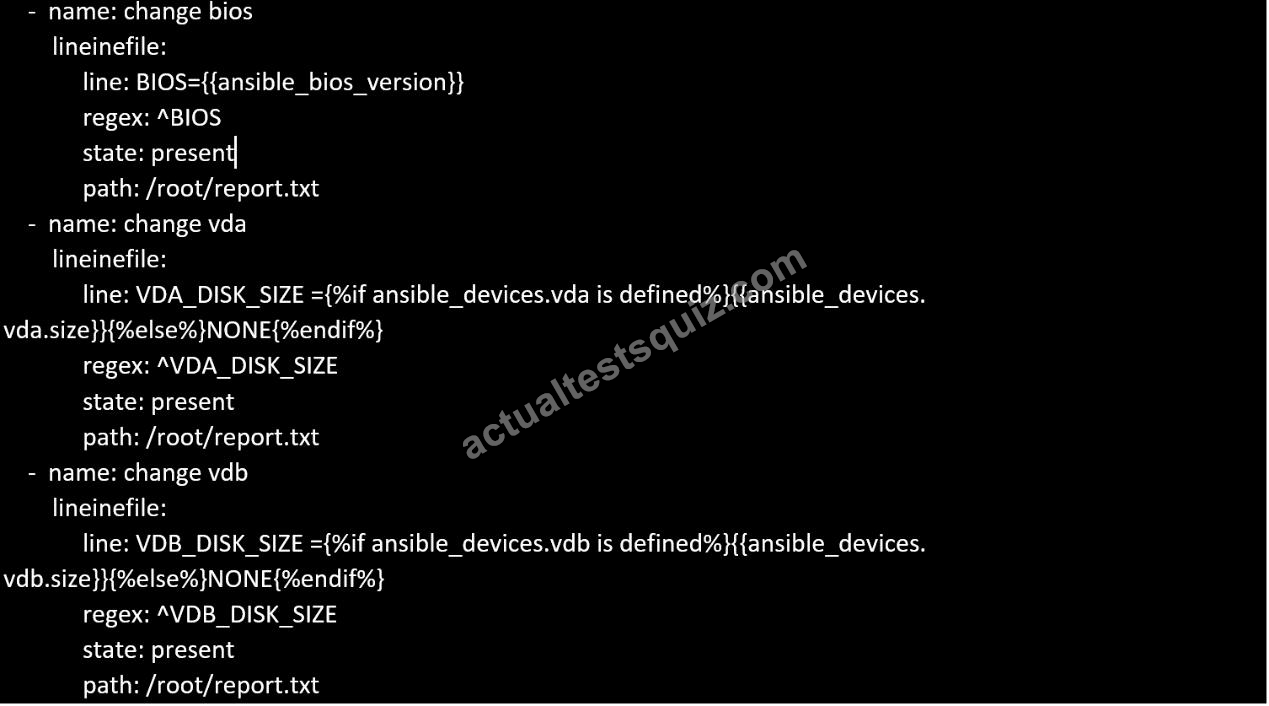
Create a file in /home/sandy/ansible/ called report.yml. Using this playbook, get a file called report.txt (make it look exactly as below). Copy this file over to all remote hosts at /root/report.txt. Then edit the lines in the file to provide the real information of the hosts. If a disk does not exist then write NONE.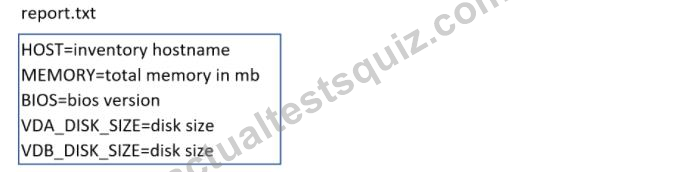
Correct Answer:
Solution as: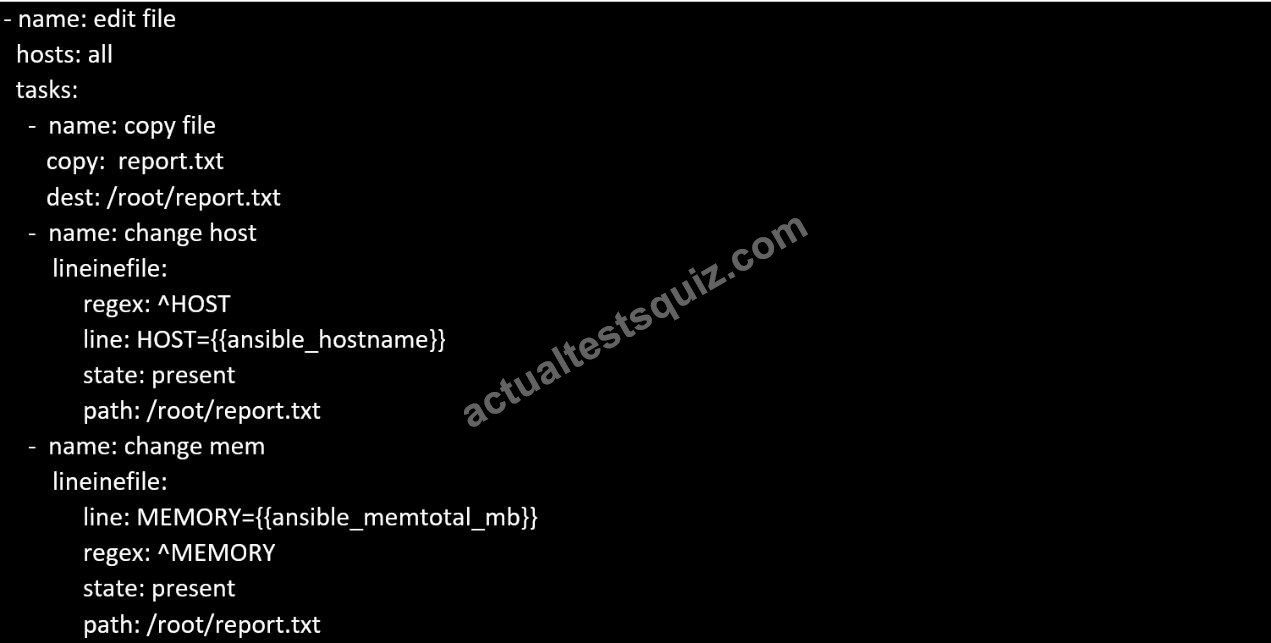
Create a playbook called regulartasks.yml which has the system that append the date to /root/datefile every day at noon. Name is job 'datejob'
Reveal Solution Discussion 0Correct Answer:
Solution as:
Create an empty encrypted file called myvault.yml in /home/sandy/ansible and set the password to notsafepw. Rekey the password to iwejfj2221.
Reveal Solution Discussion 0Correct Answer:
ansible-vault create myvault.yml
Create new password: notsafepw Confirm password: notsafepw ansible-vault rekey myvault.yml
Current password: notsafepw New password: iwejfj2221 Confirm password: iwejfj2221
===================================================================================
control.realmX.example.com _ workstation.lab.example.com
node1.realmX.example.com _ servera.lab.example.com
node2.realmX.example.com _ serverb.lab.example.com
node3.realmX.example.com _ serverc.lab.example.com
node4.realmX.example.com _ serverd.lab.example.com
node5.realmX.example.com
- username:root, password:redhat
- username:admin, password:redhat
note1. don't change 'root' or 'admin' password.
note2. no need to create ssh-keygen for access, its pre-defined
note3. SELinux is in enforcing mode and firewalld is disabled/stop on whole managed hosts.
Install and configure Ansible on the control-node control.realmX.example.com as
follows:
-------------------------------------------------------------------------------------------
--> Install the required packages
--> Create a static inventory file called /home/admin/ansible/inventory as follows:
node1.realmX.example.com is a member of the dev host group
node2.realmX.example.com is a member of the test host group
node3.realmX.example.com & node4.realmX.example.com are members of the prod
host group
node5.realmX.example.com is a member of the balancers host group.
prod group is a member of the webservers host group
--> Create a configuration file called ansible.cfg as follows:
--> The host inventory file /home/admin/ansible/inventory is defined
--> The location of roles used in playbooks is defined as /home/admin/ansible/ roles
Correct Answer:
Solution as:
Through physical host, login to workstation.lab.example.com with user root.
# ssh [email protected]
# hostname
workstation.lab.example.com
# yum install platform-python*
# su - admin
# pwd
/home/admin/
# vim .vimrc
# mkdir -p ansible/roles
# cd ansible
# vim inventory
[dev]
servera.lab.example.com
[test]
serverb.example.com
[prod]
serverc.example.com
serverd.example.com
[balancer]
serverd.lab.example.com
[webservers:children]
prod
:!wq
# vim ansible.cfg
[defaults]
inventory = ./inventory
role_path = ./roles
remote_user = admin
ask_pass = false
[privilege_escalation]
become = true
become_method = sudo
become_user = root
become_ask_pass = false
:!wq
# ansible all --list-hosts
Viewing page 1 out of 9 pages.
Viewing questions 1-5 out of 42 questions.
 Hazel
Kimberley
Michelle
Prima
Teresa
Adair
ActualTestsQuiz is the world's largest certification preparation company with 99.6% Pass Rate History from 70233+ Satisfied Customers in 148 Countries.

Over 70233+ Satisfied Customers

Our Clients













ActualTestsQuiz offers best test Quiz materials to help all candidates pass exams and obtain certification successfully all over the world. If you are eager to obtain a certification, we will be your best select.
Contact Us
From Monday to Saturday
Support: Contact now
If you have any question please leave me your email address, we will reply and send email to you in 12 hours.
Copyright © 2026 ACTUALTESTSQUIZ.COM. All rights reserved. All trademarks are the property of their respective owners and we don't provide actual questions from any vendor. Privacy Policy